Private Label Pet Grooming Products: A Complete Guide for Brand Owners
Written by: Rixin Pet Care Editorial Team
Reviewed by: Product Development Team for manufacturing context and claim-risk alignment.
This content is provided for product planning, packaging discussion and claim-risk awareness. It is not veterinary advice, treatment guidance or market authorization.
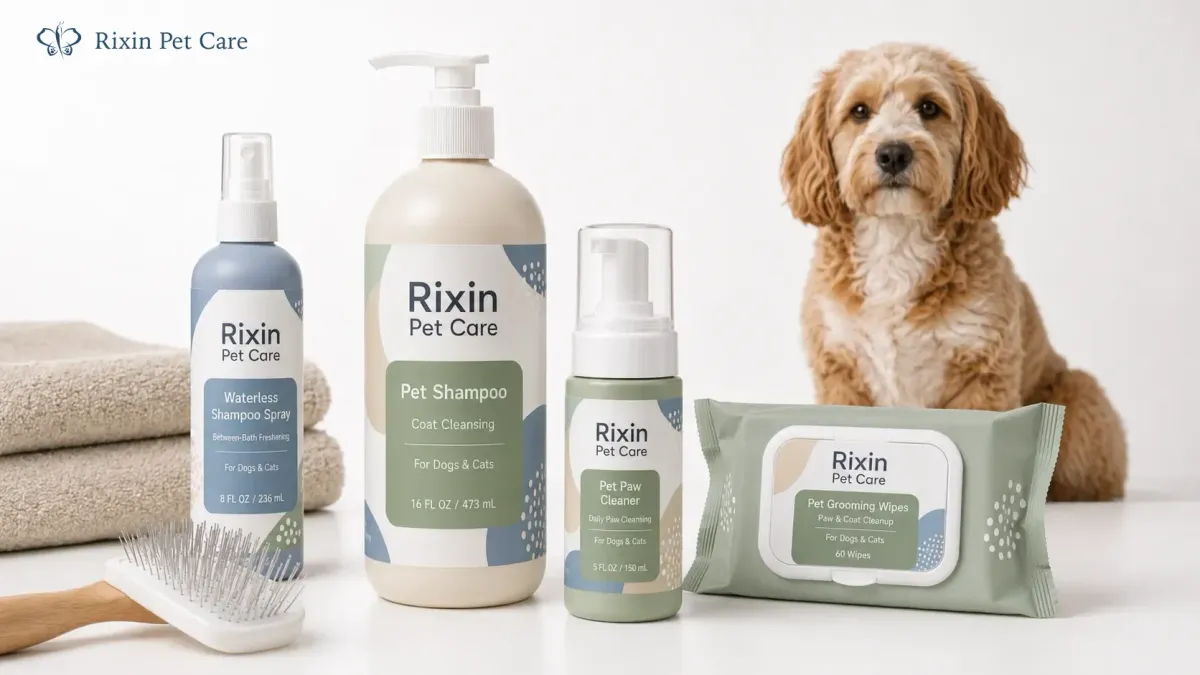
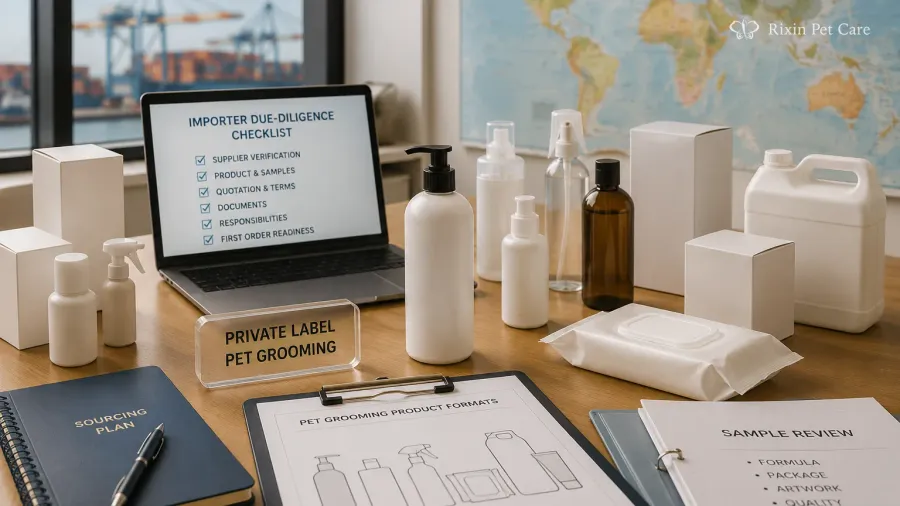
A private label pet grooming line is not one product category. It is a set of grooming routines, application formats, and product roles that may be combined into a focused assortment. A bath-time shampoo, a waterless spray, a wipe pack, and an eye-area cleanser may all belong to the same broader brand while serving different moments.
The most useful starting point is therefore not a long product list. It is a clear view of the product families available, the differences between overlapping formats, and the role each product could play in the first assortment. This guide maps the current private label pet grooming product system for brand owners, retailers, importers, distributors, marketplace sellers, and grooming businesses. Use the private label pet grooming products hub to move from the overview to individual product routes.
This content is for product planning, packaging discussion, and claim-risk awareness only. It is not veterinary advice, medical guidance, or market authorization.
Quick Answer: Start With the Grooming Routine
A practical product-planning sequence is:
- Identify the grooming routine, customer, channel, and use occasion.
- Select the product family and format that fit that routine.
- Check whether similar formats have distinct roles or simply duplicate one another.
- Build the smallest connected assortment that the business can explain and support.
- Turn the selected category direction into a product brief for manufacturer review.
There is no universal first product or universal number of SKUs. A strong assortment is one in which each product has a clear reason to exist, the formats work together, and the buyer can explain the line without relying on unsupported product claims.
The Four Private Label Pet Grooming Product Families
The current product system is organized around four planning families:
| Product family | What it covers | Assortment role |
|---|---|---|
| Wash & Coat Care | Bath-time cleansing and coat-care extensions | A core wash route or a connected coat-care routine |
| Between-Bath Grooming | No-rinse, wipe-based, and coat-freshening formats | Convenience and repeat-use routines between baths |
| Targeted Pet Hygiene | Paw, eye-area, and outer-ear grooming routes | Focused daily-use products for specific cleanup routines |
| Sensitive & Daily Hygiene | Sensitive-skin and technical hygiene spray directions | Carefully defined hygiene routes requiring early wording review |
The family names describe product-planning routes. They do not replace a product brief, formula review, packaging review, or market-specific claim review.
1. Wash & Coat Care
Wash and coat care is the most direct starting point for a conventional bath-time or coat-care line. The products can be connected, but they should not be presented as the same product in different packaging.
| Product route | What the format is planned to do | How it can fit a line |
|---|---|---|
| Pet Shampoo | A rinse-off bath-time cleansing and coat-care route | Core wash product for an everyday grooming range |
| Pet Conditioner & Detangling Spray | A rinse-off or leave-on coat-care extension for brushing and detangling routines | Companion product that extends the coat-care routine |
Shampoo versus conditioner and detangling spray
Shampoo is planned around the wash step. Conditioner or detangling spray is planned around the coat-care step that follows or accompanies grooming. That distinction affects the intended use, dispensing format, sensory direction, and how the products are presented together.
A brand does not need both products at launch. The right choice depends on whether the first assortment needs one clear wash route or a connected wash-and-coat-care routine. If both are selected, each should have a distinct product role rather than repeating the same promise.
2. Between-Bath Grooming
Between-bath grooming covers formats used when a customer wants a convenient routine between conventional washes. The three routes below overlap in the broad category, but they create different application actions and packaging questions.
| Product route | What the format is planned to do | Key planning distinction |
|---|---|---|
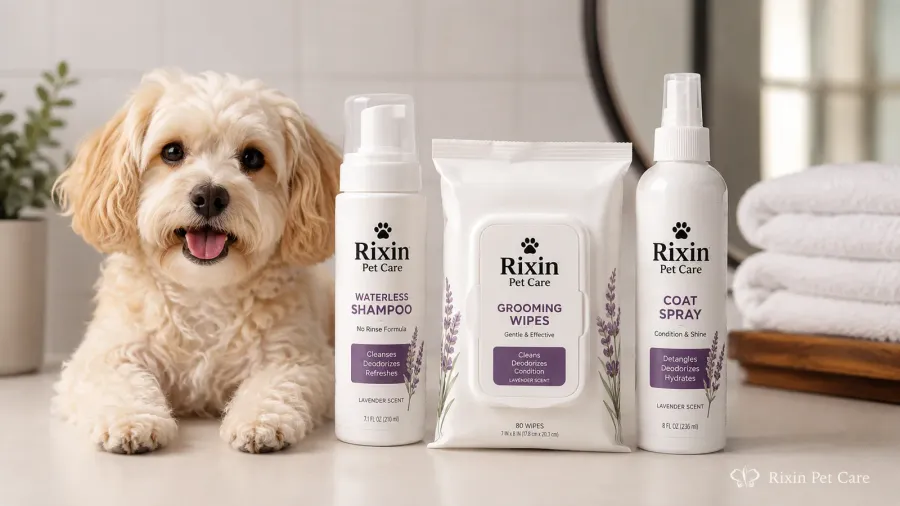
| Waterless Pet Shampoo Spray | A no-rinse route for broader coat freshening and light cleanup between baths | Spray or foam application across a broader coat area |
| Pet Grooming Wipes | A direct-wipe route for selected-area cleanup, travel, paws, or coat freshening | Wipe material, moisture, pack, and closure are part of the product system |
| Pet Coat Deodorizing Spray | A leave-on coat-freshening route for home grooming, salon finishing, or line extensions | Fine-mist or trigger application with a lighter finishing role |
Waterless spray versus wipes versus coat spray
Waterless shampoo, grooming wipes, and coat spray should not be considered interchangeable formats. Waterless shampoo may fit a broader no-rinse coat routine. Wipes may fit direct contact with selected areas and portable use. Coat spray may fit a lighter leave-on freshening role when the line already has a cleansing route.
The detailed comparison belongs to the waterless shampoo, grooming wipes, and coat spray guide. Use that guide after the broad product family is clear and before turning the format choice into a detailed brief.
3. Targeted Pet Hygiene
Targeted pet hygiene products are organized around a specific grooming area or cleanup routine. Their focused role can make an assortment easier to explain, but the intended application area and directions still need to be defined carefully.
| Product route | What the format is planned to do | Key planning distinction |
|---|---|---|
| Pet Paw Cleaner | Routine paw cleanup after walks, outdoor use, and everyday home grooming | A paw-specific cleansing route rather than a general whole-coat product |
| Pet Tear Stain Cleaner | Careful routine cleansing around the eye area | Application area, dispensing control, and wording need early review |
| Pet Ear Cleaner | Routine outer-ear cleaning within a daily grooming line | Controlled dispensing and outer-ear use should be kept clear in the brief |
These products are not automatically substitutes for general grooming wipes. A paw cleaner is built around a specific paw-cleanup routine, while wipes can be planned for flexible selected-area use. An eye-area or outer-ear route also needs clearer application boundaries than a general coat product.
4. Sensitive & Daily Hygiene
Sensitive and daily hygiene is a separate planning family because the product direction, intended use, formula discussion, packaging, and public wording may need to be aligned early.
| Product route | What the format is planned to do | Key planning distinction |
|---|---|---|
| Sensitive Skin Pet Hygiene Spray | A gentle daily skin-and-coat hygiene route for careful grooming positioning | Keep the direction within routine skin and coat hygiene and review wording before artwork |
| HOCl Pet Hygiene Spray | A spray-based hygiene route with technical formula, packaging, and market-wording questions | Define the hygiene role and target use context before the formula and label direction are finalized |
Sensitive skin spray versus HOCl hygiene spray
Both formats may be considered for daily hygiene planning, but they are not interchangeable claim routes. A sensitive-skin hygiene spray should stay focused on careful skin-and-coat grooming. An HOCl project needs coordinated discussion of formula details, stability questions, packaging, intended use, and market-specific wording.
The presence of HOCl does not by itself establish a particular market claim or authorization. Keep the public product direction conservative until the exact product, target market, responsible party, and supporting information have been reviewed.
Compare Product Formats Before Building the Assortment
The product system has several intentional areas of overlap. Use the differences below to decide whether two formats create separate roles or whether one is enough for the first launch.
| Comparison | Practical difference to assess |
|---|---|
| Shampoo versus waterless shampoo spray | Rinse-off bath-time cleansing versus a no-rinse between-bath routine |
| Waterless spray versus grooming wipes | Broader spray or foam application versus direct wiping of selected areas |
| Waterless spray versus coat deodorizing spray | Broader no-rinse grooming versus a lighter leave-on coat-freshening role |
| Paw cleaner versus grooming wipes | A paw-specific routine versus a flexible wipe-based cleanup format |
| Shampoo versus conditioner or detangling spray | Wash step versus coat-care extension for brushing and detangling |
| Sensitive skin hygiene spray versus HOCl hygiene spray | Different formula and wording review pathways within daily hygiene planning |
Ask five questions for every proposed pair:
- Is the intended grooming occasion different?
- Does the customer perform a different application action?
- Does the product need a different package or dispensing system?
- Can the buyer explain the role in one sentence?
- Would the second product add a useful routine or simply repeat the first one?
If the answer is not clear, keep the format as an open question in the product brief rather than marking it as a confirmed requirement.
Build a Focused Launch Assortment
The current system includes ten product routes, but a first launch rarely needs all ten. Start with a product role and then choose the family and format that support it.
| Assortment role | Planning question | Possible direction |
|---|---|---|
| Anchor product | What is the clearest first routine for the target buyer? | A core wash, between-bath, or targeted hygiene route |
| Companion product | What distinct step makes the first routine more useful? | A conditioner, detangling, or selected-area hygiene route |
| Convenience product | What happens between the main grooming occasions? | A waterless spray, wipe, or coat-freshening route |
| Focused hygiene product | Is there a specific cleanup area the brand can explain well? | Paw, eye-area, or outer-ear grooming |
| Technical hygiene route | Does the project have enough clarity for early formula and wording review? | Sensitive skin or HOCl hygiene spray |
Before adding a product, define the target customer, sales channel, intended use occasion, product role, packaging direction, and expected quantity by SKU. Separate confirmed requirements from preferences and open questions. This keeps the first line easier to compare, brief, review, and reorder.
The guide to how many pet grooming products to launch owns the deeper one-, two-, and three-product launch decision. It also explains what each additional SKU can add to development, packaging, inventory, and launch work.
Move From Category Choice to a Product Brief
Once a product family and format are clear, prepare a short manufacturer-facing brief. It does not need to be a finished technical specification. It should make the intended project understandable and show which decisions remain open.
At minimum, record:
- the product family and exact format;
- the intended grooming use and application area;
- the target market, customer, and primary sales channel;
- the product role in the first assortment;
- the formula starting point or benchmark direction, if known;
- the preferred package and dispensing direction;
- the expected quantity by SKU;
- wording or label questions that need review;
- confirmed requirements, preferences, and open questions.
Use the pet grooming product brief guide for manufacturers to organize these inputs. When the category direction and core project questions are clear enough for a scoped discussion, submit a request for a proposal.
Use the Right Guide for the Next Decision
This article owns the broad product landscape and assortment-planning decision. Move to a narrower guide when the next question is more specific:
| Next question | Use this guide |
|---|---|
| How many products belong in the first launch? | How Many Pet Grooming Products Should a New Brand Launch? |
| How should the selected product be described to a manufacturer? | Pet Grooming Product Brief Template for Manufacturers |
| Which between-bath format fits the routine? | Waterless Shampoo vs Wipes vs Coat Spray |
| How should a supplier be compared after the product scope is defined? | How to Choose a Private Label Pet Grooming Manufacturer |
| What should be checked before a China sourcing order? | Private Label Pet Grooming Products China Sourcing Checklist |
The products hub remains the broad discovery point for the current product system. Individual product pages should be used for the route-specific questions that cannot be answered by this overview.
Final Recommendation: Choose the Product Role First
Do not choose a private label pet grooming product only because it is familiar or easy to list. Choose it because its grooming occasion, format, package direction, and role in the line are clear.
A focused first assortment may contain one anchor product, two connected products, or a small set of distinct routes. The right structure is the one the brand can explain to its buyer, brief to a manufacturer, review for market-specific wording, and support through the next decision.
Start with the private label pet grooming products hub, narrow the choice to a clear product role, then use the product brief guide and request a proposal when the project is ready for a more detailed discussion.
Ready to Discuss Your Pet Grooming Product Project?
Share your product type, target market, packaging direction, estimated quantity, and any support you need. A rough brief is enough to start a practical next-step discussion.