How to Evaluate a Private Label Pet Detangling Spray Sample Before Approval
Written by: Rixin Pet Care Editorial Team
Reviewed by: Product Development Team for manufacturing context and claim-risk alignment.
This content is provided for product planning, packaging discussion and claim-risk awareness. It is not veterinary advice, treatment guidance or market authorization.
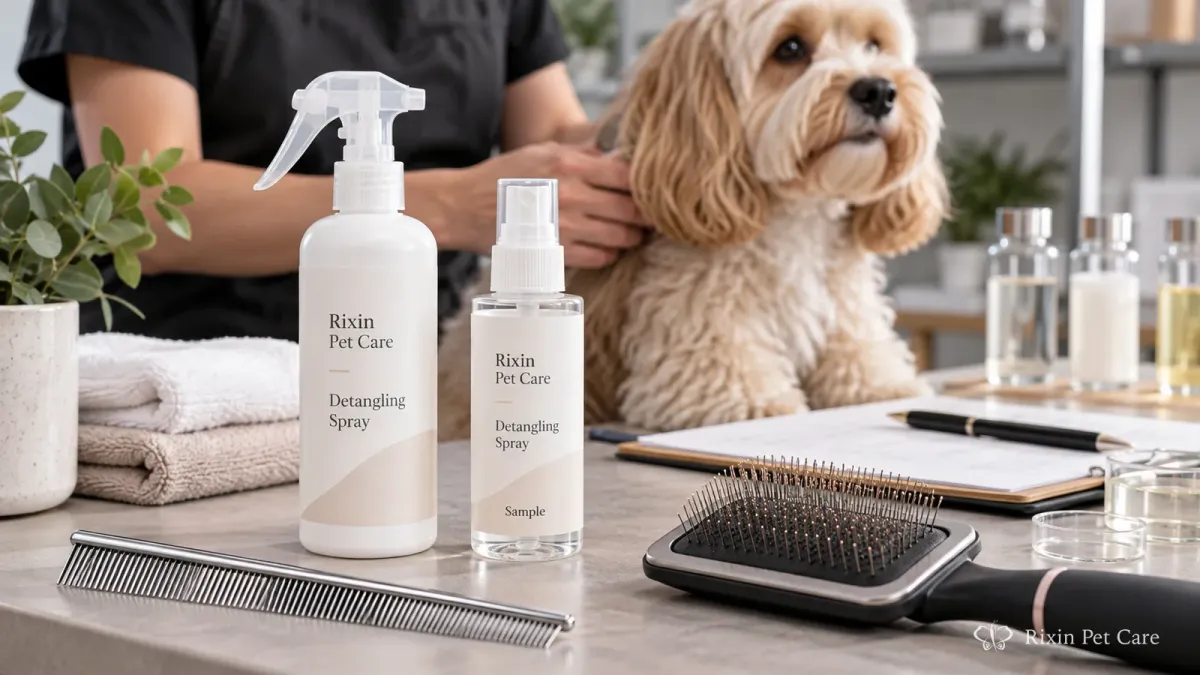
Evaluate a private label pet detangling spray sample by observing how the coat handles during the intended brushing or combing routine. Start by defining the coat type, condition and routine in the product brief.
For a leave-on detangling spray, check whether the sample matches that specific brushing and coat-care experience. A fine mist, pleasant scent or shiny coat alone is not enough to approve it. A sample that feels attractive on a hand or sprays well onto a surface may still behave differently when applied before grooming and worked through the intended coat.
The practical review has three connected parts:
- Comb-through fit: What changes, if anything, can the reviewer observe while brushing or combing in the agreed coat context?
- Application fit: Does the sprayer place and distribute the formula in a way that supports that grooming routine?
- Finished-coat fit: After the agreed routine, does the coat’s appearance and feel match the intended product direction without obvious unwanted residue or heaviness?
These are buyer-side development observations, not standardized efficacy or animal-safety test results. The purpose is to identify what the manufacturer should keep, adjust, or investigate before the next sample or production decision.
If you are still choosing between a rinse-off conditioner and a leave-on grooming spray, start with Rixin Pet Care’s pet conditioner and detangling spray product routes. This article addresses the leave-on detangling spray sample after that route has been chosen.
Quick Answer: Evaluate the Brushing Routine, Not the Bottle Alone
A useful detangling sample review begins with the brand’s intended grooming job and finishes with a decision about the particular formula–sprayer combination.
| Review focus | Core buyer question | What the review should produce |
|---|---|---|
| Coat and brushing context | For which coat and grooming situation is this sample being considered? | A clear record of the coat type and review conditions |
| Comb-through experience | How does brushing or combing compare with the agreed reference under that context? | Specific observations, not an unsupported performance claim |
| Spray application | Is the product easy to place and distribute where the brushing routine needs it? | Actionable formula/dispenser feedback |
| Finished coat | What does the coat feel and look like after the agreed application and brushing routine, including any intended drying step? | A match or mismatch with the product brief |
| Next development step | Which attribute should stay, change, or receive further review? | Specific feedback to send the manufacturer |
The general procedures for sample identification, version control, review records, and approval decisions belong in our private label pet grooming sample evaluation guide. Here we concentrate on observations that are specific to a detangling spray.
1. Define the Detangling Job Before You Evaluate Performance
“Detangling spray” describes a product role, but it does not tell a development team enough about the brand’s intended experience.
Before the first meaningful comparison, define:
- Product route: a leave-on spray used before brushing or combing, rather than a conditioner intended to be rinsed out.
- Intended animal and coat context: the species, coat presentation and grooming setting actually included in the project brief. Do not assume one sample has been shown suitable for every coat or species.
- Routine: whether the product is intended for routine brushing, grooming-salon finishing, between-bath coat care, or another clearly agreed non-medical grooming use.
- Use sequence: when the formula is applied relative to brushing, and whether any waiting, towel or drying step is part of the agreed directions.
- Experience target: for example, a light finish, a particular fragrance direction, or easier-feeling coat handling in the defined context.
- Package direction: the bottle and sprayer combination that will be considered alongside the sample.
The brief tells reviewers what a good match looks and feels like. A lightweight everyday coat spray may need a different after-feel from a richer salon-finishing product.
Without the coat and routine details, a reviewer’s preferences may not give the manufacturer useful feedback on the product brief.
If your product concept is still unclear, prepare it first using the manufacturer product-brief guide. Once the intended use is agreed, the physical sample can be reviewed against that direction.
Do not use difficult mats as a performance demonstration
A brand should not create or intensify tangles to make a sample appear impressive. Avoid forceful combing through tight or painful mats, and do not treat an animal’s discomfort as an acceptable test condition. If the coat or skin condition requires special handling, have an appropriately qualified groomer or veterinarian determine the suitable approach instead.
A buyer’s casual grooming observation is not a substitute for professional animal-care judgment, nor does it prove that a formula will resolve severe matting.
2. Compare Comb-Through Experience in the Agreed Coat Context
Comb-through is the central evaluation task for this article. It distinguishes a detangling spray review from a general no-rinse shampoo or coat-freshening sample check.
Use a review situation that is appropriate for the animal or agreed test material. Where on-animal review is appropriate, conduct it responsibly with suitable grooming expertise and the intended-use directions. If a product is not yet suitable for that kind of review, discuss a staged or alternative assessment with the manufacturer rather than improvising an animal-use test.
Keep the relevant comparison conditions as consistent as practical, and record the comb or brush type, coat type and condition. Do not compare one formula on a clean, lightly tangled area with another on a substantially different coat condition. Differences in the coat could be mistaken for a product result.
Before the review, name the reference for each observation. This could be an earlier sample version used in a comparable, appropriate grooming context. If no physical reference is available, use the handling target in the brief. If a reliable comparison is not possible, record that limitation; unrelated coat conditions are not equivalent evidence.
Observe what happens during the brushing routine, not just before it:
- Does the comb or brush travel through the selected area with more, less, or similar apparent drag relative to the agreed reference?
- Is there noticeable catching or pulling at particular points, and does it change across samples?
- Does the reviewer need to adjust the amount or distribution of product to complete the intended routine?
- Does the coat appear to separate and handle in the intended direction, rather than becoming flattened or clumped?
- Is the reviewer able to distinguish the formula’s role from changes caused by coat condition, tools, or grooming technique?
Avoid turning a subjective observation into a numerical friction or detangling-efficiency claim. Without an agreed, validated method, comments such as “30% easier brushing” or “prevents knots for seven days” are not supported by this kind of sample review.
Better feedback: explain the brushing difference
Weak feedback:
“Sample B detangles better.”
More useful feedback:
“With the same grooming tool and agreed coat context, Sample B felt easier to work through during the first brushing pass than Sample A, but left a heavier finish afterward. We prefer B’s initial comb-through direction and A’s lighter finish.”
That statement provides a practical tradeoff for the manufacturer to investigate. It does not establish that Sample B is universally more effective or suitable for all coat types.
3. Check Whether Application Coverage Supports Brushing
Check whether the sprayer places the current formula where the defined grooming routine needs it, with manageable coverage and amount. A fine-looking mist alone does not show that the sprayer is suitable for this job.
Review the formula with the actual proposed sprayer, or clearly mark the packaging as provisional if it is still being selected.
Useful detangling-specific questions include:
- Can the reviewer apply the product to the intended coat section without oversaturating one small spot?
- Is the spray coverage workable for the brushing sequence, or does it make the reviewer repeatedly stop to redistribute product?
- Does the output remain reasonably consistent across repeated normal actuations during the review?
- Does the formula reach the intended application area, or is much of the product lost outside the target area?
- Does the current nozzle/formula pairing feel appropriate for the planned light or richer product direction?
A packaging mismatch can change how the formula appears to work during grooming. A broad, heavy spray may wet an area more than intended. If the output is hard to place, the comparison can also become unreliable. A formula change is not always the answer: the nozzle, actuator, or agreed use direction may need review too.
For example:
“The formula’s coat feel is close to the target, but the current nozzle deposits too much product in a small area before brushing. Please compare a different spray direction with the same formula version.”
This is more actionable than “make the spray finer,” which can lead to an undefined packaging requirement.
Spray pattern, repeated output and minor visible leakage can be observed during review. Long-term sprayer compatibility, clogging resistance, stability and transport performance cannot be proven by a few trial sprays. For the broader relationship between the formula and package, use our formula–packaging compatibility guide, and discuss the actual dispenser options with packaging and label design support.
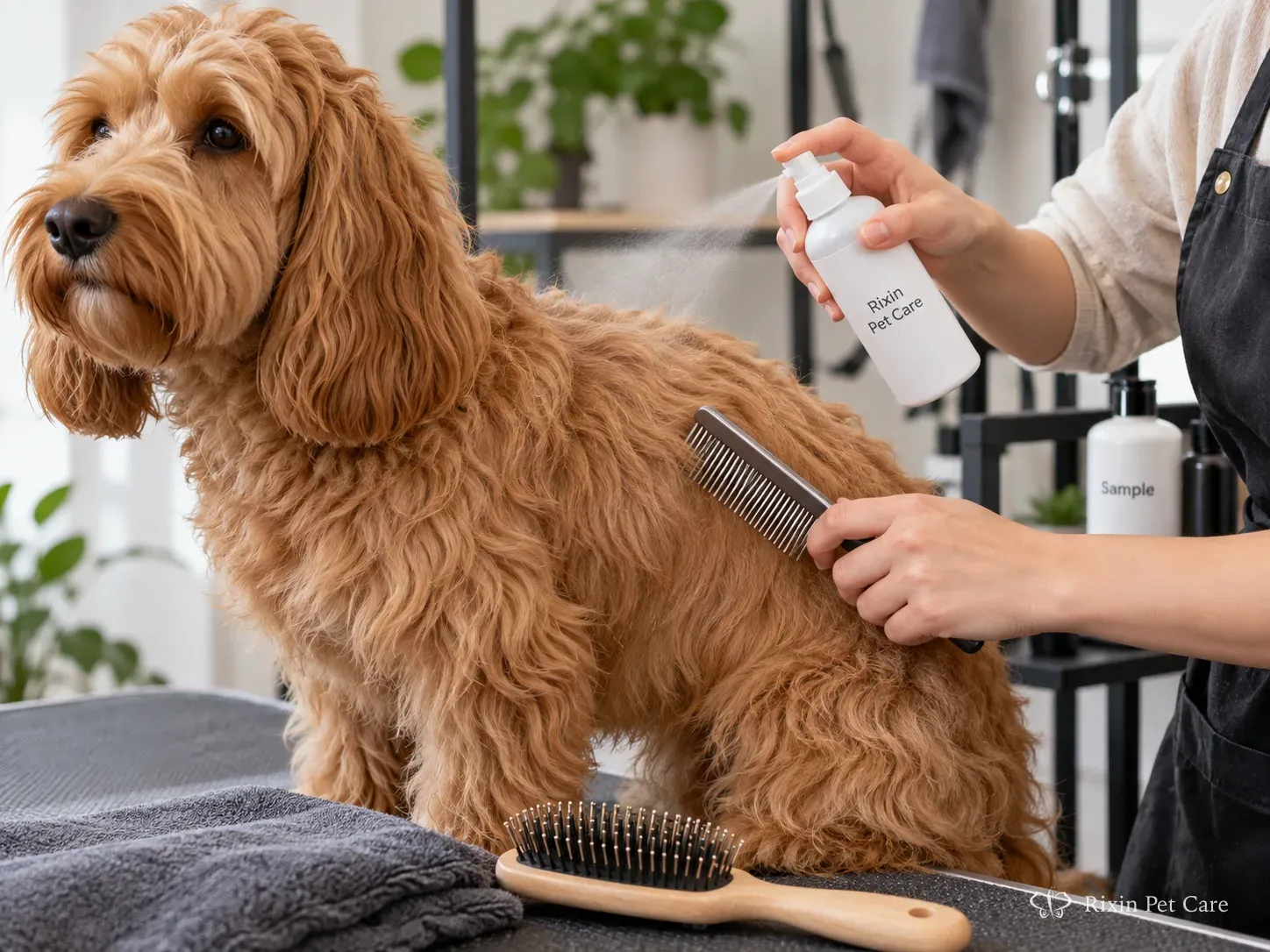
4. Review the Finish After the Intended Brushing Routine
The initial impression can change once the formula has been distributed through the coat and the agreed routine is complete.
Record the finish at the time point defined in the review plan. Depending on the intended use, relevant buyer observations may include:
- whether the coat appears separated and groomed or visibly weighed down;
- whether the finish feels light, sticky, greasy, coated or otherwise different from the brief;
- whether product appears concentrated on certain areas because of how it was sprayed or worked through;
- whether fragrance character and perceived strength still fit the agreed direction;
- whether the product leaves a visible residue that affects the desired appearance or handling;
- whether the finish remains consistent with the intended leave-on use rather than behaving like a rinse-off product.
Do not assume that a very slippery or glossy first impression is automatically better. The useful choice is the direction that fits the intended product brief and brushing context.
A detangling spray review focuses primarily on how application and finish relate to combing and brushing. Keep the distinction clear: a no-rinse cleansing product is primarily reviewed for its intended cleaning/freshening routine. Its dispensing, wetness and dry-down also matter. For a cleansing-focused route, see our separate no-rinse shampoo sample review.
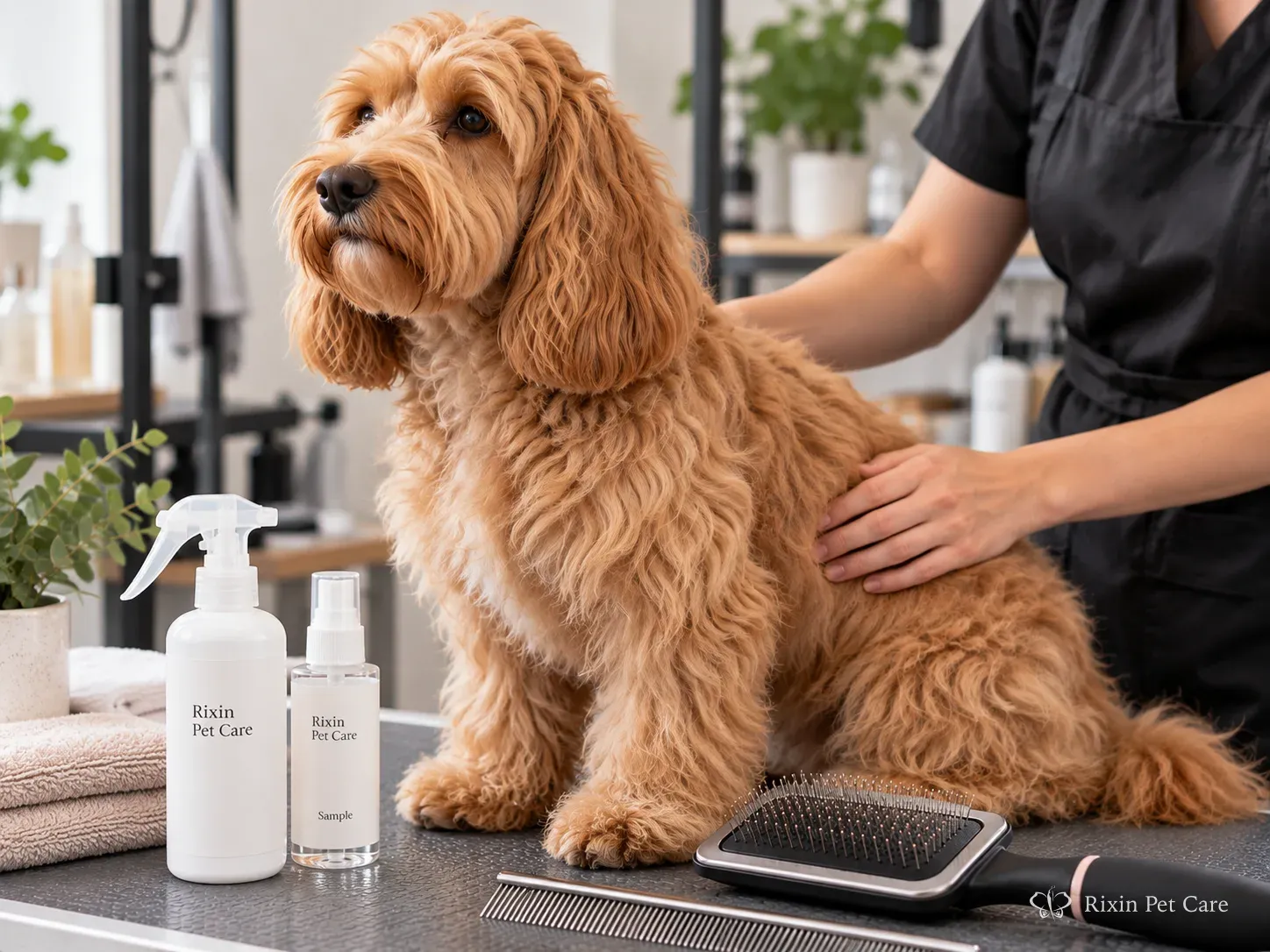
5. Use a Detangling-Specific Sample Observation Record
Use the review form to show the manufacturer which part of the detangling experience needs work.
Copy the table below to guide your discussion. It does not prescribe laboratory methods, score thresholds, or universal approval criteria.
The “Buyer observation” column contains prompts, not completed results. Replace each question with what you actually observed, and mark unassessed items as “not assessed.” In the final column, record a specific requested change or “no change requested.”
| Review area | Context to record | Buyer observation | Direction for manufacturer |
|---|---|---|---|
| Intended coat/routine | Agreed coat context, brushing situation, tool and use sequence | Was the review relevant to the intended product? | Clarify or narrow the brief if needed |
| Initial application | Proposed sprayer and intended application area | Was placement and coverage manageable before brushing? | Revisit nozzle, output or use direction |
| First comb-through | Same agreed review context/reference | Where did the reviewer notice apparent drag or snagging? | Investigate the comb-through direction |
| Continued brushing | Normal intended grooming sequence | Did the reviewer repeatedly need to reapply or redistribute product? | Review delivery, distribution or sensory direction |
| Coat separation/appearance | Finish after the agreed routine | Did the coat look appropriately groomed or clumped/heavy? | Keep or adjust finish direction |
| After-feel | Same agreed observation point | Sticky, greasy, light, coated or other specific observation? | Refine after-feel target |
| Formula + nozzle | Current sample package, including any provisional components | Inconsistent output, visible drips, dispensing difficulty or other issue? | Review component/formula combination |
| Fragrance | Brand-approved fragrance or fragrance-free direction | Does perceived scent match the intended concept? | Keep or revise fragrance direction |
Below the table, add a brief note with the exact sample reference and what it was compared with. Include unresolved questions and the change you want the manufacturer to consider next. Keep the physical observations in the table; these notes should not replace them. The general sample evaluation guide already explains version control and formal approval records.
Example: two observations can point to different fixes
Observation A: The sprayer produces uneven coverage, but the treated area that receives product feels close to the intended brushing direction.
Possible next step: Review the proposed nozzle/application system before making a broad formula change.
Observation B: Coverage is manageable, but comb-through still feels inconsistent with the agreed reference and the finished coat feels heavier than intended.
Possible next step: Review the formula’s detangling/finish direction under the same grooming context before locking the package.
Neither example proves technical performance. Both help the development team isolate the part of the experience that needs attention.
6. Separate Sample Observations From Claims and Required Testing
A buyer may decide that one version feels closer to the intended grooming experience. That does not authorize all possible statements on the final label or prove that the formula meets every technical requirement.
A routine sample comparison does not, by itself, establish:
- quantified reduction in combing force, friction or breakage;
- prevention or treatment of matting, skin irritation or disease;
- performance on every breed, species or coat type;
- safety for a particular animal, sensitive skin, or eye area;
- stability or microbiological quality over the intended shelf life;
- formula compatibility with a final bottle and sprayer over time;
- transport performance or future batch consistency;
- substantiation for anti-static, hypoallergenic, therapeutic or other market-facing claims.
Those topics may require separate project-specific testing, supporting records, market review, or professional judgment. The US FDA distinguishes animal grooming aids intended solely to cleanse or beautify animals from products promoted with disease or other drug-type claims; the full claim and product context matters. See FDA’s Animal Grooming Aids guidance for the US framing. Different target markets may require different review.
If the desired product attributes require reformulation or a change to the intended use, discuss the scope of pet grooming formula development before treating a revised sample as equivalent to the prior version.
7. Decide What to Keep, What to Revise, and What Must Be Confirmed
At the end of the review, write a product-specific decision rather than a general statement that the sample is good or bad.
A useful decision might read:
“Keep the light after-feel of Sample A. Investigate a more manageable application pattern using the proposed packaging route, then repeat the comb-through review in the agreed coat context. Fragrance is acceptable for the current concept; package compatibility and any marketing performance statements remain separate open items.”
The next step could be to retain the current direction, ask for a focused formula or sprayer revision, conduct another appropriate sample comparison, or hold the project until a key input is confirmed.
Do not call a sample “production approved” if the final formula, package, documents, or any required testing remain unresolved. Approval of a grooming direction is not proof that every later technical and commercial requirement has been satisfied.
For project-level approval records and handoff controls, use the general private label pet grooming sample guide. This article’s job is to make the detangling-specific decision clear.
Frequently Asked Questions
Should a detangling spray sample be judged on shine or softness alone?
No. Appearance and feel are relevant only as part of the intended product direction. For a detangling spray, the key buyer observation is how application and the finished-coat experience relate to the agreed brushing or comb-through routine. Shine alone cannot establish detangling performance.
Do we need to assess different coat types?
Only the coat contexts genuinely included in the project brief and appropriate for review. A brand should not assume that one observation on one coat establishes suitability or performance for every coat type or animal. Agree on the relevant review context with the manufacturer and an appropriate grooming professional when needed.
Can we use the same sample checklist as a no-rinse shampoo?
The general recording and packaging checks can be shared, but the central buyer question is different. No-rinse shampoo is evaluated around its cleansing/freshening routine. A detangling spray needs explicit comb-through and brush-handling observations in the intended coat context.
Should we approve the formula before selecting the final sprayer?
You may agree that a formula direction looks promising, but do not treat that as approval of the final formula–package combination. Spray placement, output and coverage can affect the brushing experience, and final compatibility or package requirements still need the relevant project-level review.
Does a smoother-feeling sample justify an “anti-tangle” or performance percentage claim?
Not automatically. Informal buyer observations do not establish a quantified, durable, or universal performance claim. Discuss the proposed wording and required evidence for the target market before publishing claims.
What should a brand send when requesting a detangling spray sample?
Send the intended animal/coat context, grooming role, leave-on use direction, desired finished feel, fragrance preferences, provisional bottle/sprayer concept, market, expected project quantity, and the specific questions the sample should help answer. Do not invent numerical performance targets simply to make the brief look technical.
Make the Next Detangling Spray Decision Useful
The strongest private label detangling spray review is not the one with the longest checklist. It is the one that tells the product team what happened during brushing, in which agreed coat context, and what the formula–sprayer combination needs to do next.
Start with Rixin Pet Care’s private label conditioner and detangling spray product options. When your intended use, coat context, packaging direction and known requirements are clear, request a project proposal to discuss the next development step.
Ready to Discuss Your Pet Grooming Product Project?
Share your product type, target market, packaging direction, estimated quantity, and any support you need. A rough brief is enough to start a practical next-step discussion.