Waterless Shampoo vs Grooming Wipes vs Coat Spray: Which Fits Your Pet Grooming Line?
Written by: Rixin Pet Care Editorial Team
Reviewed by: Product Development Team for manufacturing context and claim-risk alignment.
This content is provided for product planning, packaging discussion and claim-risk awareness. It is not veterinary advice, treatment guidance or market authorization.
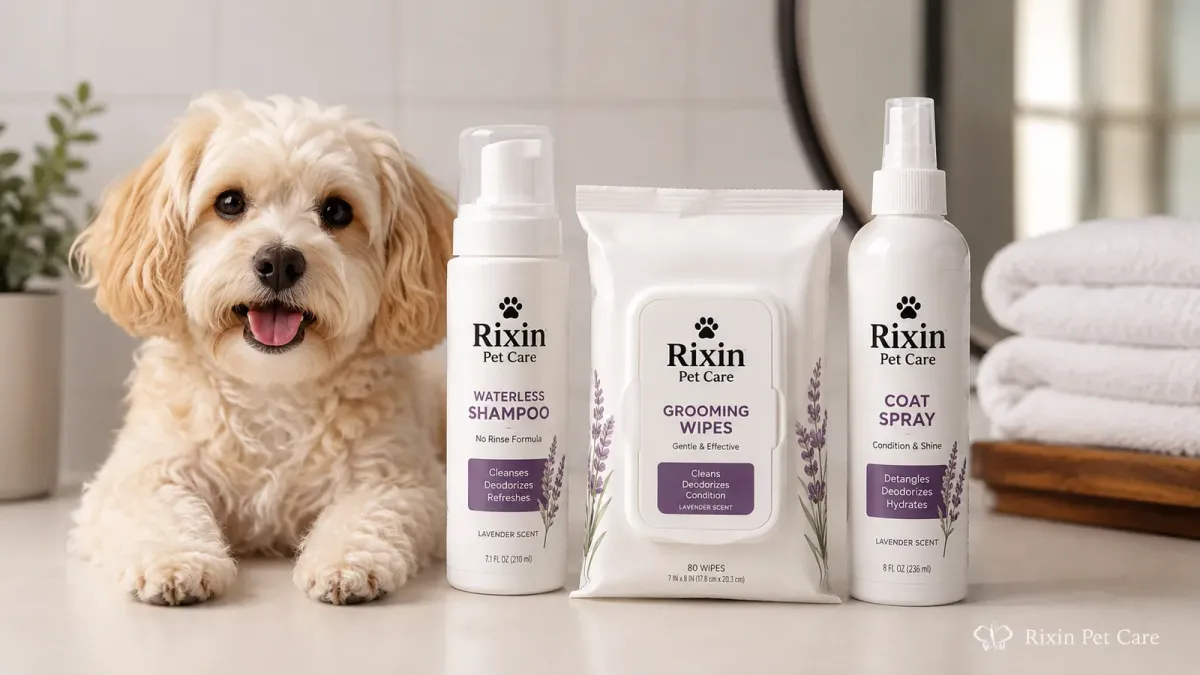
A private label pet grooming brand may already know that its line needs a product for grooming between full wash-and-rinse baths but still be unsure which format should fill that role.
Waterless shampoo, grooming wipes, and coat spray can all support between-bath grooming, but they are not interchangeable. They differ in how much of the coat they are intended to cover, how the customer applies them, what packaging system they require, and what job they perform within the product line.
This content is for product planning, packaging discussion, and claim-risk awareness only. It is not veterinary advice, medical guidance, or market authorization.
Quick Answer
Choose the format by the job the product needs to perform.
- Waterless shampoo generally fits broader no-rinse coat grooming and light cleanup.
- Grooming wipes fit targeted, quick cleanup where direct wiping and portability matter.
- Coat spray fits lighter coat refresh, grooming finish, and leave-on use when the formula and product directions support that application.
None is universally better.
The right choice depends on whether the product needs to clean or mainly refresh, how much coat coverage is required, how the customer should apply it, which packaging system fits the project, and what role the sellable product version—or SKU—needs to fill within the wider line.
For broader private label planning, see the complete private label pet grooming products guide.
Start With the Job, Not the Format
Do not begin with the package.
A bottle, wipe pouch, fine-mist sprayer, or foaming pump is the delivery system. The first question is what the product actually needs to do.
If the goal is broader no-rinse grooming across the coat, a waterless shampoo direction may fit.
If the goal is quick cleanup of selected areas, grooming wipes may be more practical.
If the goal is light coat refreshing or a finishing step, a coat spray may fit better.
These are product-planning directions, not rigid definitions. Exact formulas, application methods, and directions can vary by project.
For this comparison, coat spray means an ordinary coat-refresh or grooming-finishing spray. It does not mean a dedicated conditioner or detangling product.
Once the grooming job is clear, the format decision becomes easier.
Compare the Three Formats Side by Side
| Decision factor | Waterless Pet Shampoo Spray | Pet Grooming Wipes | Pet Coat Deodorizing Spray |
|---|---|---|---|
| Primary role | Broader no-rinse grooming and light cleanup | Direct, selected-area cleanup | Lighter coat freshening and finishing |
| Application action | Spray or foam, then distribute as directed | Wipe directly across the selected area | Mist or spray onto the coat as directed |
| Coverage role | Broader coat application | Selected areas and direct contact | Coat-surface freshening with a lighter mist |
| Cleanup vs freshening | Sits closer to no-rinse cleanup | Sits closer to direct cleanup | Sits closer to leave-on freshening |
| Portability / convenience | Depends on the bottle and dispensing route | Self-contained direct-use format | Depends on the bottle and dispensing route |
| Packaging system | Bottle with spray or foam dispensing | Wipe substrate, liquid, pack, and closure | Bottle and spray-dispensing system |
| Assortment role | Broader between-bath route or anchor format | Portable cleanup or selected-area route | Complementary refresh or finishing extension |
| Overlap risk | Overlaps if positioned as the same quick refresh | Overlaps if positioned as generic refresh | Overlaps if positioned as the same coat spray |
The main difference is not simply whether the product comes in a bottle or pouch. It is how the customer interacts with the product and how much of the coat the format is intended to cover.
A waterless shampoo can be planned for broader coat application. Wipes provide direct contact with selected areas. A coat spray normally applies a lighter mist and, when designed as a leave-on format, serves a different role from broader no-rinse cleansing.
The overlap question is therefore about the routine, not just the package. Two formats can coexist when the customer performs a different action, uses them on a different occasion, or expects a different result from the product role. If the only difference is the bottle or pouch, the assortment may be duplicating one idea.
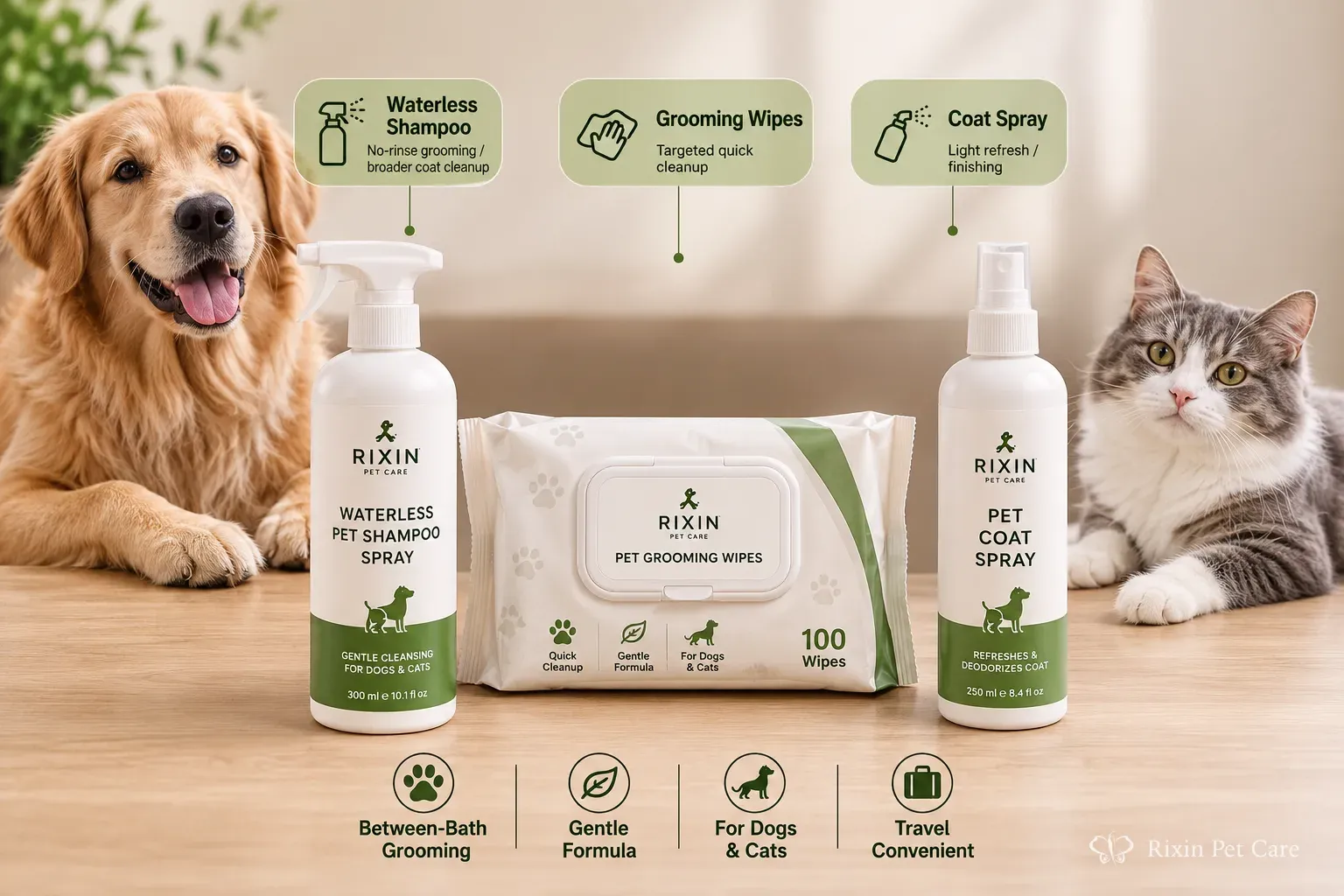
Compare the Application Experience
Application matters because it shapes both the customer experience and the product specification.
A waterless shampoo is generally intended for broader coat contact. Depending on the final format and directions, it may be sprayed or foamed onto the coat and then distributed, towelled, or brushed through.
A grooming wipe gives the customer direct control over where the product goes. That can make the format useful for paws, selected coat areas, travel, or other quick-cleanup situations where broader application would be unnecessary.
A coat spray usually involves the lightest application of the three. When the selected formula and directions support leave-on use, it can be misted over the coat for refresh or grooming finish rather than used as a broader cleansing step.
The right application model should match the grooming moment the brand is trying to create.
Compare the Packaging and Manufacturing Route
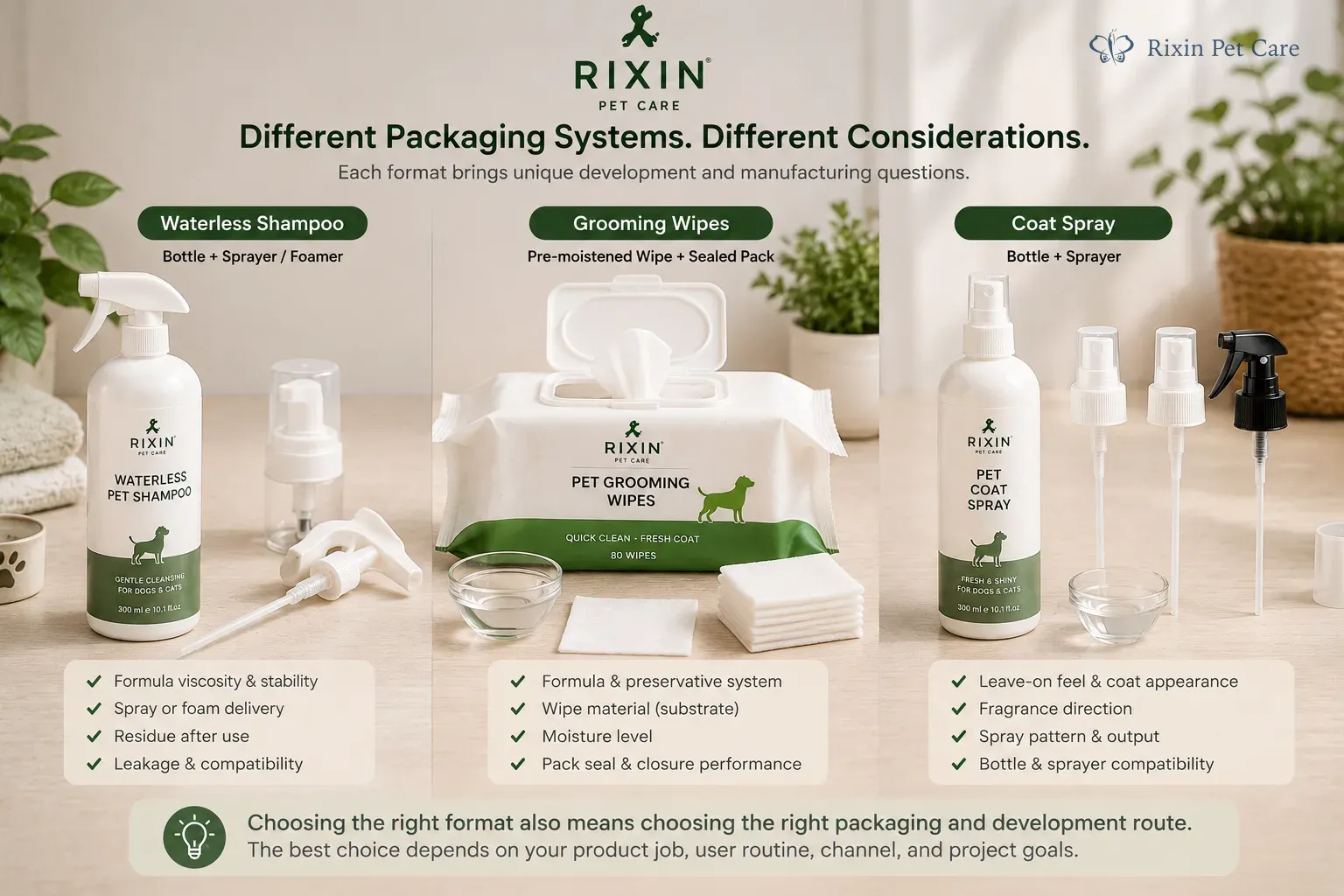
Choosing a format also means choosing a different formula-and-package system.
For a waterless shampoo, the formula and delivery system need to work together. Formula thickness (viscosity), spray or foam delivery, residue after use, and package leakage are examples of factors that may need review during development.
For grooming wipes, the finished product combines the liquid formula, wipe material, moisture level, and sealed package. A change to one part of that system may affect how the finished wipe feels and functions in use.
For a coat spray, development may focus more on leave-on feel, fragrance direction, spray pattern, and how the selected formula works with the sprayer.
These differences do not mean one manufacturing route is inherently easier or better. They mean the project inputs and development questions are different.
This article does not replace detailed package testing or compatibility review. Once the format and packaging direction are defined, use the formula and packaging compatibility guide for the deeper technical questions.
If one of the three formats already fits your project, the individual product pages provide more format-specific manufacturing information:
Which Format Should You Choose?
Use the product role to make the first selection.
Choose Waterless Pet Shampoo Spray When
- the brand needs a broader no-rinse coat grooming route;
- light cleanup and broader coat application belong in the same between-bath routine;
- the customer can spray or foam the product and distribute it as directed;
- the format should sit closer to a cleansing role than a light finishing role.
Waterless shampoo complements conventional wash-and-rinse grooming. It should not be presented as a universal replacement for rinse-off shampoo.
Choose Pet Grooming Wipes When
- the routine depends on direct wiping of selected areas;
- portability and a self-contained direct-use format matter;
- the customer benefits from controlling exactly where the product is applied;
- broader coat application would be unnecessary for the intended grooming moment.
Wipes are not automatically a paw-only product. Their role can cover selected-area cleanup, travel convenience, or other direct-wipe routines defined in the product brief.
Choose Pet Coat Deodorizing Spray When
- the main role is lighter leave-on coat freshening or a grooming-finishing step;
- a spray-based application fits the intended customer experience;
- scent, after-feel, and sprayer direction are part of the product concept;
- the line needs a complementary freshening format rather than another broad cleansing route.
Coat deodorizing spray should not be described as a cleansing substitute unless the exact formula and product directions support that wording.
Check the Application Before You Confirm the Format
Ask what the customer should actually do: spray and distribute, apply foam and work it through, wipe directly, or mist lightly and leave on when the formula and directions support that use. The action should match the intended grooming moment and the packaging system should support that action.
A wipe pouch, foaming bottle, standard spray bottle, and fine-mist system create different development and sourcing requirements. None is automatically easier or more portable without considering the selected package, closure, channel, and use occasion.
When One Format Is Enough
A brand can reasonably launch one between-bath format when:
- the first assortment has one clear between-bath job;
- one format already covers the primary customer routine;
- the other formats would create the same application action and customer expectation;
- the brand cannot yet explain a distinct role for a second format;
- keeping the first project narrow is more useful than adding a similar SKU.
There is no universal requirement to launch one, two, or three formats. If the role difference is not clear, start with the format that best matches the defined routine and keep the other ideas as open questions. The pet grooming product launch-size guide owns the broader one-, two-, and three-product decision.
When Two Formats Can Coexist
Two formats can coexist when they create distinct routines, actions, or customer expectations. These are assortment-planning possibilities, not universal recommendations:
- Waterless shampoo + wipes: waterless shampoo can handle broader no-rinse coat grooming while wipes handle portable, selected-area direct wiping.
- Waterless shampoo + coat spray: waterless shampoo can handle no-rinse grooming and light cleanup while coat spray handles lighter leave-on freshening or finishing.
- Wipes + coat spray: wipes can handle direct cleanup while coat spray provides a separate leave-on coat-freshening role.
Before adding the second format, ask:
- Does it serve a different grooming occasion?
- Does the customer perform a different application action?
- Does the package support a meaningfully different use experience?
- Can the brand explain the two roles without describing both as the same refresh product?
If the answer is no, one format may be enough for the first assortment.
What Should You Send the Manufacturer?
Once the preferred format is clear, give the manufacturer enough information to evaluate the project.
Useful inputs include:
- target market;
- sales channel;
- intended grooming role;
- intended species and coat type, if relevant;
- desired coverage area;
- preferred application style;
- fragrance direction, if relevant;
- packaging preference;
- estimated quantity;
- benchmark product, if available;
- sample and approval expectations;
- target timing or lead-time needs, if known;
- open questions that still require technical input.
An initial inquiry does not need to resolve every formulation or packaging detail. Its purpose is to make the intended product role and format clear enough for the manufacturer to identify the next development questions.
Use the pet grooming product brief guide when preparing the full inquiry.
Final Recommendation: Choose the Product Role First
Waterless shampoo, grooming wipes, and coat spray can all fit a between-bath grooming range, but they should not be considered interchangeable formats.
Define the grooming job first. Then choose the format whose coverage, application method, packaging system, and product-line role best match that job. If two formats are selected, make the distinction visible in the brief, packaging direction, and market-facing wording before moving to a proposal discussion.
Ready to Discuss Your Pet Grooming Product Project?
Share your product type, target market, packaging direction, estimated quantity, and any support you need. A rough brief is enough to start a practical next-step discussion.