How to Evaluate Private Label Paw Cleaner Foam Samples Before Approval
Written by: Rixin Pet Care Editorial Team
Reviewed by: Product Development Team for manufacturing context and claim-risk alignment.
This content is provided for product planning, packaging discussion and claim-risk awareness. It is not veterinary advice, treatment guidance or market authorization.
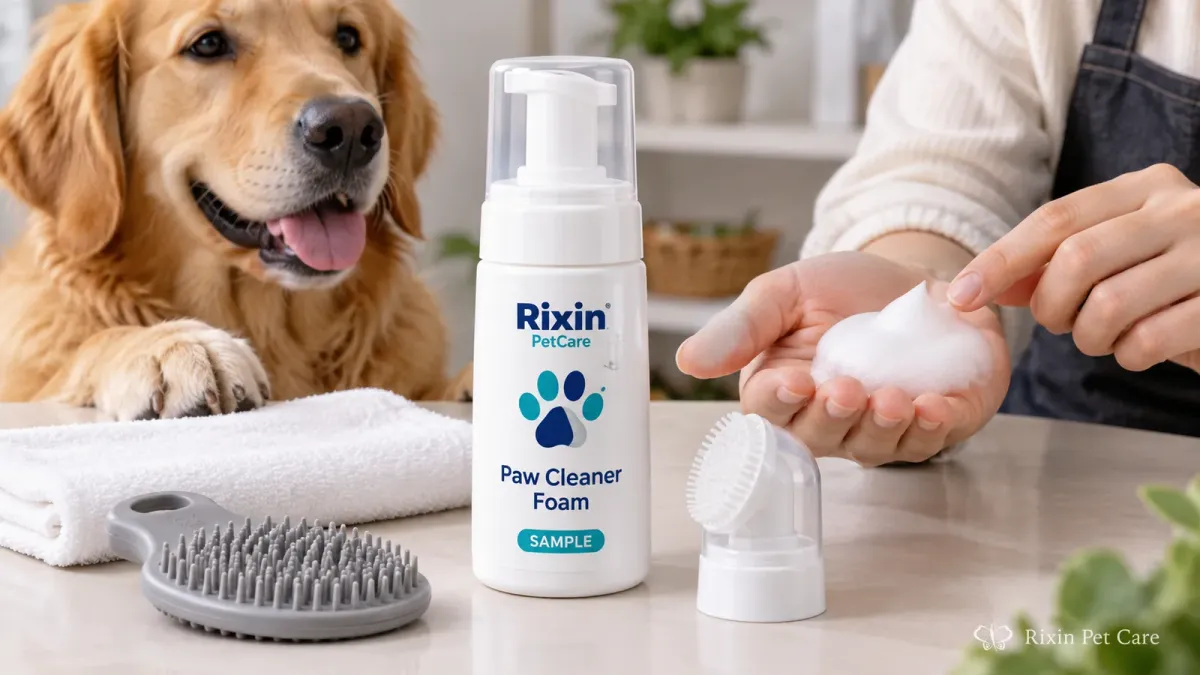
A private label paw cleaner foam sample should not be approved only because the foam looks dense when it first leaves the pump.
The more useful question is whether the complete sample experience supports the paw-cleaning concept defined in your product brief.
For a wipe-off paw cleaner, that usually means evaluating the product through a sequence such as:
Apply → Massage or distribute → Wipe → Review
The exact method depends on the project, but the buyer should look beyond foam appearance and consider localized application control, wetness, observable grooming result, wipe-off behavior, post-wipe feel, and dispenser performance.
This makes paw cleaner foam evaluation more specific than a general pet grooming sample review.
For broader guidance on sample identity, version control, review conditions, and consolidated feedback, see our private label pet grooming sample evaluation guide.
What Should You Evaluate in a Paw Cleaner Foam Sample?
A practical review can be organized around six parts of the physical use experience:
| Review stage | What to observe |
|---|---|
| Foam delivery | Priming, foam consistency, density direction, liquid separation, sputtering, and runoff |
| Localized application | Whether the foam stays controllable around the intended paw area |
| Massage or distribution | How easily the product can be worked through the intended area using the agreed method |
| Wipe-off | How the product behaves when removed with the agreed wipe or towel step |
| Post-wipe finish | Visible residue, excess moisture, stickiness, greasiness, coated feel, and intended finished feel |
| Package use | Pump handling, dripping, leakage, product collection around the dispenser, and application control |
These are buyer observations.
They are useful for product-development decisions, but they are not formal laboratory results, safety tests, or validated efficacy claims.
Start by Confirming the Exact Paw Cleaner Concept
Before judging the sample, confirm what the project is supposed to be.
A paw cleaner foam project can vary in:
- formula direction;
- foaming-pump style;
- bottle and dispenser;
- fragrance direction;
- intended amount of wetness;
- massage or distribution method;
- wipe-off method;
- target animal defined in the brief;
- desired finished feel.
Some projects may use a conventional foaming pump. Others may explore a brush-head foaming package or another dispensing route.
Those are project choices, not universal requirements.
Do not compare two samples fairly unless you know:
- which sample version you are reviewing;
- which dispenser belongs to that version;
- what application method is intended;
- what sensory direction was agreed;
- what should remain unchanged from the previous sample;
- what was supposed to improve.
For a wipe-off concept, the sample should be reviewed using the agreed routine rather than judged only inside the bottle.
Evaluate the Foam Before You Evaluate the Whole Formula
Foam presentation is one of the most visible parts of a paw cleaner sample, but it should be evaluated in context.
Relevant observations may include:
- whether the pump primes normally;
- whether successive normal pump strokes produce a reasonably consistent foam;
- whether the foam appears soft enough for the intended concept;
- whether its density matches the approved direction;
- whether liquid separates from the foam too quickly;
- whether the foam collapses before it can be distributed;
- whether the product runs away from the intended area;
- whether the pump sputters;
- whether the output becomes noticeably watery during normal use.
There is no universal foam density that every paw cleaner must use.
A very dense foam is not automatically better, and a lighter foam is not automatically worse.
The useful question is:
Does the foam behave the way this specific product concept requires?
For example, if the project brief calls for a controlled foam that can be applied to one paw at a time, a sample that quickly turns into free-flowing liquid may need revision even if the formula otherwise appears acceptable.
That is a product-development observation, not a universal specification.
Check Whether the Foam Stays Controlled During Localized Application
Paw cleaning is different from applying a product across a large coat area.
The target area is relatively localized, so application control becomes especially important.
During review, observe whether:
- the foam can be placed where intended;
- it stays reasonably localized before distribution;
- excessive liquid runs away from the application area;
- the sample creates more wetness than expected;
- the buyer can use the intended amount without immediately losing control of the foam;
- the dispenser allows practical application during the intended routine.
A sample may have attractive foam inside the hand but become much wetter once it reaches the paw area.
That difference should be documented as an application observation.
Follow the Agreed Massage and Wipe-Off Method
Do not invent a different use routine during every sample round.
Use the method defined in the project brief.
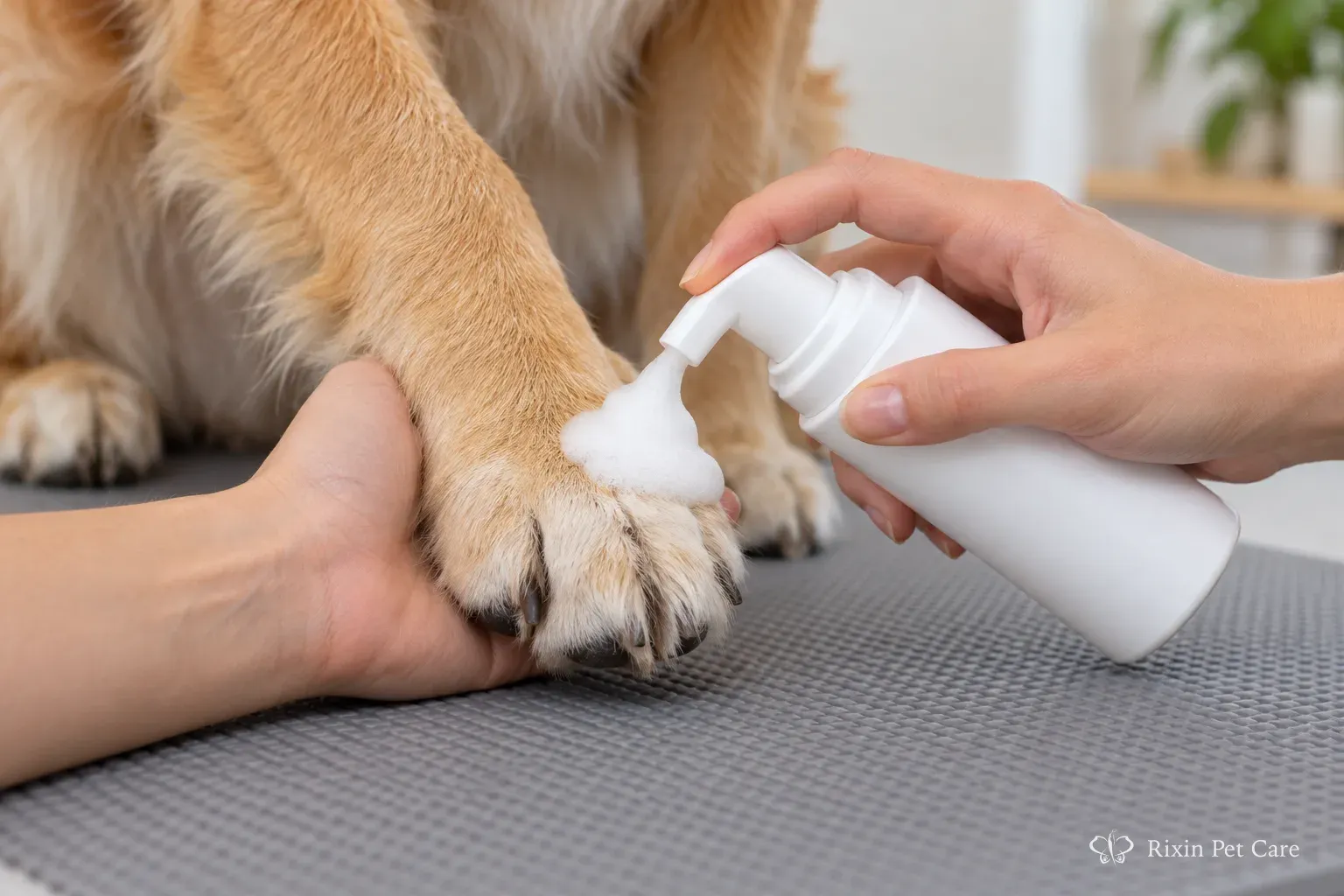
For a wipe-off foam concept, the review sequence may include:
- dispensing the intended amount;
- applying it to the intended paw area;
- massaging or distributing it as directed;
- wiping the area using the agreed method;
- reviewing the appearance and feel afterward.
The exact sequence should remain project-specific.
During the massage or distribution step, relevant observations may include:
- how easily the foam spreads;
- whether it stays manageable;
- whether excessive liquid develops;
- whether the product becomes difficult to control;
- whether the intended area can be covered without unnecessary product.
During wipe-off, observe:
- whether the product can be removed through the agreed routine;
- whether excessive foam remains visible;
- whether the area stays wetter than expected;
- whether the wipe-off process feels materially more difficult than the target experience;
- whether the finished result appears consistent with the intended product direction.
The purpose is not to create a universal consumer paw-cleaning instruction.
The purpose is to evaluate whether the physical sample behaves correctly for the project being developed.
Check the Intended Observable Grooming Result
Good foam and controlled application are not enough if the sample does not move the finished paw appearance in the direction defined by the brief.
After following the agreed application and wipe-off method, review the treated area.
Depending on the project concept, useful observations may include:
- whether visible surface soil appears reduced in the intended direction;
- whether the paw looks more appropriately refreshed or groomed;
- whether the treated area appears closer to the desired finished appearance;
- whether the result supports the intended quick-cleaning concept.
This evaluation should stay observational.
For example:
Under the agreed application and wipe-off method, Sample B leaves the paw looking closer to the target grooming result than Sample A, but the finish still feels too heavy.
That is useful development feedback.
It does not mean that the buyer has established a quantified cleaning-efficacy claim.
The distinction is important:
Buyer-observed grooming result ≠ validated efficacy claim
A sample review can help a brand decide whether development is moving in the right direction. It does not establish standardized performance, antimicrobial activity, disinfection, infection prevention, or another technical claim.
Make the Post-Wipe Finish a Major Approval Criterion
The sample should also be reviewed after the visible foam has been wiped away.
A paw cleaner can produce acceptable foam and still leave an undesirable finished feel.
After the agreed wipe-off step, observe whether there is:
- visible foam remaining;
- white or powder-like residue;
- excess moisture;
- sticky feel;
- greasy or oily feel;
- heavy or coated feel;
- unexpectedly slick product film;
- product accumulation around fur or other visible paw surfaces;
- a finished feel that differs materially from the approved direction.
Do not evaluate only the first few seconds after application.
Give the product enough time to reach the normal finished state defined by the review method before recording the post-wipe result.
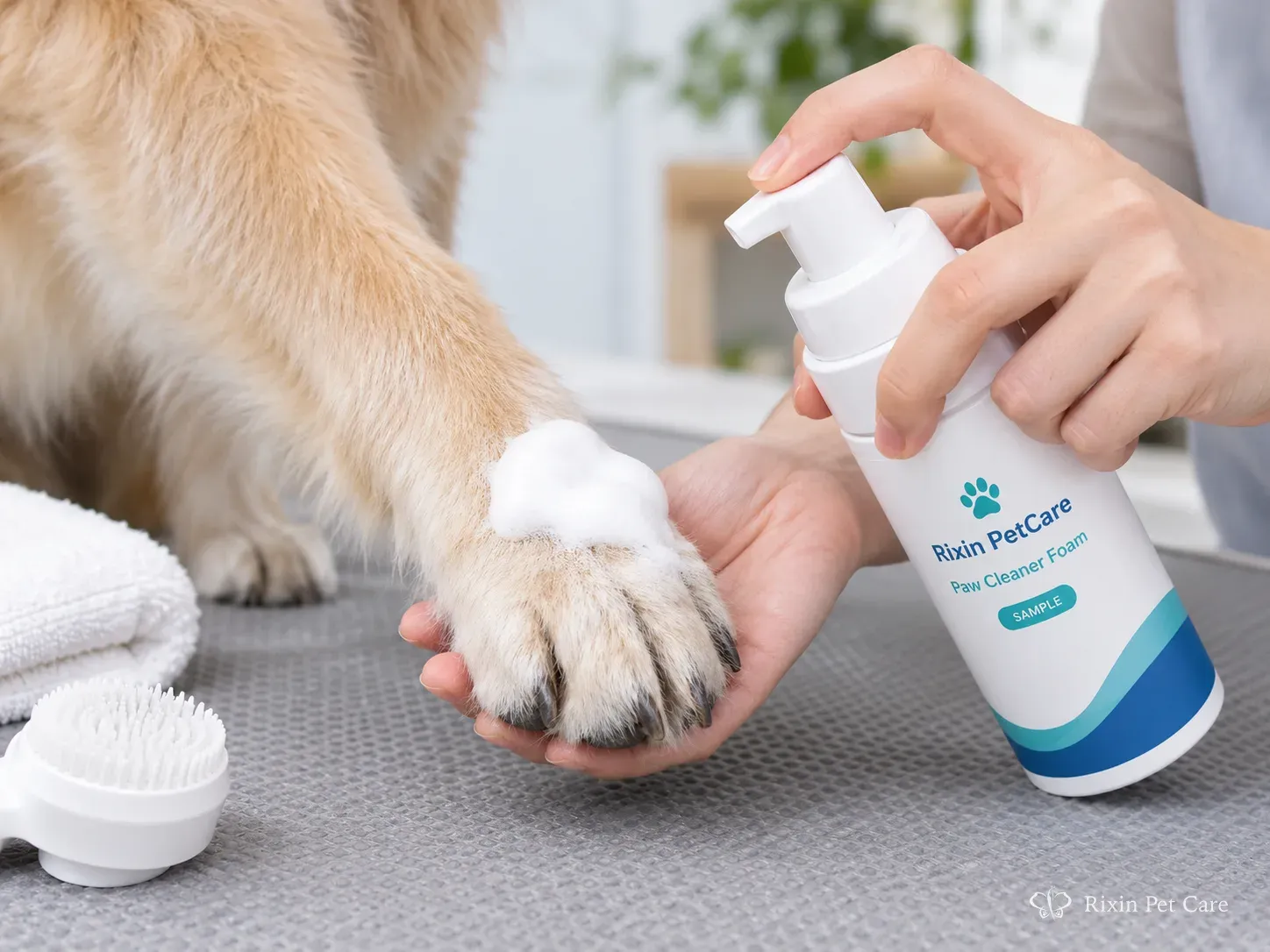
It is also useful to separate two comments that might otherwise be combined.
Instead of:
The sample feels wrong.
Record:
Foam application is controlled, but the treated area still feels sticky after the agreed wipe-off step.
That tells the development team that the problem is not necessarily the initial dispensing experience.
Likewise:
Sample C produces acceptable foam, but the paw remains wetter than intended after wiping.
This gives the manufacturer a clearer revision target.
These are ordinary sensory and grooming observations. They should not be presented as formal residue, friction, irritation, or safety testing.
Evaluate the Dispenser as Part of the Product Experience
For a foaming paw cleaner, the dispenser directly affects how the buyer experiences the formula.
During sample review, observe practical issues such as:
- priming;
- consistency between normal pump strokes;
- pump effort;
- sputtering;
- dripping;
- product collecting around the pump;
- visible leakage;
- cap or closure handling where applicable;
- ease of using the package during localized application.
If the project includes a brush-head foaming package, review how that specific package works with the agreed product routine.
Questions may include whether the package is comfortable to handle, whether foam can be delivered in a controlled way, and whether the application mechanism supports the intended product concept.
Do not turn this review into a general ranking between a standard foamer and a brush-head package.
The right packaging route depends on the project.
Ordinary sample use also cannot establish long-term formula-package compatibility. Visible leaking, inconsistent dispensing, or product accumulation can identify a question that needs further review, but they do not establish technical cause or long-term package performance.
For a deeper explanation of these boundaries, see our pet grooming formula and packaging compatibility guide.
Separate Formula Feedback From Package Feedback
Once observations have been recorded, avoid jumping directly to a technical diagnosis.
The buyer’s job during sample review is to describe what happened and, where useful, whether the issue appears to involve the formula experience, the dispenser, or the combined use system.
Consider these examples:
Observation: The foam becomes watery during application.
That does not automatically prove whether the cause is formula structure, pump behavior, sample handling, or a combination of factors.
Observation: The pump sputters after several strokes.
That is more useful than immediately concluding that the formula is too thick.
Observation: The paw looks closer to the desired grooming result, but the post-wipe feel remains too heavy.
That separates the observable grooming direction from the finished sensory result.
Observation: The formula direction appears acceptable, but visible leakage occurs during normal sample handling.
That may point toward packaging review rather than a complete formula restart.
Use sample feedback to identify what happened.
Then let the relevant formulation and packaging work determine why it happened and what should change.
For projects requiring formula adjustment, Rixin’s pet grooming formula development service can support project-specific revision work.
For dispenser, bottle, label, and artwork decisions, see our pet grooming packaging and label design service.
Turn Sample Reactions Into Manufacturer-Usable Feedback
Vague comments create unnecessary sample rounds.
Instead of:
The foam is too bad.
Use:
Compared with Sample A, Sample B separates into liquid more quickly during normal paw application. We want the next version to move toward the more uniform foam direction of Sample A.
Instead of:
It is too wet.
Use:
After the agreed amount is applied and distributed, more liquid runs away from the paw area than intended for the wipe-off concept.
Instead of:
It does not clean well.
Use:
Under the agreed application and wipe-off method, the treated area does not move as close to the target visible grooming result as the previous sample.
Instead of:
It feels greasy.
Use:
After the agreed wipe-off step, the treated area retains a heavier, greasier feel than the target direction.
Instead of:
The pump is bad.
Use:
The current pump requires inconsistent pressure and produces uneven output between normal strokes.
A useful feedback structure is:
Observation → Review context → Reference or comparison → Desired direction
For example:
During normal one-paw application, Sample B starts with acceptable foam but becomes noticeably wetter during distribution than Sample A. Please keep the current fragrance direction but move the foam behavior closer to Sample A.
That kind of feedback helps preserve what already works while identifying what should change.
When Should You Request Another Physical Sample?
Not every comment requires another formulation round.
However, a new physical sample is usually appropriate when the proposed revision could materially change the actual use experience.
That may include changes to:
- foam structure;
- wetness;
- wipe-off behavior;
- post-wipe feel;
- visible residue;
- fragrance;
- pump output;
- dispenser;
- bottle;
- brush-head or application route;
- another physical interaction the buyer must experience directly.
For example, changing label artwork usually does not require the same type of physical sensory evaluation as changing the foam direction.
But switching to a different dispenser can change how much product is delivered and how controllable the application feels.
Likewise, a formula adjustment intended to reduce post-wipe heaviness should be judged in the new physical sample rather than approved only from a written description.
There is no universal correct number of sample rounds.
The goal is to make sure that the final approved direction is based on the version the buyer has actually reviewed.
What Can a Paw Cleaner Foam Sample Review Not Prove?
A buyer sample review is valuable, but it has clear limits.
It does not establish:
- microbiological quality;
- preservative-system performance;
- stability;
- shelf life;
- long-term formula-package compatibility;
- transport performance;
- production-batch conformity;
- irritation or sensitivity performance;
- universal suitability for all animals;
- antibacterial or antimicrobial activity;
- disinfection;
- infection prevention;
- treatment of paw conditions;
- wound-care performance;
- regulatory authorization;
- formal claim substantiation.
Those questions may require technical assessment, documentation, testing, or market-specific review depending on the final project.
A sample can therefore be promising from a buyer-use perspective without every technical or commercial question being closed.
Keep the two decisions separate:
Does the buyer like the physical product direction?
and
Has the final product system completed the technical work required for the project?
They are related, but they are not the same decision.
A Practical Paw Cleaner Foam Review Record
A simple review record can help keep feedback consistent across sample rounds.
Product Identity
- correct sample version;
- current formula version;
- current dispenser;
- agreed application method;
- intended packaging direction.
Foam Delivery
- priming;
- consistency between pump strokes;
- foam softness;
- density relative to the brief;
- watery behavior or liquid separation;
- sputtering;
- runoff.
Localized Application
- ability to place the foam where intended;
- wetness control;
- spreadability;
- ease of distribution;
- ability to follow the agreed paw-cleaning routine.
Wipe-Off
- ease of removing visible product;
- excessive remaining foam;
- remaining wetness;
- general wipe-off experience.
Observable Grooming Result
- visible grooming or cleaning direction relative to the brief;
- finished appearance of the treated area;
- whether the sample appears to move toward the intended product concept.
Post-Wipe Finish
- visible residue;
- white residue;
- stickiness;
- greasiness;
- heavy or coated feel;
- unexpected slickness;
- excess moisture;
- intended finished feel.
Package Use
- pump effort;
- output consistency;
- dripping;
- leakage;
- product collection around the dispenser;
- localized application control.
Next Revision
- what should remain unchanged;
- what should be revised;
- whether the formula requires review;
- whether the dispenser requires review;
- whether another physical sample is needed.
This is a buyer observation record, not a technical test protocol.
What Happens After the Sample Direction Is Accepted?
Once the paw cleaner foam is moving in the right direction, the project can become more specific.
The next stage may include confirming:
- the accepted sample version;
- formula direction;
- foam and sensory direction;
- dispenser route;
- bottle and packaging;
- fill-size direction;
- artwork inputs;
- documentation requirements;
- technical testing requirements;
- market-facing wording;
- quotation and production planning.
The private label paw cleaner product page covers the commercial product-development route.
For broader private-label product planning, see the private label pet grooming products guide.
When you are ready to move from sample evaluation into a defined OEM/ODM project, submit your project requirements so the formula, dispenser, packaging, and next development steps can be reviewed together.
Ready to Discuss Your Pet Grooming Product Project?
Share your product type, target market, packaging direction, estimated quantity, and any support you need. A rough brief is enough to start a practical next-step discussion.