How to Source Private-Label Pet Grooming Products from China: An Importer Due-Diligence Checklist
Written by: Rixin Pet Care Editorial Team
Reviewed by: Product Development Team for manufacturing context and claim-risk alignment.
This content is provided for product planning, packaging discussion and claim-risk awareness. It is not veterinary advice, treatment guidance or market authorization.
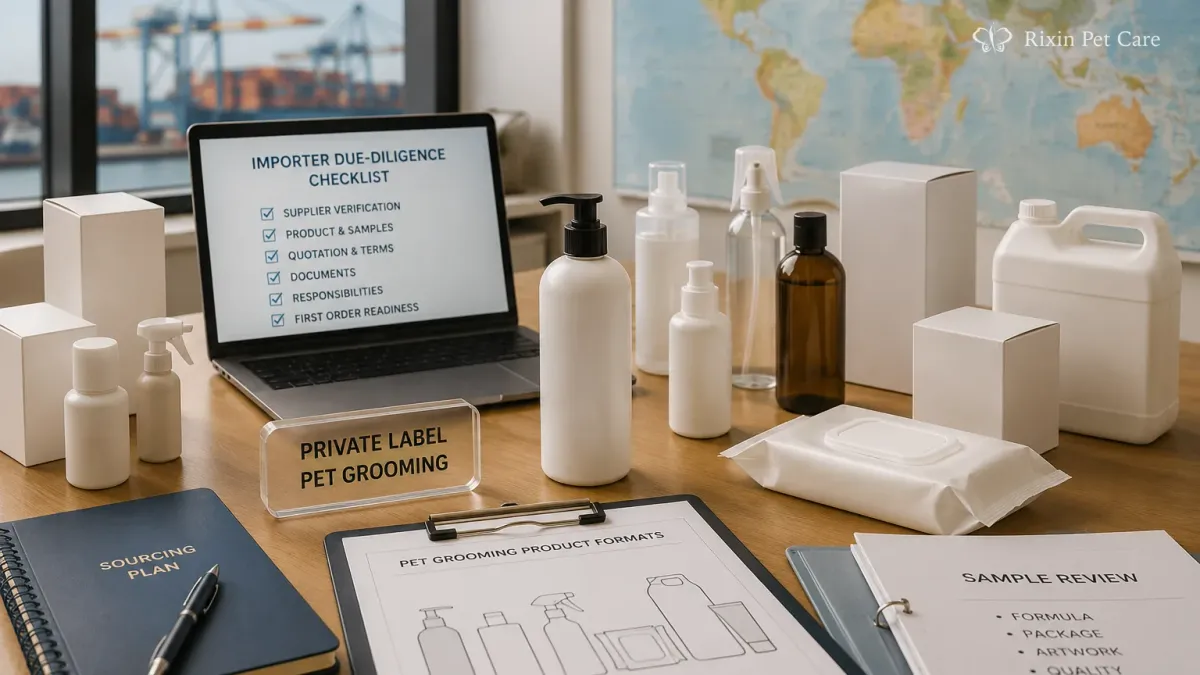
Finding a supplier is not the same as having an order-ready sourcing project.
For an importer sourcing private-label or OEM pet grooming products from China, due diligence should connect the company you are buying from with the actual manufacturing scope, the exact product version, the quotation, approved samples, supporting records, destination-market responsibilities, and the questions that are still open.
The goal is not to prove that a supplier is universally “safe” or “approved.” It is to know what has been confirmed, what remains conditional, who owns each decision, and whether the project is ready to move toward a first commercial order.
If you are still deciding which supplier best fits the project, start with the private label pet grooming manufacturer selection guide. This article starts one step later: when a supplier is under serious consideration and the importer needs to verify the transaction-specific details before relying on the quotation, samples, documents, and production plan.
This content is for B2B sourcing, product planning, documentation preparation, and claim-risk awareness only. It does not replace legal, customs, tax, regulatory, veterinary, or market-specific professional review, and it does not determine market authorization.
Quick Answer: Eight Checks Before a First Commercial Order
Use this sequence:
- Define one exact sourcing project.
- Confirm which company, site, and parties are involved.
- Verify capability for the exact pet grooming product and format.
- Normalize quotation scope before comparing price.
- Treat the approved sample as a controlled reference.
- Request documents for defined decisions.
- Separate manufacturer support from importer responsibilities.
- Close or assign every material open item before order release.
A supplier can look credible and still leave a project poorly defined. Due diligence becomes more useful when it follows the product from brief to quotation, sample, documentation, and first-order readiness.
1. Start With One Defined Import Project
Before checking a supplier against an active project, establish one current project baseline. The purpose is not to rewrite the full product brief. It is to make sure the buyer, supplier, quotation, samples, and documents are referring to the same project.
Record the current version of the essentials:
- destination market or markets;
- importing party or buyer model;
- product type and intended grooming use;
- private-label or OEM direction, if known;
- formula starting point;
- packaging and dispensing direction;
- estimated quantity by SKU;
- sample requirements;
- artwork or label status;
- requested documentation or review support;
- confirmed requirements, preferences, and open questions.
If the project baseline changes, update the reference before relying on an earlier quotation, sample, or document. A difference that is not recorded can later look like a supplier error when the underlying project has actually changed.
For a fuller briefing framework, use the pet grooming product brief guide.
Separate requirements from preferences
A compact distinction is enough:
| Status | Example | Buyer implication |
|---|---|---|
| Required | Product must use a defined dispensing format | Supplier must confirm whether the project can support it |
| Preferred | A certain bottle shape or fragrance direction | Alternatives may be considered if the first option creates a problem |
| Open | Final fill size or document scope | Keep visible until a decision owner closes it |
2. Verify Who You Are Actually Buying From
A supplier name on a website does not answer every identity and responsibility question in a cross-border project.
Record the parties that matter to the transaction, especially when more than one company or site is involved:
| Item | What to record | Why it matters |
|---|---|---|
| Legal company | Registered company name and business details available to the buyer | Identifies the counterparty being evaluated |
| Quotation entity | Company named on the quotation | Helps connect commercial scope to the correct entity |
| Contracting or invoicing entity | Company expected to sign or invoice | Avoids unexplained changes later |
| Manufacturing site | Site expected to make the product | Connects facility evidence to the actual work |
| Filling or packing site | Site used if different | Clarifies where later-stage work occurs |
| Exporter or seller | Party involved if different from the manufacturer | Clarifies the commercial handoff |
| Outsourced operations | Material external work and who controls it | Clarifies responsibility rather than assuming every step is in-house |
The presence of several parties is not automatically a problem. A trading entity, packaging supplier, external laboratory, or specialist production partner can be part of a workable project.
The risk is unclear identity or unclear responsibility.
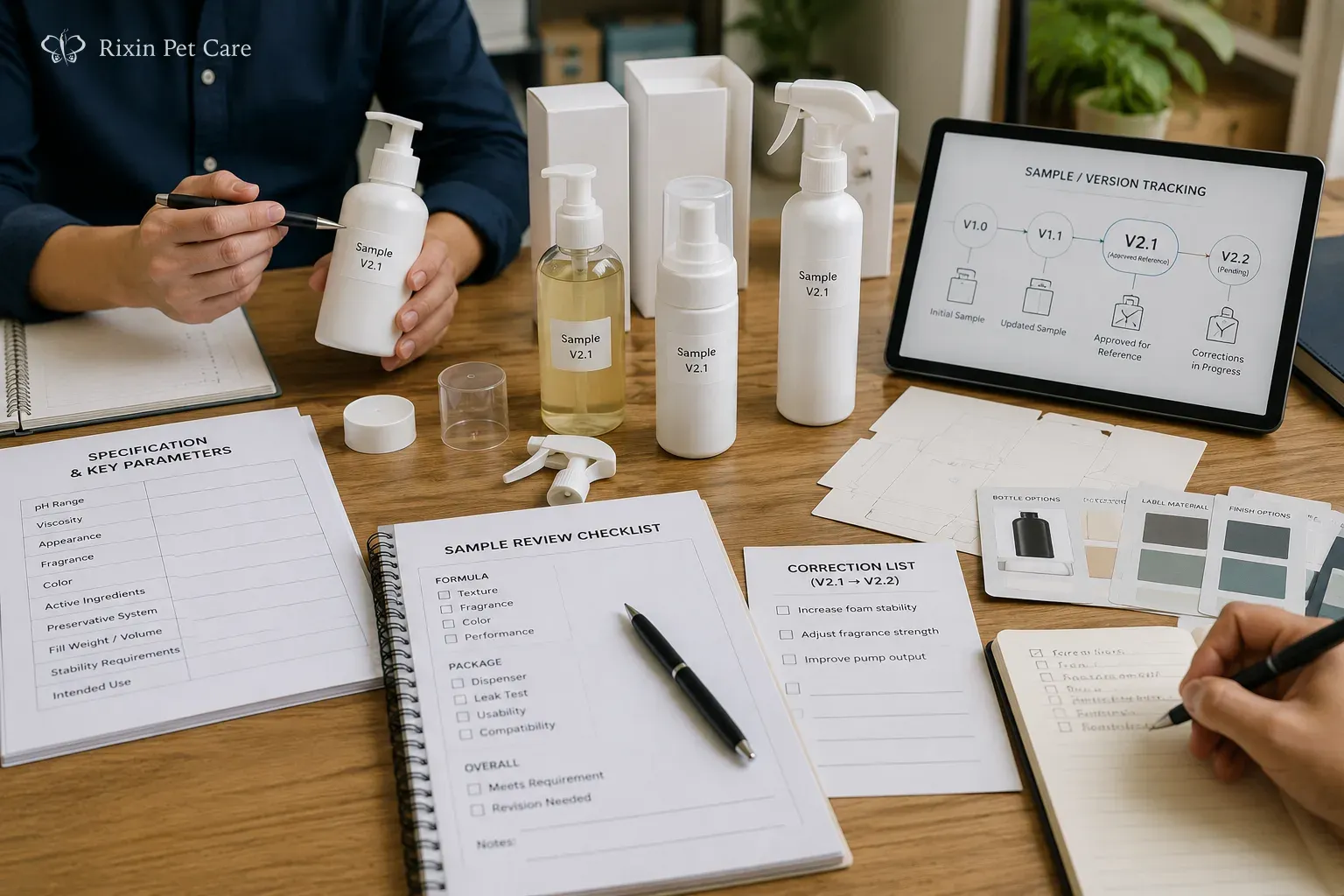
Add a China-specific company identity check
For a mainland Chinese supplier, ask for the exact registered Chinese company name and the company identifier shown in the business information provided to you, such as the Unified Social Credit Code or registration number.
Then cross-check the entity in China’s official National Enterprise Credit Information Publicity System. The system supports searches by enterprise name, Unified Social Credit Code, or registration number and publishes enterprise-registration information.
Use that registry check to confirm the identity record, then compare it with the commercial documents and project parties you are actually being asked to rely on:
- quotation entity;
- contracting or invoicing entity;
- manufacturing site;
- exporter or seller if different;
- payment instructions.
If names, entities, addresses, or payment details do not align, record the difference and ask for a written explanation before the relevant commitment. A mismatch is not automatically proof of fraud: there may be a legitimate commercial or group-company relationship. The due-diligence point is to make the relationship explicit rather than assume it.
A registry result is also limited evidence. It can help verify company identity and registration information, but it does not prove that the supplier can manufacture your exact pet grooming format, that its production will meet your requirements, that your product is compliant in a destination market, or that future batches will match an approved reference.
Connect identity to responsibility
Once the company identity is clear, confirm:
- Which entity is issuing this quotation?
- Which site will make and fill the product?
- Which work is completed elsewhere?
- Who manages an outsourced step?
- Which facility or company does each certificate or record apply to?
- If the invoicing, contracting, or payment party changes, what else in the project changes?
Background research can be one part of the review, but company identity is only one layer. The next checks still need to connect that entity to the exact project being sourced.
3. Verify Capability for the Exact Pet Grooming Product and Format
At this stage, the question is not whether the supplier generally says it makes pet products. It is whether the shortlisted supplier’s claimed scope matches the exact project baseline.
Different formats create different dependencies. A shampoo may raise viscosity and dispensing questions, a spray may add output and leakage considerations, and a wipe connects the lotion to the substrate, pack, seal, and dispensing format.
Use those format differences to confirm only what matters for this project:
- whether the requested product format is within the supplier’s actual scope;
- which operations are in-house and which are external;
- whether the intended formula and packaging route can be coordinated;
- what the buyer must supply or approve;
- which points still require testing, supplier confirmation, or market review.
If the manufacturing route itself is still unclear, the Private Label vs White Label vs OEM Pet Products guide explains those route differences in more detail.
The due-diligence objective here is narrow: confirm that the project you are evaluating is the project the supplier says it can support.
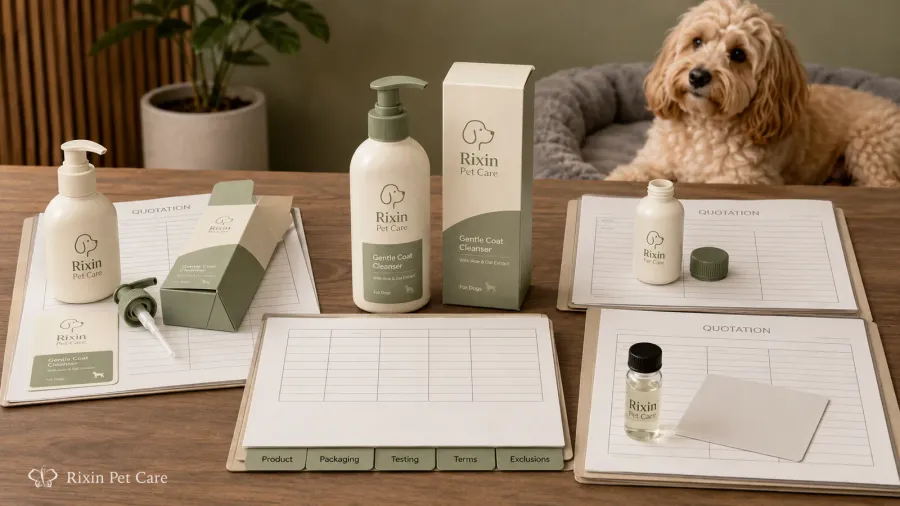
4. Normalize the Quotation Before Comparing Price
A quotation can be relied on only when it describes the same project baseline you believe you are buying.
Before comparing price, confirm the key scope items are visible and comparable:
- product and formula route;
- fill size or weight;
- number of SKUs and quantity basis;
- packaging, closure, labels, printing, and cartons;
- sample or revision scope;
- tooling or setup charges where applicable;
- testing or documentation included, excluded, optional, or unconfirmed;
- buyer-supplied items;
- currency and delivery basis;
- exclusions and unresolved assumptions.
Do not treat a blank field as included.
If two quotations describe different formula work, packaging, documentation, or logistics, the unit prices are not yet directly comparable. First make the scope difference explicit.
For the detailed line-by-line method, use the manufacturer quotation comparison guide.
A pending value is not automatically a defect when the project is incomplete. It should, however, remain visible as an open assumption rather than disappear inside the headline price.
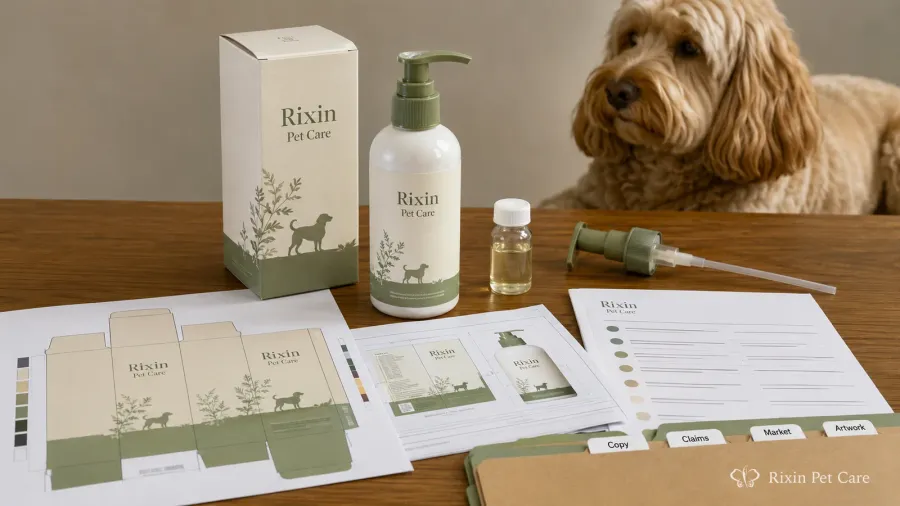
5. Treat the Approved Sample as a Controlled Reference
A sample should reduce uncertainty. It should not create a false sense of final approval.
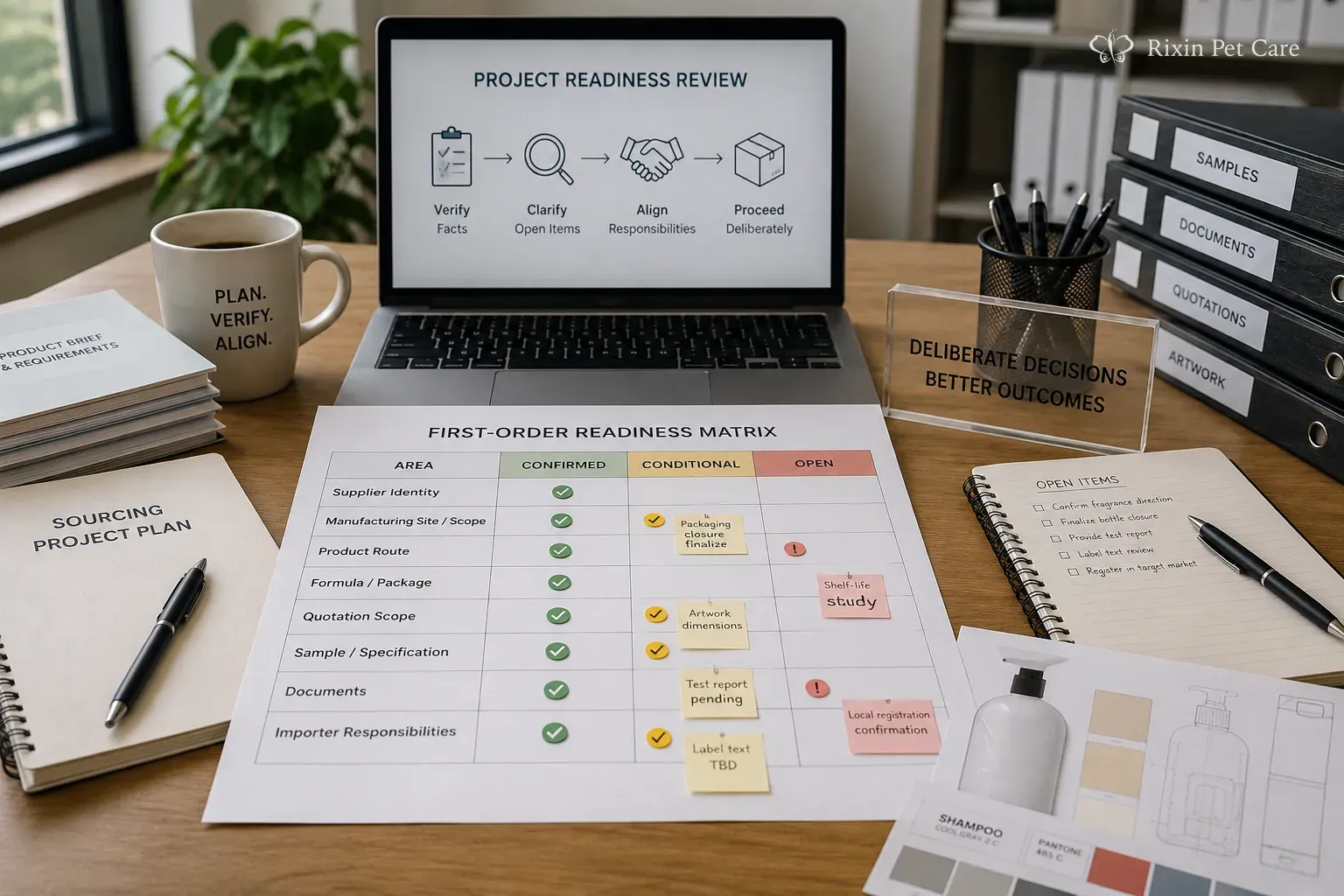
When the buyer approves a sample, record exactly what was reviewed:
- sample ID or revision;
- formula or specification reference;
- fragrance, color, viscosity, or other selected direction where relevant;
- packaging version if the sample used the intended package;
- artwork version if artwork was part of the review;
- date reviewed;
- approved points;
- required corrections;
- items still open before production.
A simple version trail may look like this:
| Reference | Status | Notes |
|---|---|---|
| Sample V1 | Reviewed | Formula direction accepted; dispenser output needs adjustment |
| Package P1 | Conditional | Bottle accepted; closure still under review |
| Artwork A1 | Open | Mandatory local information not yet confirmed |
| Sample V2 | Approved reference | Product direction accepted against recorded scope |
An approved reference sample is useful evidence, but it does not by itself prove:
- that every future production batch will match automatically;
- that the final package is compatible in every required condition;
- that a proposed claim is supported;
- that the product is suitable for every destination market;
- that all testing or documents are complete;
- that later formula, packaging, or artwork changes are already approved.
Detailed sensory, packaging, and comparison methods belong in the private label pet grooming sample evaluation guide.
Control changes after sample approval
If the formula, package, fragrance, artwork, fill size, or other material project input changes after approval, do not rely on the old approval without checking the effect of the change.
Record:
What changed → why it changed → which reference is now current → what needs review again
This is especially important when several teams are involved across sourcing, design, manufacturing, import, and local-market review.
6. Request Documents for a Defined Decision
Do not use a long certificate list as a substitute for project-specific evidence.
For each important record, confirm four things:
- Purpose — What decision should this support?
- Scope — Which entity, site, product, version, or batch does it cover?
- Timing — Is it available now, after formula approval, after testing, after manufacture, or before shipment?
- Responsibility — Who requests, prepares, pays for, reviews, and retains it?
This distinction matters because facility-level and product-level evidence answer different questions. A facility certificate does not automatically approve a specific product, while a product or batch record does not establish the scope of an entire facility.
Also confirm that the record applies to the entity or manufacturing site identified in Gate 2 and to the current product or version where relevant.
For the detailed facility-versus-product record framework, use the pet grooming manufacturer documents checklist.
Do not convert “document available” into “market approved.” Destination-market requirements and intended wording still require the appropriate local review.
7. Separate Manufacturer Support From Importer Responsibility
Cross-border sourcing becomes confusing when both sides assume the other party is handling the same requirement.
For an importer project, write down the responsibility split before artwork, production, and shipment decisions become difficult to change.
A practical planning table may look like this:
| Project area | Manufacturer-side discussion/support | Importer or local-team confirmation |
|---|---|---|
| Product direction | Review product and manufacturing route | Confirm the product fits the local commercial plan |
| Formula development | Discuss formula direction where it fits the project | Confirm destination-market suitability and any local requirements |
| Packaging | Discuss container, closure, samples, and artwork inputs | Confirm mandatory local information and importer details |
| Samples | Prepare and identify project samples | Review against the intended market, product, and local needs |
| Manufacturer-side documents | Confirm available records and project scope | Confirm what the destination market, retailer, marketplace, or local reviewer requires |
| Claims and wording | Discuss manufacturing inputs and market-specific wording questions within scope | Confirm final local claim, language, and legal requirements |
| Registration or notification | Provide relevant manufacturing inputs where available | Confirm whether local registration or notification applies |
| Customs, tax, and import formalities | Provide agreed commercial/shipping inputs | Confirm local customs, tax, importer, and import procedures |
The exact responsibility split depends on the market and project. Do not assume that manufacturer support transfers every local obligation to the factory.
RixinPetCare’s current commercial route for these projects is explained on the Importers & Regional Brands solution page, which separates manufacturing-side support from matters the importer or local team should confirm.
Confirm responsibility in writing
For every material open item, record:
- the question;
- the current status;
- the person or party responsible;
- what evidence or decision is needed;
- the target stage for closing it.
A simple owner field can prevent a packaging, label, document, or customs question from becoming “someone else was handling it.”
8. Use an Open-Issue Register Before Releasing the Order
The final due-diligence step is not a decorative checklist. It is a decision about whether the project is sufficiently defined to move forward.
Before using the matrix, apply these status rules:
- Confirmed — the current project state is supported by a named current record, approved reference, or written decision, with no material unresolved condition for that stage.
- Conditional — the project may move only under a named condition, with a responsible owner and a defined stage for closing it.
- Open — the question is unresolved and must have an owner, the evidence or decision needed, and a closing stage before the relevant commitment.
Use a first-order readiness matrix:
| Area | Confirmed | Conditional | Open |
|---|---|---|---|
| Supplier and contracting identity | |||
| Manufacturing site and project scope | |||
| Product and formula route | |||
| Packaging and artwork | |||
| Quotation and MOQ basis | |||
| Sample and specification reference | |||
| Requested documents | |||
| Importer and market responsibilities | |||
| Shipping/commercial handoff |
Then assign one project status based on the material open items, not on the number of boxes checked.
Proceed
Critical scope, responsibility, and evidence questions are sufficiently clear for the next commercial step.
Proceed with conditions
The project can move forward only if named conditions are closed before a defined later stage.
Example:
Proceed with packaging order only after final artwork dimensions and closure selection are confirmed.
Hold and clarify
A material question affects price, product scope, sample approval, documents, market preparation, or responsibility and must be resolved first.
Do not proceed yet
A project-critical requirement has failed or the available evidence is too incomplete to make the next commitment responsibly.
Do not label a supplier “verified” simply because one checklist is complete. A better conclusion is narrower:
We know which facts are confirmed for this project, which assumptions remain conditional, and which open items must be closed before the next commitment.
What Should You Send Before Requesting a Proposal?
You do not need a finished technical dossier before starting a useful manufacturer discussion.
For an import project, send the clearest current version of:
- destination market or markets;
- importing party or buyer model;
- product or formats being considered;
- private-label or OEM direction, if known;
- formula requirements, if any;
- packaging direction;
- estimated quantity by SKU;
- target timing if relevant;
- artwork or label status;
- requested documentation;
- intended-use or wording questions;
- whether one or several market versions may be needed;
- open questions you want the manufacturer to review.
RixinPetCare can review the manufacturing scope and identify the next project questions around products, packaging, samples, quantities, documentation inputs, or quotation requirements. Your local importing or market team should separately confirm the requirements that apply in the destination market.
If your project is already at this stage, review the RixinPetCare importer manufacturing route or request a proposal with the information you have today.
Final Recommendation
Sourcing private-label pet grooming products from China should not depend on one supplier claim, one certificate, one sample, or one attractive quotation.
Build a connected project record instead:
registered supplier identity → exact project scope → normalized quotation → controlled sample/specification → purposeful documents → clear responsibility split → open-item closure
That process does not eliminate every sourcing risk. It does make the next decision more deliberate because the buyer can see what is confirmed, what remains conditional, and who owns the unresolved work.
For supplier selection before this stage, use the manufacturer selection guide. For an active importer project, move from due diligence into a defined proposal only when the product, commercial scope, responsibilities, and open questions are clear enough to review together.
Ready to Discuss Your Pet Grooming Product Project?
Share your product type, target market, packaging direction, estimated quantity, and any support you need. A rough brief is enough to start a practical next-step discussion.