How to Evaluate Private Label Pet Shampoo Samples Before Approval
Written by: Rixin Pet Care Editorial Team
Reviewed by: Product Development Team for manufacturing context and claim-risk alignment.
This content is provided for product planning, packaging discussion and claim-risk awareness. It is not veterinary advice, treatment guidance or market authorization.
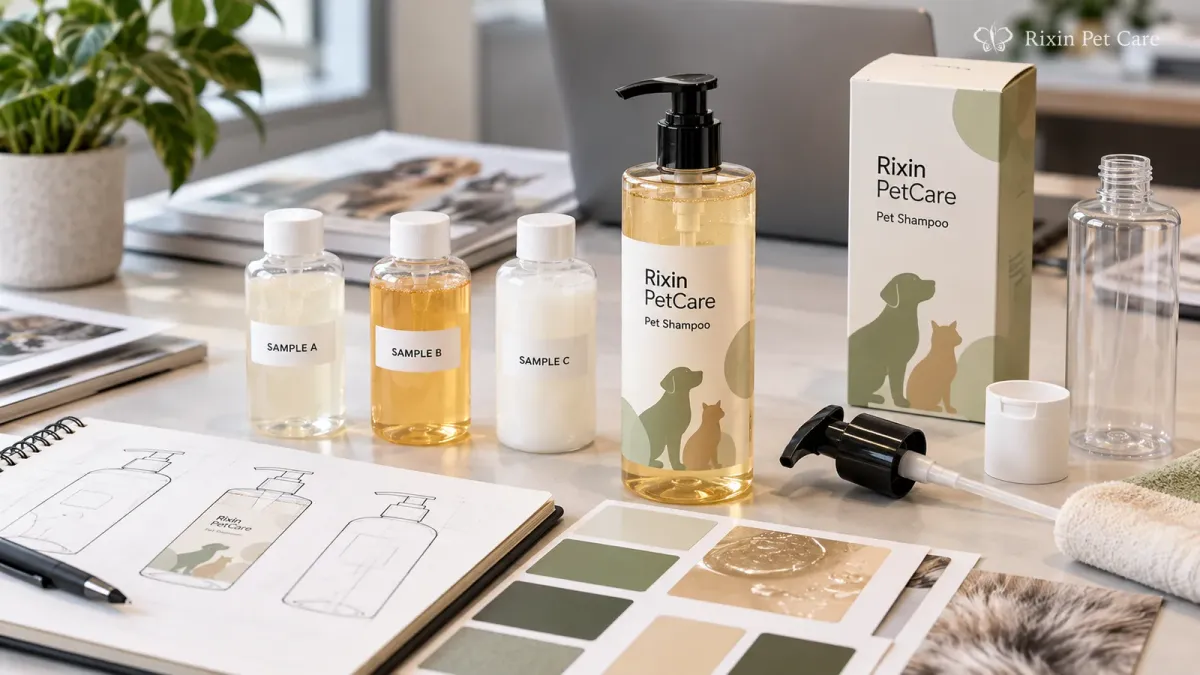
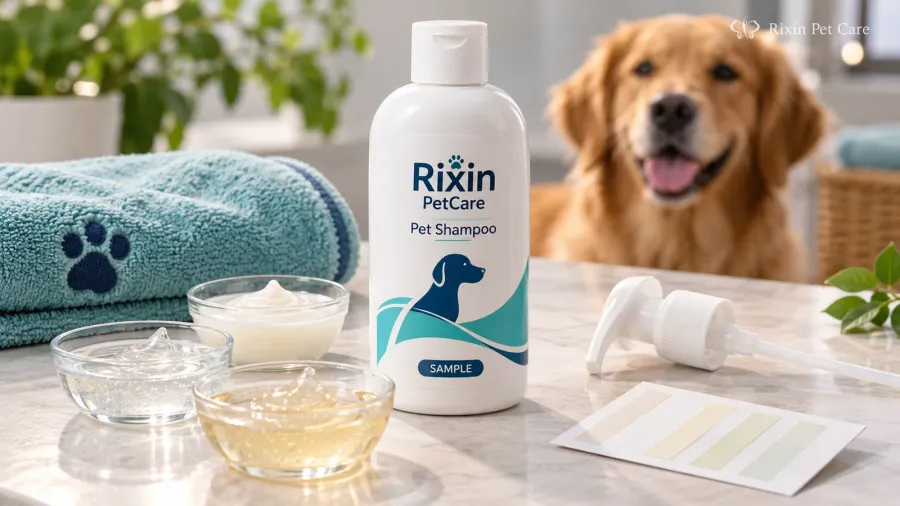
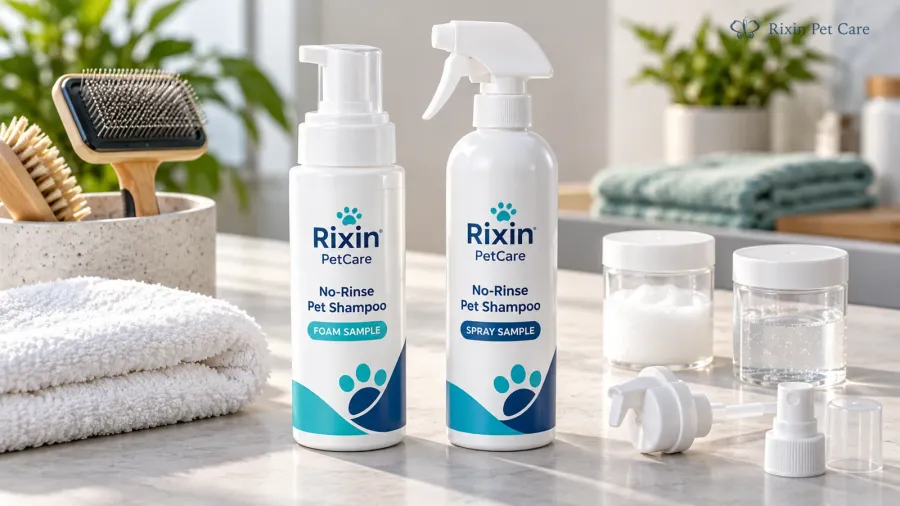
A private label pet shampoo sample should not be approved because it smells good, produces a lot of foam, or looks close to what you expected.
For a B2B product project, the useful question is whether the sample matches the shampoo direction you briefed, works with the intended packaging route, and is clear enough for the project to move to the next stage.
A practical review can be organized around three gates:
- Shampoo experience fit — Does the product behave and feel like the shampoo you intended to develop?
- Formula–packaging fit — Does the current formula work sensibly with the planned dispensing and packaging direction?
- Approval readiness — Is this exact sample version ready to proceed, or does it need revision, resampling, or further review?
This guide focuses specifically on rinse-off private label pet shampoo samples. For the broader process of identifying sample versions, keeping review conditions consistent, recording feedback, and managing approval records across different pet grooming formats, use our private label pet grooming sample evaluation guide.
Start With the Shampoo Direction You Actually Briefed
Before judging the sample, return to the product direction.
A shampoo should be evaluated against its intended project brief, not against a vague idea of what a “good shampoo” should feel like.
For example, a brand may be developing a:
- daily grooming shampoo;
- deodorizing grooming shampoo;
- fragrance-free everyday grooming shampoo; or
- salon or refill shampoo route.
These directions can lead to different priorities for fragrance, foam character, viscosity, rinse behaviour, packaging, and overall grooming experience.
If the brief called for a light everyday grooming shampoo, a very rich texture may not automatically be an improvement. If the project is fragrance-free, a pleasant fragrance is not a positive feature—it is a mismatch with the brief.
Before beginning the review, confirm at least:
- which sample version you received;
- which formula direction it represents;
- which fragrance or fragrance-free direction applies;
- what package or dispenser is being considered;
- what feedback was requested from the buyer;
- what changed from the previous version, if applicable.
If the basic product direction is still unclear, review the available private label pet shampoo manufacturing options before treating the sample as an approval-stage reference.
Quick Answer: Use a Three-Gate Shampoo Sample Review
Evaluate a private label pet shampoo sample in this order:
| Gate | Main Question | Typical Decision |
|---|---|---|
| Gate 1 — Shampoo Experience | Does the shampoo match the intended wash, rinse, fragrance, and coat-feel direction? | Keep or revise the formula direction |
| Gate 2 — Formula + Package | Does the current formula dispense and handle appropriately in the intended package? | Keep, adjust, or review the packaging route |
| Gate 3 — Approval Readiness | Is this exact version ready for the next project stage? | Approve direction, revise, resample, or hold |
The goal is not to give the sample a high score. The goal is to make the next project decision clear.
Gate 1 — Evaluate the Shampoo Experience Against the Brief
Start with the characteristics a buyer can reasonably observe during the agreed sample review.
These observations help the manufacturer understand whether the product is moving toward the intended commercial direction. They are not a substitute for technical testing.
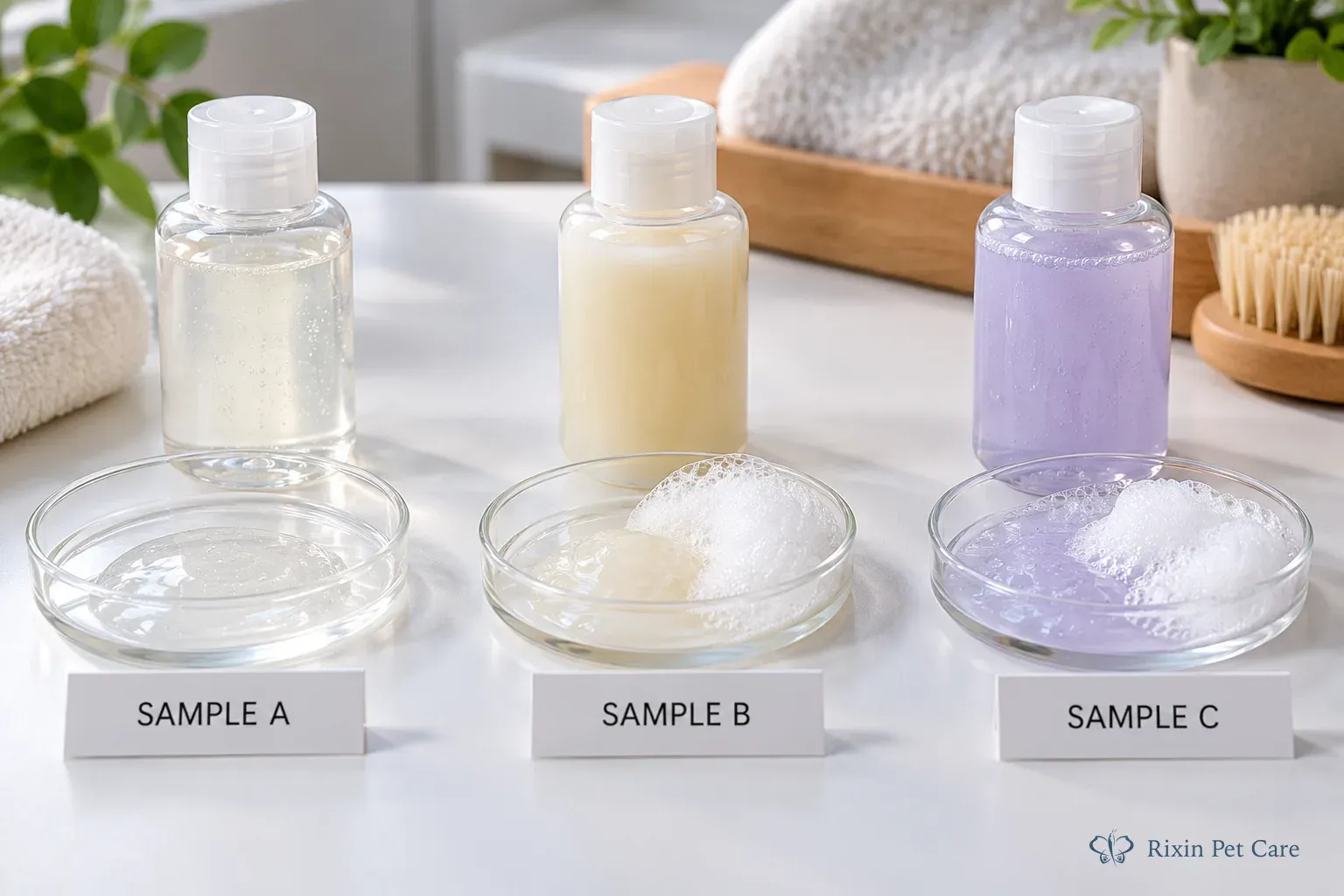
Appearance and Consistency
Look at the sample before use.
Record observations such as:
- clarity or opacity;
- visible separation;
- unexpected particles;
- colour direction, where relevant;
- apparent thickness;
- flow from the sample container.
The useful question is not simply, “Is it thick enough?”
Ask whether the consistency suits the intended shampoo concept and planned dispenser.
Feedback such as:
“The current version pours much slower than the previous sample, and we prefer the easier-flowing direction.”
is more actionable than:
“Make it thinner.”
It tells the development team what changed and which direction the buyer prefers.
Fragrance Direction
Fragrance feedback should also refer back to the brief.
Evaluate:
- fragrance character;
- perceived strength;
- whether it matches the agreed direction;
- how the fragrance changes during the wash experience;
- whether the remaining fragrance after rinsing matches the intended concept.
Avoid vague feedback such as:
“The smell is not premium enough.”
A better comment would be:
“We prefer the lighter fragrance direction of Sample A. Sample B feels too strong for the everyday grooming concept.”
For a fragrance-free project, the evaluation is different. The objective is not to choose the nicest fragrance; it is to confirm whether the sample remains aligned with the fragrance-free direction discussed for the project.
Foam Development and Foam Character
Foam is easy to notice, which is why buyers can give it too much weight.
Instead of asking only whether the shampoo creates “enough foam,” observe:
- how quickly foam develops;
- how easily the shampoo distributes during the wash process;
- whether the foam feels light, dense, loose, or creamy;
- whether the foam direction matches the intended product experience.
Do not use foam volume alone as a proxy for cleansing performance.
A private label shampoo project should be evaluated as a complete product experience, not approved because one sample produces visibly more foam than another.
Useful feedback might be:
“Sample B develops foam more slowly than Sample A under the same review conditions. We prefer the faster initial foam development of Sample A.”
That gives the manufacturer a comparison point rather than an abstract instruction to “increase foam.”
Rinse Behaviour
Rinse experience is especially important for a rinse-off shampoo because the product must be judged beyond initial application.
Where an intended-use wash assessment is appropriate for the project, keep the review conditions as consistent as practical between versions.
Observe:
- whether the shampoo spreads easily;
- whether the foam rinses away as expected;
- whether additional rinsing seems necessary compared with another version;
- whether an obvious residue remains;
- whether the rinse experience matches the intended product direction.
Record comparisons rather than universal conclusions.
For example:
“Under the same review method, Sample C required noticeably more rinsing than Sample B.”
is more useful than:
“Sample C is difficult to rinse.”
Coat After-Feel
The sample review should also include the intended after-feel where this is part of the project brief.
Depending on the shampoo direction, buyers may compare:
- perceived softness;
- coat lightness or heaviness;
- ease of combing or handling;
- visible finish;
- residual fragrance;
- obvious residue after drying.
The goal is not to make therapeutic or veterinary conclusions.
A shampoo sample review can help a buyer describe the grooming experience. It does not, by itself, establish treatment benefits, suitability for a medical condition, long-term safety, or performance claims.
A Practical Shampoo Evaluation Table
Use observations that can lead to a development decision.
| Evaluation Area | What the Buyer Can Observe | More Useful Feedback | What Not to Conclude From the Sample Alone |
|---|---|---|---|
| Fragrance | Character and perceived strength | “Sample B is closer to our lighter everyday fragrance direction.” | Suitable for every pet or sensitivity profile |
| Consistency | Visible flow and apparent thickness | “This version dispenses more slowly than Sample A.” | A formal viscosity specification unless measured |
| Foam | Development and character | “Sample A develops foam faster under the same review conditions.” | More foam means better cleansing |
| Rinse | Relative rinse experience | “Sample C requires more rinsing than the previous version.” | Universal performance under every use condition |
| After-feel | Observable coat feel after the agreed review method | “The dry coat feels heavier than our intended direction.” | Therapeutic or veterinary benefit |
| Dispensing | How the formula leaves the current dispenser | “Product remains around the closure after dispensing.” | Long-term packaging compatibility |
| Package | Handling and visible issues | “We observed leakage after the sample shipment.” | Shelf-life compatibility or transport validation |
This distinction keeps buyer feedback useful without turning a commercial sample review into technical proof it cannot provide.
Gate 2 — Evaluate the Formula and Package Together
A shampoo formula cannot be reviewed in isolation from the package indefinitely.
The formula may feel right while the planned dispenser performs poorly. The bottle may look attractive while the current consistency makes dispensing inconvenient.
Once the project has a packaging direction, evaluate the sample as a formula–package system.
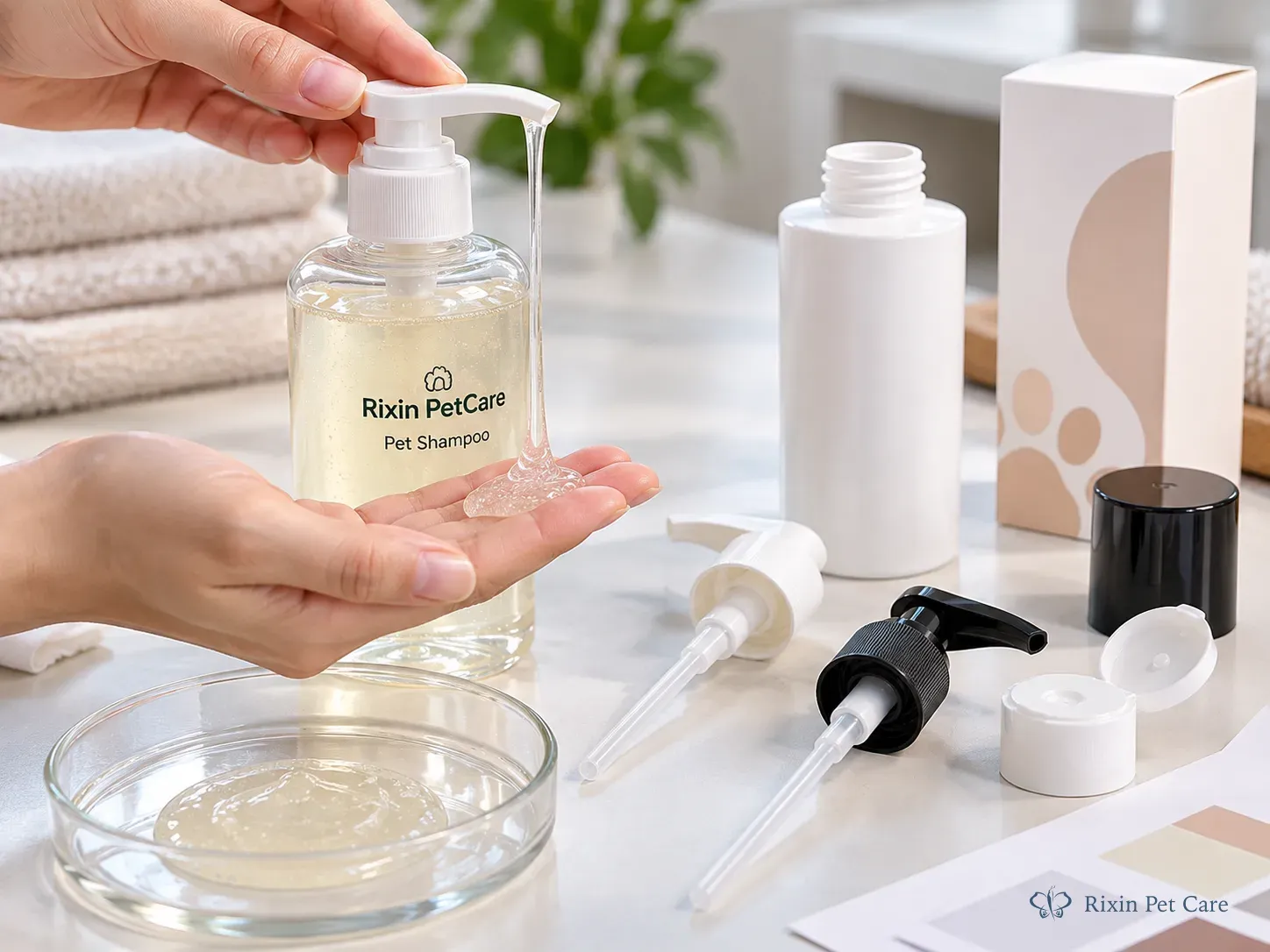
Check Dispensing Behaviour
Review practical questions such as:
- Does the shampoo leave the dispenser cleanly?
- Does the closure become messy after repeated dispensing?
- Is excessive force needed to dispense the product?
- Does the delivered amount feel appropriate for the intended package concept?
- Does the current consistency appear mismatched with the closure or dispensing route?
These are buyer observations.
They are useful inputs for packaging discussion, but they should not be presented as formal compatibility test results.
If formula consistency, closure choice, bottle material, fill configuration, or other package variables are still changing, the packaging decision may need another review after those variables are locked.
RixinPetCare’s packaging and label design support can be used to discuss packaging direction alongside the formula and project brief.
Look for Visible Package Problems
During sample review, buyers can document visible issues such as:
- leakage;
- cap or closure problems;
- product collecting around the dispensing area;
- difficult opening or closing;
- unusual deformation;
- poor handling during normal review.
Visible inspection is not the same as formal formula–packaging compatibility evaluation.
Longer-term stability, compatibility, transport performance, and other technical requirements depend on the actual project scope and the tests or records required for that product.
The important rule is simple:
Observe what happened. Do not turn the observation into a broader technical conclusion than the sample can support.
Turn “I Don’t Like It” Into Manufacturer-Usable Feedback
One of the biggest causes of unnecessary sample rounds is feedback that describes a reaction but not a useful direction.
Instead of:
“The shampoo is too heavy.”
write:
“Compared with Sample A, Sample B feels heavier after drying. We prefer the lighter after-feel of Sample A for the everyday grooming direction.”
Instead of:
“The fragrance is wrong.”
write:
“The current fragrance is stronger than the direction we approved in the previous sample. Please move closer to Sample A.”
Instead of:
“The pump does not work well.”
write:
“The current formula requires noticeably more force to dispense from this pump than the previous sample.”
A useful shampoo feedback note contains four elements:
Observation → Review context → Comparison or reference → Desired direction
For example:
Observation: Foam develops slowly.
Context: The same shampoo amount and review method were used for Samples A and B.
Reference: Sample A develops foam faster.
Desired direction: Move Sample B closer to Sample A’s initial foam behaviour.
This gives the formulation or engineering team something specific to evaluate.
Gate 3 — Decide Whether This Shampoo Direction Is Ready to Move Forward
At this point, keep the decision simple.
| Decision | Use It When |
|---|---|
| Approve direction | The shampoo’s current sensory and use direction is suitable for the project to continue, while clearly recording any items still open |
| Revise | The overall direction is right, but specific shampoo attributes need controlled adjustment |
| Resample | A material change needs another physical review before the project proceeds |
| Hold | A key product, packaging, fragrance, market, or commercial input is still unresolved |
Approval should identify the sample or reference being approved. It should not imply that every later formula change, package change, artwork version, production batch, test, document, or market claim has automatically been approved.
If the formula itself needs further development or revision, review the available pet grooming formula development support.
For the buyer inputs that define what the next shampoo sample should change, see the private label pet shampoo formula customization guide.
If you are comparing samples as part of a broader supplier decision rather than reviewing one established project, the private label pet grooming manufacturer selection guide covers the wider supplier-evaluation questions that do not belong in a shampoo sample review.
What a Shampoo Sample Can Tell You—and What It Cannot
A buyer sample is useful for product-development decisions.
It may help you review:
- product direction;
- appearance;
- fragrance;
- perceived consistency;
- foam and rinse experience;
- after-feel;
- dispensing;
- visible package behaviour;
- comparison between identified versions.
A buyer sample review does not automatically establish:
- microbiological quality;
- stability over the intended shelf life;
- long-term formula–packaging compatibility;
- transport performance;
- regulatory acceptance;
- substantiation for claims;
- suitability for every market;
- conformity of every future production batch.
Those questions require the appropriate project-level review, documentation, specifications, or testing.
This boundary matters because sample approval is one stage of product development, not a substitute for the rest of the development and manufacturing process.
From Sample Approval to the Next Project Stage
Once the shampoo direction is approved, record the approved reference clearly and identify what still needs to happen.
Depending on the project, next steps may include:
- confirming the formula version;
- confirming fragrance or fragrance-free direction;
- confirming bottle, closure, dispensing, and fill configuration;
- finalizing artwork inputs;
- reviewing required documentation and testing scope;
- reviewing market-specific wording or claim questions;
- confirming the final manufacturing proposal and project requirements.
Do not continue changing formula, fragrance, packaging, and artwork independently without recording which version is now current.
If a later change affects an approved reference, decide whether that change needs another sample or another technical review.
For a new shampoo project, you can review RixinPetCare’s private label pet shampoo manufacturing route or request a project proposal with your intended formula direction, packaging concept, quantity, target market, and other known requirements.
Shampoo-Specific Review Record
Before closing the shampoo review, make sure the project record captures the product-specific observations that matter:
- fragrance or fragrance-free direction;
- apparent consistency and flow;
- foam development and character;
- rinse behaviour;
- coat after-feel;
- dispensing behaviour with the current package direction;
- any visible closure, leakage, or handling issue;
- the exact attribute that should remain or change in the next version;
- the shampoo direction being approved, revised, resampled, or held;
- any technical or project questions that remain outside buyer sample approval.
For version-control, review-condition, feedback-record, and general sample-approval procedures across different pet grooming products, use the broader private label pet grooming sample evaluation guide.
Make the Next Shampoo Decision Clear
A useful private label pet shampoo sample review should end with a clear product decision, not just a list of likes and dislikes.
Compare the shampoo with the brief, review its wash and rinse experience, check how the current formula works with the intended package, document specific feedback, and decide whether the product direction should move forward, be revised, be resampled, or be held.
If you are preparing a private label shampoo project, review our private label pet shampoo options and submit your project requirements when you are ready to discuss the next development step.
Ready to Discuss Your Pet Grooming Product Project?
Share your product type, target market, packaging direction, estimated quantity, and any support you need. A rough brief is enough to start a practical next-step discussion.