How to Compare Pet Grooming Manufacturer Quotations
Written by: Rixin Pet Care Editorial Team
Reviewed by: Product Development Team for manufacturing context and claim-risk alignment.
This content is provided for product planning, packaging discussion and claim-risk awareness. It is not veterinary advice, treatment guidance or market authorization.
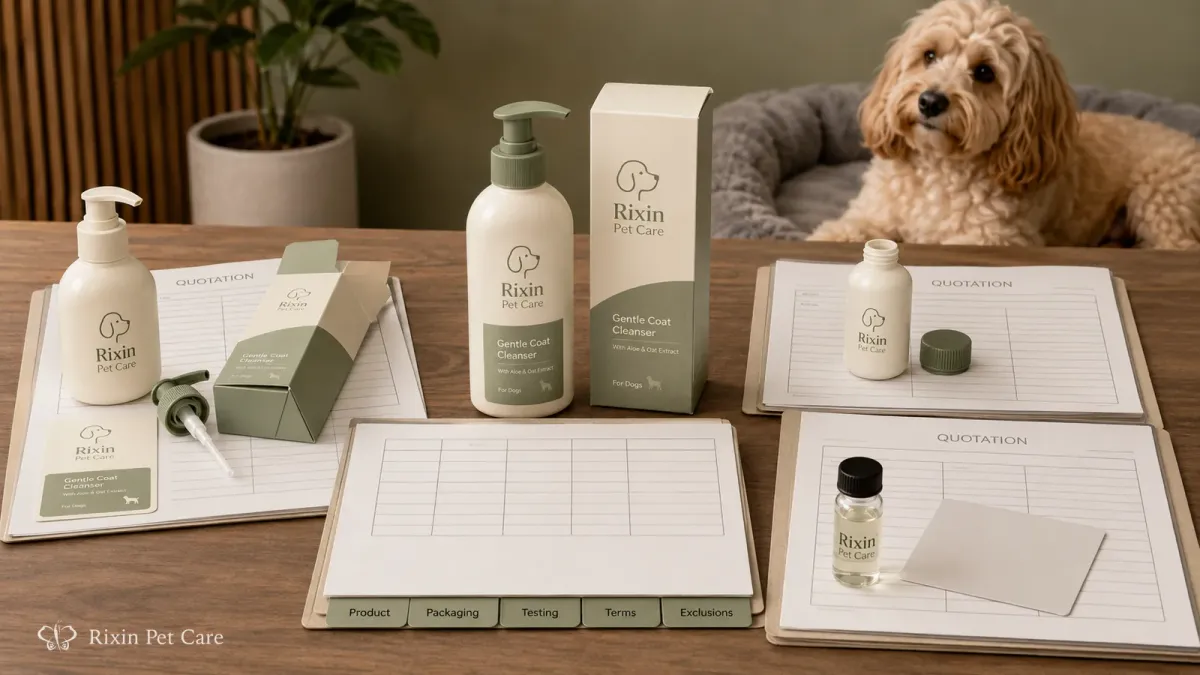
Two pet grooming manufacturer quotations can show different unit prices while describing different products, quantities, packaging, testing, documents, and services.
For private-label pet grooming buyers, a quotation should be compared by scope before it is compared by price. The goal is to have each manufacturer quote the same project scope—or clearly identify every difference.
Use the private label pet grooming products guide for the wider development path.
This content is for product planning, packaging discussion, and claim-risk awareness only. It is not veterinary advice, medical guidance, or market authorization.
Quick Answer: How to Compare Manufacturer Quotations
Use this sequence:
- Send the same product brief to every manufacturer.
- Confirm the exact formula and product scope.
- Compare the same quantity, SKU count, fill size, and price tier.
- List every packaging component.
- Separate one-time charges from recurring unit costs.
- Confirm sample, development, tooling, artwork, and revision scope.
- Confirm included testing and documents.
- Record currency, quotation validity, payment, freight, and delivery assumptions.
- Mark exclusions and buyer-supplied items.
- Request revised or clarified quotations before choosing.
Compare the same project, not only the numbers printed in the unit-price column.
Why Unit Price Alone Is Not Comparable
A unit price is meaningful only when you know exactly what product, packaging, services, and terms it includes.
For example:
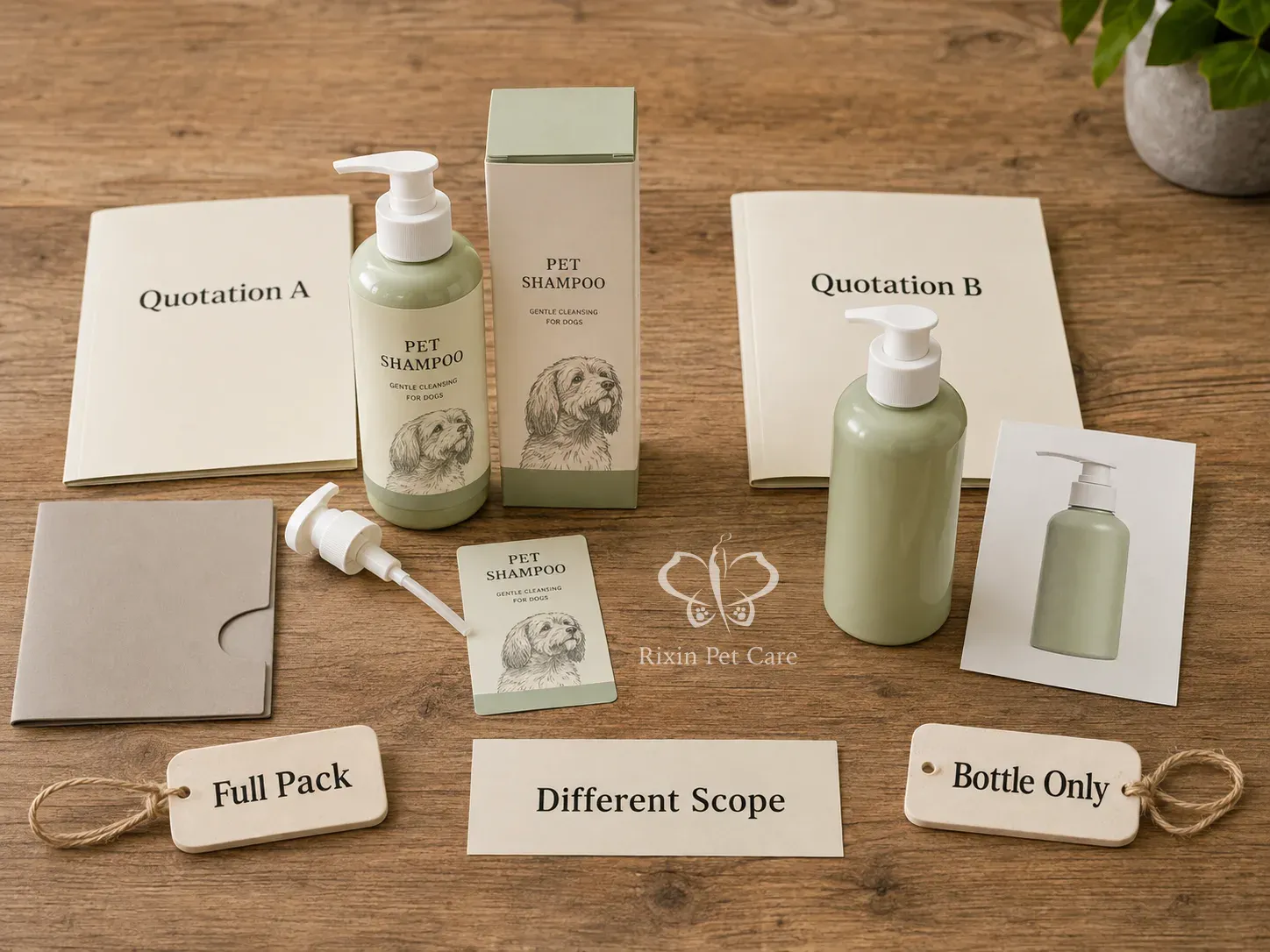
Quotation A includes the bottle, pump, label application, carton,
product specification, and one sample round.

Quotation B includes filled product in a bottle supplied by the buyer.
These quotations do not describe the same deliverable. A direct unit-price comparison would hide the packaging, service, and document differences.
Separate the quotation into:
Unit price
One-time project charges
Optional charges
Excluded costs
Quoted project total
Unresolved cost exposure
The private label pet grooming cost factors guide explains why formula, packaging, quantity, testing, and service choices can change project cost. This article focuses on making those differences visible across quotations.
Start with One Comparison Brief
Every manufacturer should receive the same core requirements.
The comparison brief should identify:
Product type:
Formula route:
Fill size:
Packaging format:
Closure:
Label and carton requirements:
SKU count:
Quantity per SKU:
Target market:
Sample requirements:
Testing questions:
Documentation questions:
Delivery destination or logistics basis:
The pet grooming product brief can provide this baseline.
If one manufacturer quotes a stock formula in standard packaging while another quotes a modified formula with a custom carton, the prices are not directly comparable. First confirm whether the difference was intentional.
Compare Product and Formula Scope
Ask whether each quotation covers:
- an existing private-label formula;
- a modified formula;
- a custom formula;
- bulk product only;
- filled and packed finished units;
- one product or several variants;
- fragrance, color, viscosity, or other requested options;
- the same fill volume or weight;
- the same packaging format.
Also confirm whether formula development, samples, revisions, and approval stages are included.
Two products may share the same category name while using different formula routes, packaging, or development work. The key question is:
Does each quotation describe the same product deliverable?
Normalize Quantity, MOQ, and Price Basis
Record the basis behind every quoted unit price:
Quantity per SKU:
Number of SKUs:
Total units:
MOQ basis:
Price tier:
Unit of measure:
Fill size:
Currency:
Quotation validity:
A quotation based on 2,000 units should not be compared directly with one based on 5,000 units. One supplier may apply MOQ per formula, fragrance, size, or package, while another may show a combined total.
Additional SKUs may also introduce separate setup, artwork, component, or production requirements.
Use the private label pet grooming MOQ guide to review how quantity assumptions affect project planning. For quotation comparison, place every supplier on the same quantity and SKU basis where possible.
Compare Packaging Line by Line
Packaging should be broken into individual components and services.
Check whether the quotation includes:
Bottle, jar, tube, pouch, or wipe pack
Pump, sprayer, foamer, disc top, cap, or other closure
Dip tube or internal component
Label
Printing or decoration
Carton
Insert
Seal or tamper-evident component
Inner packing
Master carton
Divider or protective insert
Assembly
Label application
Coding
Packing
Then ask:
- Is the packaging standard or custom?
- Is printing or decoration included?
- Is the label supplied, printed, and applied?
- Is the carton included and assembled?
- Are packaging freight and storage included?
- Does the quotation assume buyer-supplied components?
- Does the package match the formula and dispensing method?
A quotation may look lower because it excludes a pump, carton, decoration method, or assembly step that another supplier included.
Separate One-Time and Recurring Costs
Do not mix project setup charges with repeat-order costs.
One-time or project charges
These may include:
Formula development
Sample development
Tooling or molds
Printing plates or cylinders
Dielines
Artwork setup
Testing setup
Special component setup
Recurring or order-related costs
These may include:
Bulk formula
Filling
Packaging components
Printing
Labels
Cartons
Assembly
Packing
Inspection
Storage
Freight
Conditional or optional charges
These may include:
Extra sample rounds
Formula revisions
Artwork revisions
Replacement components
Additional documents
Additional testing
Expedited work
A category is not automatically one-time or recurring. Ask each manufacturer to identify how the charge applies and when it may appear again.
Compare Testing and Documentation
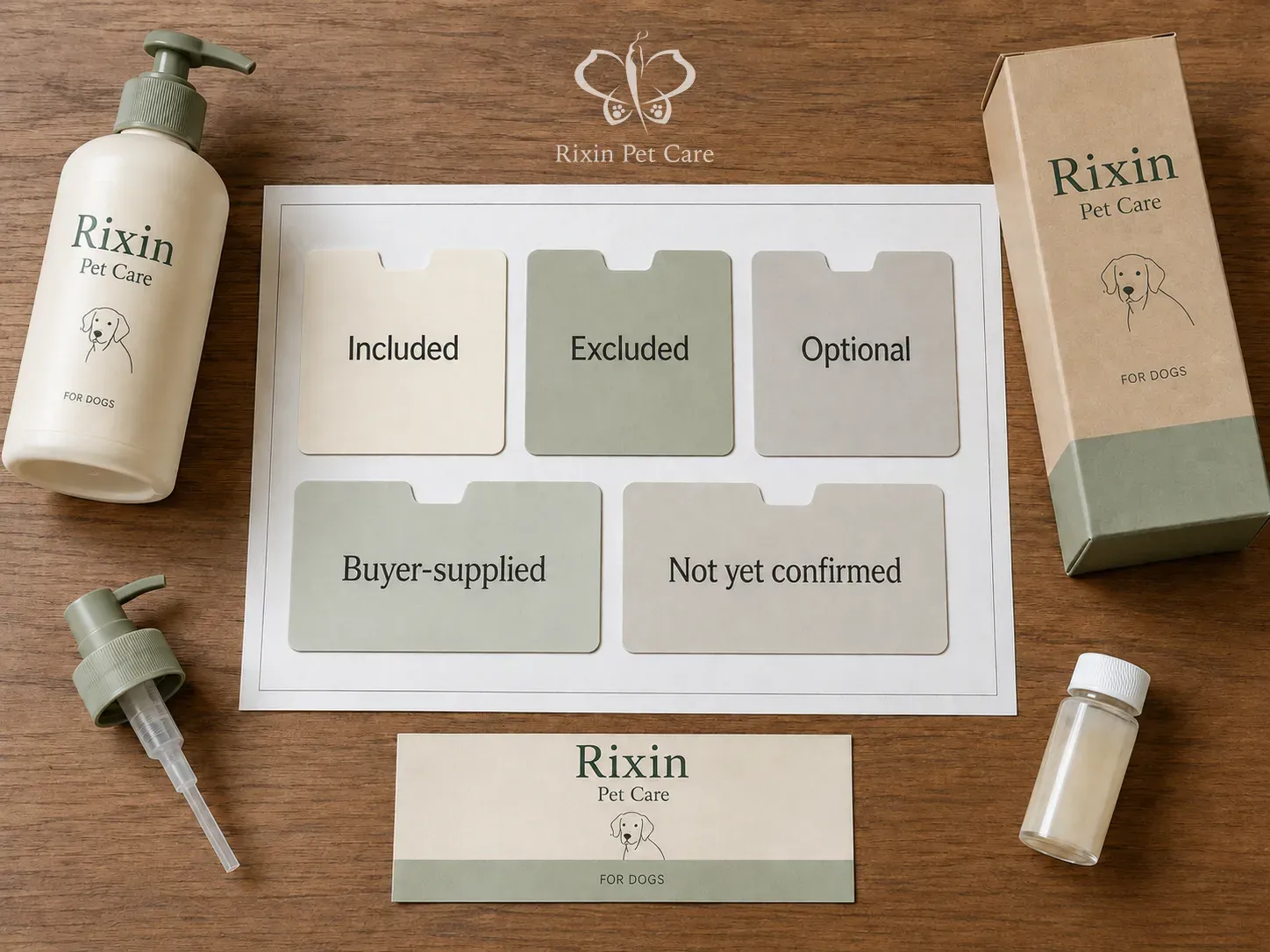
Mark each item as Included, Excluded, Optional, Buyer-supplied, or Not yet confirmed.
Review whether the quotation covers:
Product specification
Formula or ingredient information
SDS where applicable
COA or batch documentation where applicable
Packaging specification
Compatibility work
Stability-related work
Microbiological or other project-specific testing
Label or claim review support
Target-market document preparation
Documentation availability depends on the product, supplier inputs, project, and market. Testing scope should be confirmed rather than assumed.
A listed document also does not automatically establish market authorization. The pet grooming manufacturer documents checklist explains what common records may cover and what they do not prove.
Record Commercial and Logistics Assumptions
A comparable quotation should record:
Currency:
Quotation date:
Quotation-validity period:
Payment schedule:
Deposit requirement:
Balance timing:
Production or delivery basis:
Freight included or excluded:
Insurance included or excluded:
Delivery destination:
Duties and taxes included or excluded:
Storage assumptions:
Order-change conditions:
Cancellation conditions, where stated:
These terms can affect cash requirements, timing, and total project cost even when the unit price remains unchanged.
Do not assume that freight, insurance, duties, taxes, or local delivery are included. Do not compare quotations using different currencies without recording the conversion basis used by the buyer.
Commercial, customs, tax, logistics, and contract questions may require review by the relevant qualified adviser.
Identify Exclusions and Buyer-Supplied Items
Ask each manufacturer to identify what the buyer must provide.
Possible buyer-supplied items include:
- bottles or closures;
- labels or cartons;
- final artwork;
- barcodes;
- translations;
- legal or regulatory review;
- claim evidence;
- shipping accounts;
- import arrangements;
- supplier or market documents.
Use the same five status labels across the comparison:
Included
Excluded
Optional
Buyer-supplied
Not yet confirmed
An item that is not mentioned should not be treated as included.
Normalized Quotation Comparison Template
Complete one copy for each manufacturer, or use these fields as columns in one comparison worksheet. Do not treat a blank or unconfirmed field as included.
PROJECT BASIS
Product:
Formula route:
Fill size:
SKU count:
Quantity per SKU:
Target market:
Delivery destination or logistics basis:
Currency:

PRODUCT AND DEVELOPMENT
Formula included:
Development included:
Sample rounds:
Included revisions:
Additional revision charge:
Approval stage:

PACKAGING
Primary container:
Closure:
Label:
Decoration:
Carton:
Insert:
Seal:
Master carton:
Assembly:
Buyer-supplied items:

PRODUCTION
Bulk formula:
Filling:
Coding:
Label application:
Carton assembly:
Packing:
Inspection:
Storage:

TESTING AND DOCUMENTATION
Product specification:
SDS:
COA or batch record:
Packaging specification:
Compatibility work:
Stability-related work:
Microbiological or other testing:
Label or claim review support:
Other documents:

COMMERCIAL TERMS
Unit price:
Quantity basis:
One-time charges:
Optional charges:
Currency:
Quotation validity:
Payment schedule:
Freight:
Insurance:
Duties and taxes:
Delivery basis:
Production or delivery assumption, if quoted:

OPEN ITEMS
Exclusions:
Unconfirmed items:
Clarification requested:
Quotation revision date:
Decision owner:
This template organizes comparison. It does not calculate total landed cost—the purchase, freight, duty, tax, and local-delivery costs of bringing goods to the buyer—or replace qualified commercial, tax, customs, or logistics review.
Common Mistakes When Comparing Quotations
Avoid these common errors:
- Comparing different quantities or SKU counts.
- Comparing different formula routes.
- Looking only at unit price.
- Treating optional items as included.
- Missing tooling and setup charges.
- Assuming all packaging is included.
- Ignoring sample and revision limits.
- Assuming testing and documents are identical.
- Ignoring buyer-supplied items.
- Ignoring currency, validity, payment, and logistics assumptions.
- Choosing before unresolved questions are answered.
These mistakes usually come from comparing totals before confirming the quoted scope.
Before Choosing a Manufacturer
Send the same clarification table to each shortlisted manufacturer. Ask them to mark every item as Included, Excluded, Optional, Buyer-supplied, or Not yet confirmed.
Compare the quotations only after the material differences are visible.
The strongest quotation is the one whose scope, assumptions, responsibilities, and open items are clear enough for the buyer to compare it confidently.
Ready to Discuss Your Pet Grooming Product Project?
Share your product type, target market, packaging direction, estimated quantity, and any support you need. A rough brief is enough to start a practical next-step discussion.