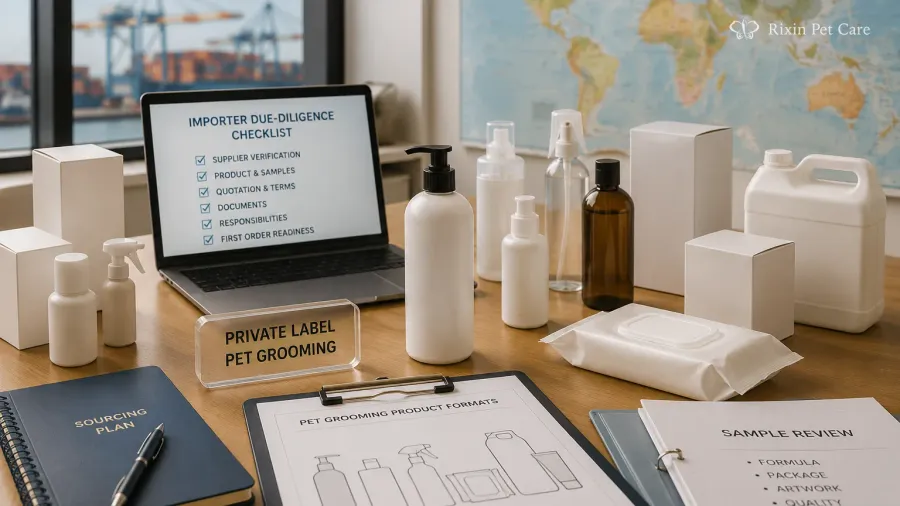
How to Prepare a Pet Grooming Product Brief for a Manufacturer
Written by: Rixin Pet Care Editorial Team
Reviewed by: Product Development Team for manufacturing context and claim-risk alignment.
This content is provided for product planning, packaging discussion and claim-risk awareness. It is not veterinary advice, treatment guidance or market authorization.
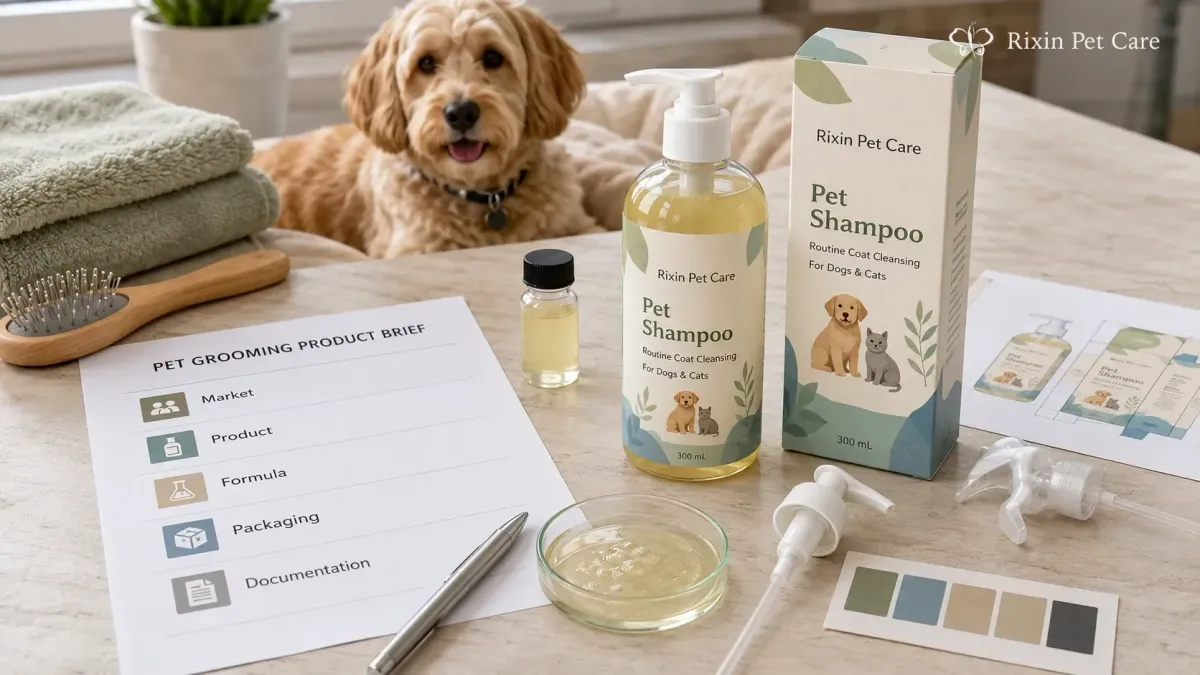
A pet grooming project often starts with a short idea: “I want a gentle dog shampoo,” “I need a waterless grooming spray,” or “I like this benchmark but want a different scent and package.”
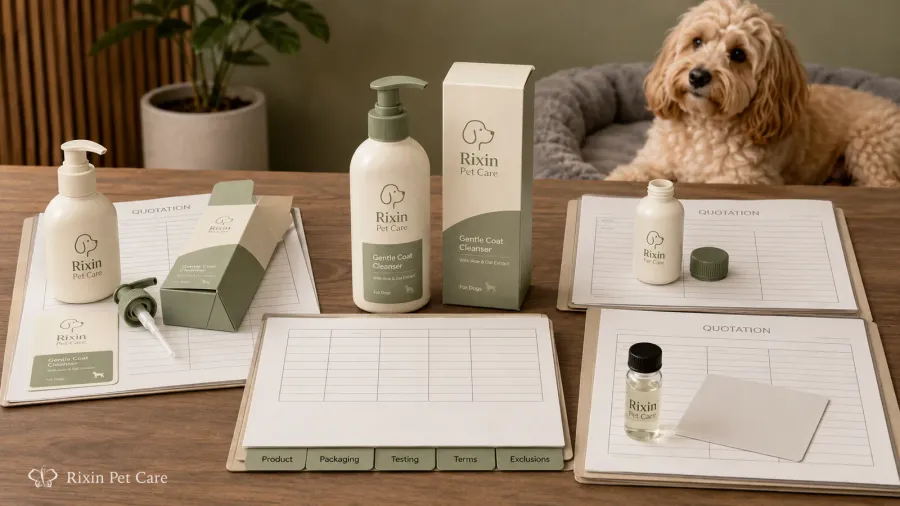
That is enough to start a conversation, but not enough for a manufacturer to recommend the right formula route, packaging, project scope, or quotation basis.
A useful pet grooming product brief converts the idea into five connected parts. The same framework can be used as a private label pet product brief for a mature formula, an adjusted formula, or a more customized OEM project:
Market → Product → Formula → Packaging → Documentation
The brief does not need to be a laboratory specification. It needs to explain what you plan to sell, who it is for, how it should be used, what experience you want, how it may be packaged, and which commercial or market requirements need early review.
For a wider overview of manufacturing routes, sampling, MOQ, supplier evaluation, and launch planning, read the complete guide to private label pet grooming products.
Quick Answer
A strong pet grooming product brief tells the manufacturer where and how the product will be sold, what grooming routine it supports, what formula and sensory direction you prefer, what packaging and quantity you are considering, and which documents or market requirements may affect the project.
You do not need every answer before making contact. Divide the brief into confirmed requirements, preferences, and open questions. This provides direction without presenting early ideas as final specifications.
Why Manufacturers Need a Clear Product Brief
“Pet shampoo” can describe a small DTC bottle, a concentrated salon product, a sensitive skin grooming concept, or the first SKU in a coordinated retail line. Each route can change the formula starting point, sample work, package, fill size, label space, quantity, documents, and quotation scope.
A vague inquiry forces the manufacturer to make assumptions. A clear brief makes the remaining decisions visible.
For example:
- Confirmed requirement: Fragrance-free direction is required.
- Preference: A clear or lightly pearled appearance is preferred.
- Open question: The manufacturer may recommend a pump or disc-top cap.
This distinction helps both parties discuss trade-offs without repeatedly restarting the project.
The Five-Part Pet Grooming Product Brief
| Brief Section | Main Question | Useful Information |
|---|---|---|
| Market | Where, how, and to whom will it be sold? | Country, channel, target customer, price position |
| Product | What grooming routine will it support? | Product type, intended use, target pet, line role |
| Formula | What should it look, smell, dispense, and feel like? | Formula route, scent, texture, foam, rinse, residue |
| Packaging | How should the finished product be presented and used? | Fill size, bottle, pump, sprayer, pouch, label, carton |
| Documentation | What market or buyer review needs must be considered? | Requested files, label wording, channel requirements |
These parts are linked. Viscosity affects dispensing. A fine-mist product needs a suitable sprayer. A retail channel may influence pack size, barcode planning, case packing, and artwork. Proposed wording may influence formula and documentation discussions.

Market and Sales Channel Information
Start with the commercial context. It guides the product route before formula details are discussed.
Target market
Name the first country or region where the product will be sold. Avoid writing only “global” unless a multi-market launch is already planned.
Target market can affect product classification, label elements, safety communication, responsible-party arrangements, public wording, and requested files.
For U.S. planning, the FDA describes products intended solely to cleanse or beautify animals as animal “grooming aids.” Intended use and public wording still require careful review. See the FDA’s Compliance Policy Guide on Animal Grooming Aids.
Primary sales channel
Identify the main channel:
- Amazon or another marketplace
- Direct-to-consumer ecommerce
- Pet retail
- Pet salons and groomers
- Distributor or importer networks
- Subscription or bundled-product programs
A 250 mL ecommerce shampoo has different packaging priorities from a salon refill. A distributor or retailer may also have its own document, barcode, artwork, carton, or case-pack requirements.
Target customer and price position
Replace broad words such as “premium” with useful context:
- Urban dog owners needing between-bath cleanup
- Groomers seeking an easy-rinse back-bar shampoo
- Sensitive skin grooming positioned around mild, low-fragrance care
- A coordinated DTC range designed for bundles
- An accessible product within a defined retail price band
The manufacturer does not need your full business plan. It needs enough context to avoid proposing a product that conflicts with the channel or price architecture.
Product Type and Intended Grooming Routine
State both the format and its role in the routine.
Define the product type
Examples include:
- Rinse-off pet shampoo
- Waterless grooming spray
- Grooming wipes
- Paw cleanser
- Coat deodorizing spray
- Detangling or conditioning spray
- Routine ear cleaner
- Eye-area cleansing product
- Sensitive skin hygiene spray
- Salon or refill shampoo
For a shampoo project, review the available product decisions on the private label pet shampoo page.
Explain the intended grooming use
Describe what the customer will do with the product:
- Regular bath-time cleansing
- Between-bath coat freshening
- Paw cleanup after walks
- Routine outer-ear cleaning
- Eye-area cleansing to help remove visible stains
- Salon back-bar use with a related retail product
Keep the wording close to grooming, cleansing, deodorizing, daily hygiene, and skin and coat care. When a proposed position goes beyond ordinary grooming, mark it for market-specific assessment rather than treating it as an approved claim.
Define the target pet and use boundaries
Include what is already known:
- Dogs, cats, or both
- Home use, professional use, or both
- Expected use frequency
- Relevant coat type or grooming context
- Areas where the product will be applied
“Dogs first; cat suitability to be reviewed” is more useful than making an unsupported all-pets statement.
Formula and Sensory Direction
Most buyers do not need to provide a finished ingredient list. They do need to explain the desired experience.
Select a formula starting point
State which route is closest to the project:
- Existing or mature formula direction is acceptable
- Mature formula with selected adjustments
- Benchmark-led development
- Buyer-owned formula or specification
- More customized formula direction
- Open to manufacturer recommendation
This helps separate a faster private label route from deeper OEM work. The route can be refined after review.
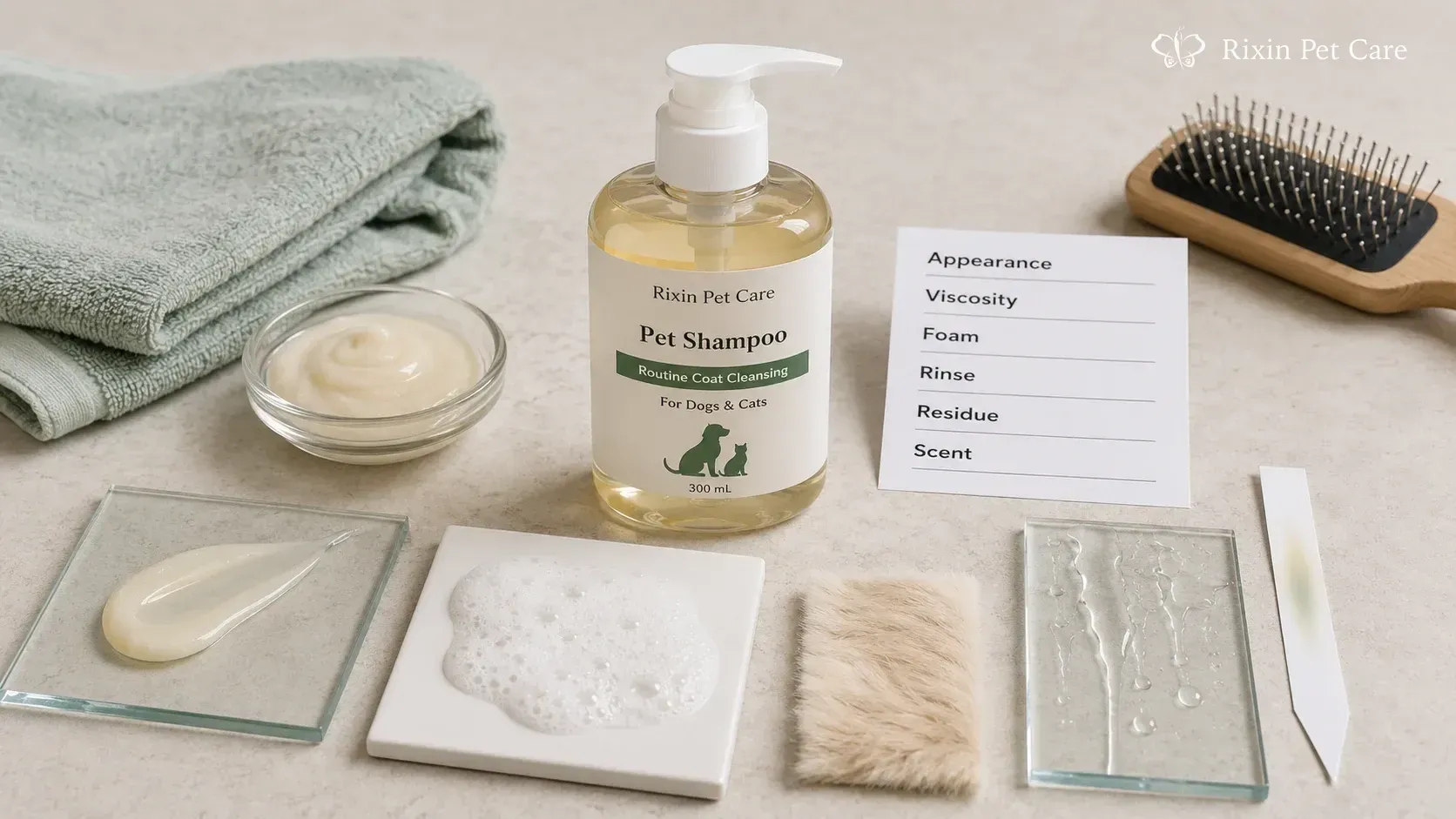
Use observable sensory descriptions
Replace “luxurious,” “natural,” or “better” with features that can be sampled.
For a pet shampoo product brief, describe:
- Clear, pearly, opaque, gel, or creamy appearance
- Low, medium, or higher viscosity
- Low, moderate, or rich foam
- Faster or more controlled rinse
- Light or fuller coat after-feel
- Low-residue finish
- Fragrance-free, lightly scented, or named scent direction
For sprays, add spray pattern, drying preference, residue, and scent strength. For wipes, add sheet size, thickness, softness, moisture level, count, and pack style.

Ingredients to consider or avoid
Separate commercial preference from technical requirement. You may list an ingredient story, a retailer restriction list, a fragrance-free requirement, or materials excluded by brand policy.
Do not assume that adding a popular ingredient automatically supports a consumer claim. Formula feasibility, ingredient level, product format, evidence, target market, and final wording should be reviewed together.
The FTC states that objective express and implied advertising claims should have a reasonable basis. See the FTC Policy Statement Regarding Advertising Substantiation.
Packaging and Fill-Size Direction
Packaging is part of the product experience, not a decoration decision added at the end.
State the preferred fill size
Provide one preferred size or a short range, such as:
- 100 mL travel spray
- 250 mL or 300 mL retail shampoo
- 500 mL family size
- 1 L professional size
- Larger refill or salon format
- 40-count or 80-count wipes
Fill size affects shipping weight, label space, pack dimensions, unit economics, and channel fit.
Describe the package by function
You can provide direction without knowing the exact supplier code:
- PET bottle with disc-top cap
- Pump bottle for controlled dispensing
- Fine-mist or trigger spray bottle
- Foam pump
- Wipes pouch with resealable label or flip-top lid
- Bottle plus printed carton
- Refill pouch or salon container
Also note ecommerce leakage concerns, tamper-evident preferences, one-hand dispensing, clear or opaque material, and whether the product should match an existing brand family.
Mark packaging details as required, preferred, or open to recommendation. The formula and package should later be reviewed together for dispensing, sealing, label material, storage, transport, and compatibility.
Quantity, Budget and Launch Timing
A manufacturer needs a realistic range, not a guaranteed forecast.
Estimated quantity per SKU
Provide an estimate for each SKU rather than one combined total:
- Shampoo: 2,000–3,000 units
- Waterless spray: approximately 2,000 units
- Two-SKU launch, with the split open to component minimums
Quantities may be affected by formula batch size, bottles, closures, labels, cartons, decoration, and wipes packaging. Keep detailed MOQ analysis for a separate discussion.
Budget direction
Budget is optional at first contact, but a target can prevent unsuitable proposals. You may provide:
- Target ex-factory unit-cost range, with scope stated
- Total first-order product budget
- Intended retail price and margin structure
- Request for standard and upgraded package options
- “Budget not confirmed; first need feasible route options”
State which priority matters most. The lowest quantity, lowest price, fully custom formula, custom packaging, extensive documents, and shortest timing may not be achievable in the same route.
Target launch date
State the desired market launch date and any fixed milestone, such as a retailer review, trade show, photography date, or seasonal campaign.
Remember that launch timing may include brief review, formula work, samples, buyer feedback, packaging, artwork, agreed testing, documents, production, freight, customs, receiving, photography, and listings.
“Target retail launch: October; artwork needed by July” is more useful than “urgent.”
Documentation and Target-Market Requirements
Do not write “all certificates required.” Name the files or reviews requested by your importer, retailer, distributor, warehouse, marketplace, or internal quality team.
Depending on the project, discussions may include:
- Safety Data Sheet (SDS)
- Certificate of Analysis (COA)
- Product specification
- Ingredient information
- Stability information or testing support
- Microbial testing support
- Preservative challenge testing support where applicable
- Packaging compatibility review or records
- Batch or production documents
- Label-ready product information
- US GHS or EU CLP review where applicable
- Market-specific claim and wording review
- Facility or quality-system documents requested by the buyer
These documents serve different purposes and may not all be applicable, included, or available in the same form. Confirm whether each document is formula-specific, batch-specific, supplier-issued, laboratory-issued, or intended for a particular supply-chain use.
OSHA’s Hazard Communication resources explain the role of classification, labels, and safety data sheets in U.S. workplace hazard communication. ECHA provides official support for mixture classification under the EU CLP framework. Exact obligations should be reviewed for the finished formula, target market, intended use, and responsible parties.
Include wording under consideration
Share proposed product names, front-label phrases, ecommerce statements, and key selling points early, even when they are not final.
| Proposed Wording | Status | Next Step |
|---|---|---|
| Daily Skin & Coat Hygiene | Preferred | Review against final product direction |
| Helps Remove Dirt and Odor | Under consideration | Confirm formula and wording support |
| Fragrance-Free Option | Required if selected | Confirm final fragrance route and label accuracy |
This makes it easier to align the formula, supporting information, label, packaging, and product-page language before artwork is printed.
How to Use a Benchmark Product
A benchmark is useful when it explains your preferences. It is not useful when the instruction is only “copy this.”
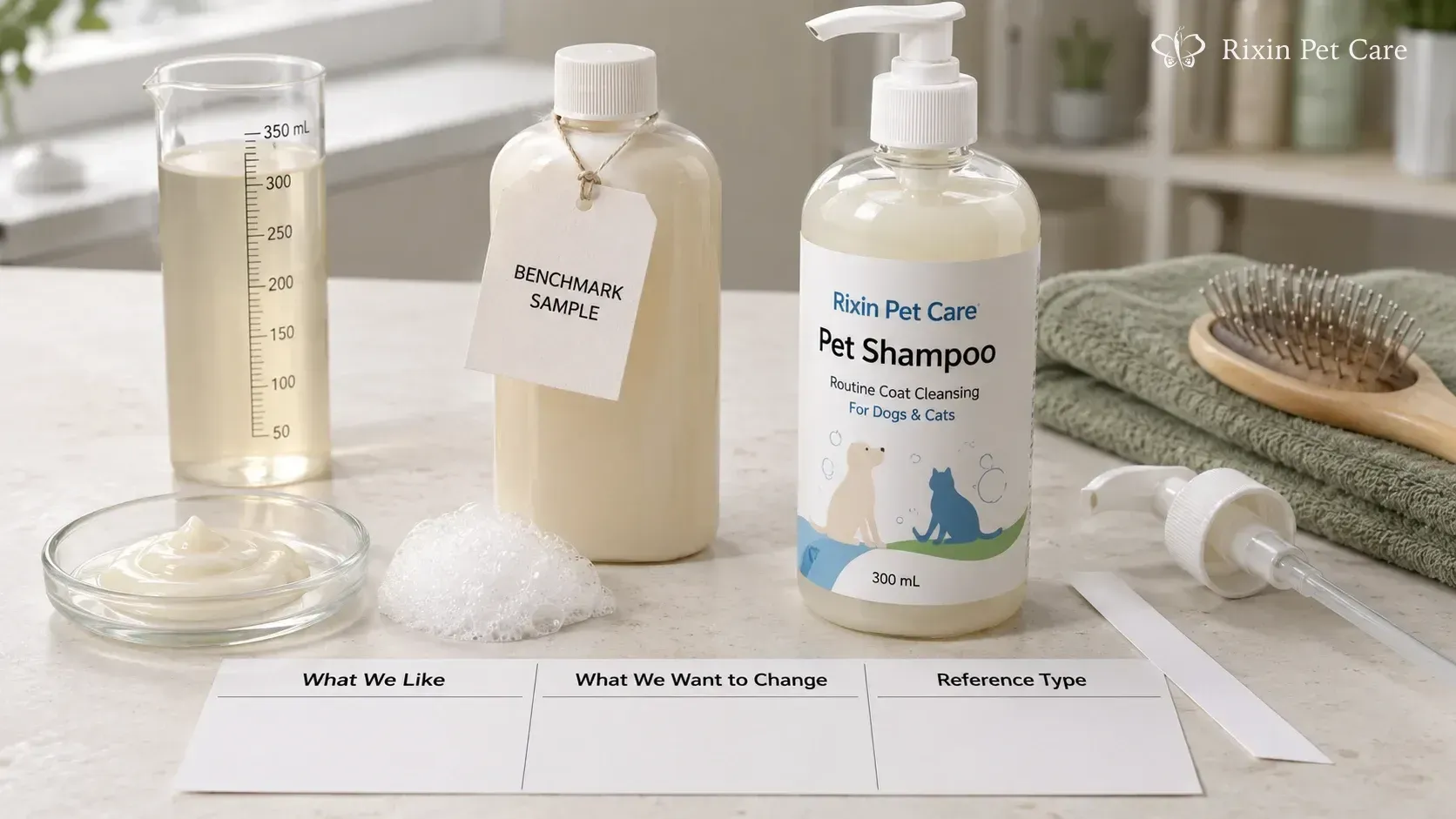
For each benchmark, record:
- Product name and market
- Format and fill size
- What you like
- What you dislike
- Which features are essential
- Which features should be different
- Whether it is a formula, sensory, packaging, price, or branding reference
Example:
We like the benchmark’s medium viscosity, easy spreading, light foam, and fast rinse. We want a softer scent, less color, a lower-residue finish, and a 300 mL pump package. It is a sensory reference, not a request to duplicate the formula or branding.
One product may guide texture, another the bottle, and another the retail position. Label each reference clearly. Photos should show the front, back, closure, dispensing method, and size where possible.

Required Information vs Optional Information
| Information | First-Brief Status | Notes |
|---|---|---|
| Brand or company | Required | A working name is acceptable |
| Target market | Required | Name the first launch market |
| Primary sales channel | Required | Choose the main channel |
| Product type and intended use | Required | State format and grooming routine |
| Estimated quantity per SKU | Required | A range is acceptable |
| Target launch timing | Required | State the date or milestone |
| Formula starting point | Preferred | Existing, adjusted, benchmark-led, custom, or open |
| Sensory direction | Preferred | Use observable descriptions |
| Fill size and package direction | Preferred | A range or reference is acceptable |
| Required documents | Required when known | Name the requester and purpose |
| Exact ingredient percentages | Optional | Usually unnecessary unless buyer-controlled |
| Final package code and artwork | Optional | Can follow development review |
| Final claims | Optional | Share proposed wording as under consideration |
| Final budget | Optional | A target range improves recommendations |
A practical rule is:
- Tell the manufacturer what must not change.
- Describe what you prefer.
- List what you want the manufacturer to recommend.
Copyable Pet Grooming Product Brief Template
This private label product brief template can be copied into an email, shared document, proposal form, or internal planning file. Write “open to recommendation” where an answer is not yet known.
PET GROOMING PRODUCT BRIEF
1. BRAND AND MARKET
Brand or company:
Website, if available:
Target market or countries:
Primary sales channel:
Target customer:
Expected retail price or market position:
2. PRODUCT DIRECTION
Product type:
Working product name:
Target pet: Dogs / Cats / Both / To be reviewed
Intended grooming use:
Rinse-off / Leave-on / Waterless / Wipes / Other:
Expected use frequency:
Role in the product line: Hero SKU / Add-on / Bundle / Salon use / Other
3. FORMULA AND SENSORY DIRECTION
Formula starting point: Existing / Adjusted / Benchmark-led / Custom / Open to recommendation
Appearance or color direction:
Texture and viscosity:
Foam or spread preference:
Rinse preference:
Residue and coat after-feel preference:
Scent direction:
Ingredients to consider:
Ingredients or materials to avoid:
Other formula requirements:
4. BENCHMARK PRODUCT
Benchmark product name and link:
What we like:
What we want to change:
Reference type: Formula / Sensory / Packaging / Price / Branding
Physical sample available: Yes / No
5. PACKAGING
Preferred fill size:
Bottle, pouch, jar, wipes pack, refill, or salon format:
Preferred closure, pump, sprayer, cap, or lid:
Label only or label plus carton:
Color, material, or visual direction:
Ecommerce, leakage, tamper-evidence, or shipping requirements:
Existing package or brand family to match:
Open packaging questions:
6. COMMERCIAL INFORMATION
Estimated quantity per SKU:
Number of SKUs:
Budget or target unit-cost direction, if available:
Target launch date:
Fixed milestones, retailer reviews, trade shows, or campaign dates:
7. DOCUMENTATION AND WORDING
Required documents:
Who requested them and for what purpose?
Target-market label or classification review needed:
Claims or wording under consideration:
Retailer, distributor, marketplace, or internal quality requirements:
8. PRIORITIES AND OPEN QUESTIONS
Non-negotiable requirements:
Preferred but flexible features:
Open questions for the manufacturer:
Additional notes:What Happens After the Brief Is Submitted
A product brief starts project definition. It does not automatically approve every request.
A manufacturer may then:
- Confirm the market, product format, cooperation route, quantity, and channel.
- Separate fixed requirements from flexible preferences.
- Recommend a formula starting point or sample route.
- Review fill size, dispensing, component availability, artwork, and shipping needs.
- Identify which documents and wording questions require further review.
- Define the next step: revised brief, sample plan, packaging proposal, or quotation based on a stated scope.
The private label pet grooming process explains how a project can move from brief review through formula, sample, specification, and production preparation.
A strong brief may lead to more questions. That does not mean the brief failed. It means the remaining decisions are specific enough to resolve.
Frequently Asked Questions
Do I need a complete formula before contacting a manufacturer?
No. You can start with a mature formula direction, benchmark, ingredient preference, sensory target, buyer-owned specification, or request for manufacturer recommendations.
Can I send only a benchmark product?
A benchmark should be accompanied by notes on what you like, what should change, the target market, package size, quantity, and sales channel.
How detailed should a pet shampoo product brief be?
Define the market, channel, intended grooming use, target pet, formula route, scent, viscosity, foam and rinse preferences, fill size, package direction, quantity, documents, benchmark, and launch target.
What if I have not selected packaging?
Share the fill-size range, dispensing method, visual references, shipping needs, and non-negotiable features. Mark the exact component as open to recommendation.
Should I include a budget?
It is not mandatory, but a realistic target helps the manufacturer compare standard, adjusted, and more customized routes. State what the budget is expected to include.
Should proposed claims be included before the formula is final?
Yes. Mark them as under consideration so the intended use, formula, evidence, packaging, label, and product-page wording can be reviewed together.
Is a product brief the same as a final specification?
No. The brief defines the commercial and product target. A final specification normally follows formula, sample, packaging, quality, and document confirmation.
Can one brief cover several products?
Use one shared brand-and-market section, then create a separate product section for each SKU. This prevents different formats from being combined into an unclear request.
Prepare the Information You Already Know
You do not need to resolve every formula, packaging, or documentation question before contacting a manufacturer. You do need to present the current project clearly enough for the next decision to be useful.
Prepare your project brief and share the information you already know. Mark firm requirements, flexible preferences, and open questions so the proposed route reflects your market, product, packaging, quantity, and launch priorities.
External References
- U.S. Food and Drug Administration: CPG Sec. 653.100 Animal Grooming Aids
- Federal Trade Commission: Policy Statement Regarding Advertising Substantiation
- Occupational Safety and Health Administration: Hazard Communication
- European Chemicals Agency: Mixture Classification Under CLP
Ready to Discuss Your Pet Grooming Product Project?
Share your product type, target market, packaging direction, estimated quantity, and any support you need. A rough brief is enough to start a practical next-step discussion.