How to Choose a Private Label Pet Grooming Manufacturer
Written by: Rixin Pet Care Editorial Team
Reviewed by: Product Development Team for manufacturing context and claim-risk alignment.
This content is provided for product planning, packaging discussion and claim-risk awareness. It is not veterinary advice, treatment guidance or market authorization.
A low MOQ, broad product list, or long certificate list does not prove that a manufacturer fits your project.
Choose the supplier whose relevant experience, evidence, commercial terms, and responsibilities fit the product you intend to launch. The goal is not to find a universally “best” factory. It is to identify which suppliers can support the defined formula, packaging, quantity, market, and approval process with clear evidence and workable responsibilities.
For the wider launch framework, read the complete private label pet grooming products guide.
This content is for product planning, packaging discussion, supplier comparison, documentation preparation, and claim-risk awareness only. It is not veterinary advice, medical guidance, legal advice, or market authorization.
Quick Answer
Use this sequence:
- Define the project.
- Apply pass/fail gate checks.
- Review relevant product and route experience.
- Check formula, packaging, and sample coordination.
- Verify facility, process, and batch evidence.
- Compare commercial terms on the same scope.
- Assess communication and responsibility.
- Score only the suppliers that pass the gates.
- Resolve open questions before final selection.
A low price should not compensate for a failed critical gate.
Define the Project Before Comparing Suppliers
A manufacturer suitable for an established shampoo formula may not fit custom wipes, a foam cleanser, a fine-mist spray, or a multi-SKU retail line.
Give each supplier the same project scope:
- target market and main sales channel;
- product type and intended grooming use;
- formula starting point;
- packaging and dispensing direction;
- estimated quantity per SKU;
- required sample and review process;
- requested documents or evidence;
- target launch window;
- confirmed requirements, preferences, and open questions.
The pet grooming product brief template provides a structured format.
Do not compare suppliers while each one is responding to a different project.
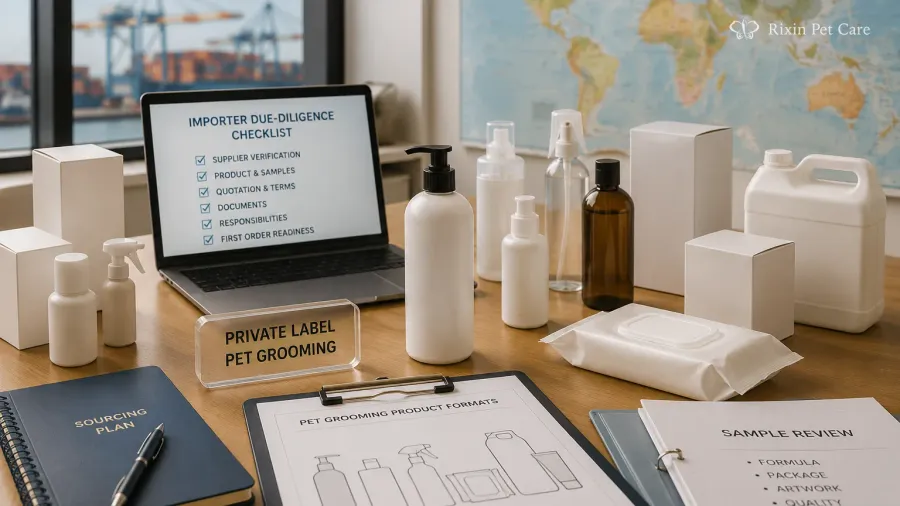
Once a supplier is a serious candidate, the China sourcing due-diligence checklist helps verify the specific entity, quotation, sample, documents, and responsibilities before a first commercial order.
Use Gate Checks First
A gate is a requirement that must be satisfied before detailed scoring is worthwhile.
Confirm:
- Can the supplier make or coordinate the required product format?
- Can it support the selected manufacturing and formula route?
- Can the proposed package work with the product and sales channel?
- Is the sample and approval process usable?
- Are major quotation inclusions and exclusions visible?
- Can facility, certificate, process, and document claims be verified?
- Can responsibilities be confirmed before production?
A supplier that fails a project-critical gate should not remain the preferred option because it offers the lowest unit price or fastest response.
Check Relevant Product and Route Experience
“Pet grooming experience” is too broad. Ask for experience relevant to the actual format and route.
A shampoo project may involve viscosity, foam, rinse, and closure selection. A spray adds output, leakage, and residue questions. A foam product depends on pump performance. Wipes require coordination among formula, substrate, liquid load, pouch, and seal.
Confirm:
- which similar formats the supplier has handled;
- which steps are completed in-house;
- which work uses outside partners;
- who manages outsourced handoffs;
- whether the route supports the requested level of customization;
- what must be supplied or approved by the buyer.
Manufacturing terms are used differently across suppliers. Compare the actual work rather than the labels. See Private Label vs White Label vs OEM Pet Products.
Outsourcing is not automatically a problem. Unclear control and responsibility are.
Review Formula, Packaging, and Samples as One Process
A manufacturer should not treat formula, packaging, and sampling as unrelated activities.

Look for a process that connects:
Formula properties → dispensing → closure → leakage or sealing → artwork space → packing and shipping → user experience
Ask how the supplier:
- reviews packaging against viscosity and application;
- distinguishes stock, special-order, and custom components;
- records the approved formula and package versions;
- manages sample identification and buyer feedback;
- explains revision limits, fees, and timing effects;
- confirms the final sample and pre-production specification;
- handles differences between a small sample and bulk scale.
A good first sample is useful evidence, but it does not prove that production, packaging, documentation, or change control will be managed well. Detailed sample feel, appearance, scent, and performance scoring belongs in a separate sample-evaluation process.
Verify Evidence, Not General Claims
Do not ask only whether the factory makes “high-quality products.” Ask what evidence applies to the legal entity, manufacturing site, process, product, and batch.
Company and facility
Confirm:
- legal company name;
- manufacturing-site name and address;
- which entity appears on the quotation and contract;
- which site makes and fills the product;
- which operations are outsourced.
Certificates and quality systems
For any certificate, check:
- facility name and address;
- referenced standard;
- scope;
- issuing or certification organization;
- issue and expiry dates;
- verification route;
- relevance to the actual manufacturing site.
A facility certificate is not a general product approval. For example, ISO 22716 provides guidelines for cosmetic production, control, storage, and shipment, but buyers still need to verify the certificate’s scope and validity.
Process and batch controls
Relevant evidence may include incoming-material checks, batch records, in-process controls, filling and packaging checks, date or batch coding, traceability, finished-product inspection, retention samples, deviations, and change control.
The objective is to understand how an approved formula and package become an identifiable finished batch.
Keep Document and Claim Support Project-Specific
“Documents available” is not enough.
Ask which records can be provided, what formula or batch they cover, who issues them, when they become available, and whether they are included in the quotation.
The required scope depends on the product, intended grooming use, target market, importer, retailer, marketplace, and proposed wording. Manufacturer support should not be presented as automatic market approval.
Keep this section at supplier-selection level. A dedicated documents guide should own the detailed document checklist, while a label and claims guide should own buyer preparation for wording review.
Compare Commercial Fit on the Same Scope
A technically capable manufacturer may still be a poor commercial fit.
Confirm:
- MOQ basis by formula, fragrance, size, package, artwork, or SKU;
- handling of unused packaging and printed materials;
- sample rounds and development charges;
- production start conditions;
- quoted timeline and excluded stages;
- formula, filling, packaging, printing, testing, documents, inspection, and freight inclusions;
- payment terms and quotation validity;
- reorder MOQ, component continuity, and stored-material conditions;
- ownership of artwork, tooling, specifications, and buyer-supplied information.
A cost may remain pending when the scope is incomplete. The supplier should identify it as pending rather than presenting an assumption as a complete price.
Use the MOQ guide, cost and quotation guide, and development timeline guide for the detailed mechanics.
Assess Communication and Responsibility
Fast replies are helpful, but response speed alone does not prove good project management.
Stronger communication:
- identifies missing information;
- explains assumptions;
- records formula, sample, packaging, and artwork versions;
- defines inclusions and exclusions;
- assigns responsibility;
- explains how changes affect MOQ, cost, timing, or documents;
- confirms what must happen before the next stage.
| Weak response | Stronger response |
|---|---|
| “Yes, we can do it.” | Defines the route, assumptions, and open decisions |
| “MOQ is 2,000.” | Explains what the MOQ applies to |
| “Lead time is 30 days.” | Defines the start condition and excluded stages |
| “Documents are available.” | Lists the record, issuer, timing, and scope |
| “Packaging is no problem.” | Reviews formula, closure, leakage, and sourcing |
A supplier that pauses to verify a pump, document, wording request, or production condition may be more dependable than one that immediately agrees to everything.
Use an Evidence-Based Scorecard
Score only suppliers that pass the critical gates.
| Dimension | Weight |
|---|---|
| Product and Route Fit | 20% |
| Formula and Packaging Fit | 20% |
| Quality and Evidence Fit | 20% |
| Sampling and Change Control | 15% |
| Commercial and Operational Fit | 15% |
| Communication and Responsibility Fit | 10% |
Use a five-point scale:
- 1 — Poor fit
- 2 — Significant gaps
- 3 — Possible fit with open questions
- 4 — Strong fit with usable evidence
- 5 — Strong fit with clear evidence and responsibilities
Record the evidence and unresolved question beside every score.
Dimension: Formula and Packaging Fit
Evidence reviewed: Bottle and pump options, viscosity range, sample packaging record
Open question: Compatibility scope before bulk approval
Score: 4/5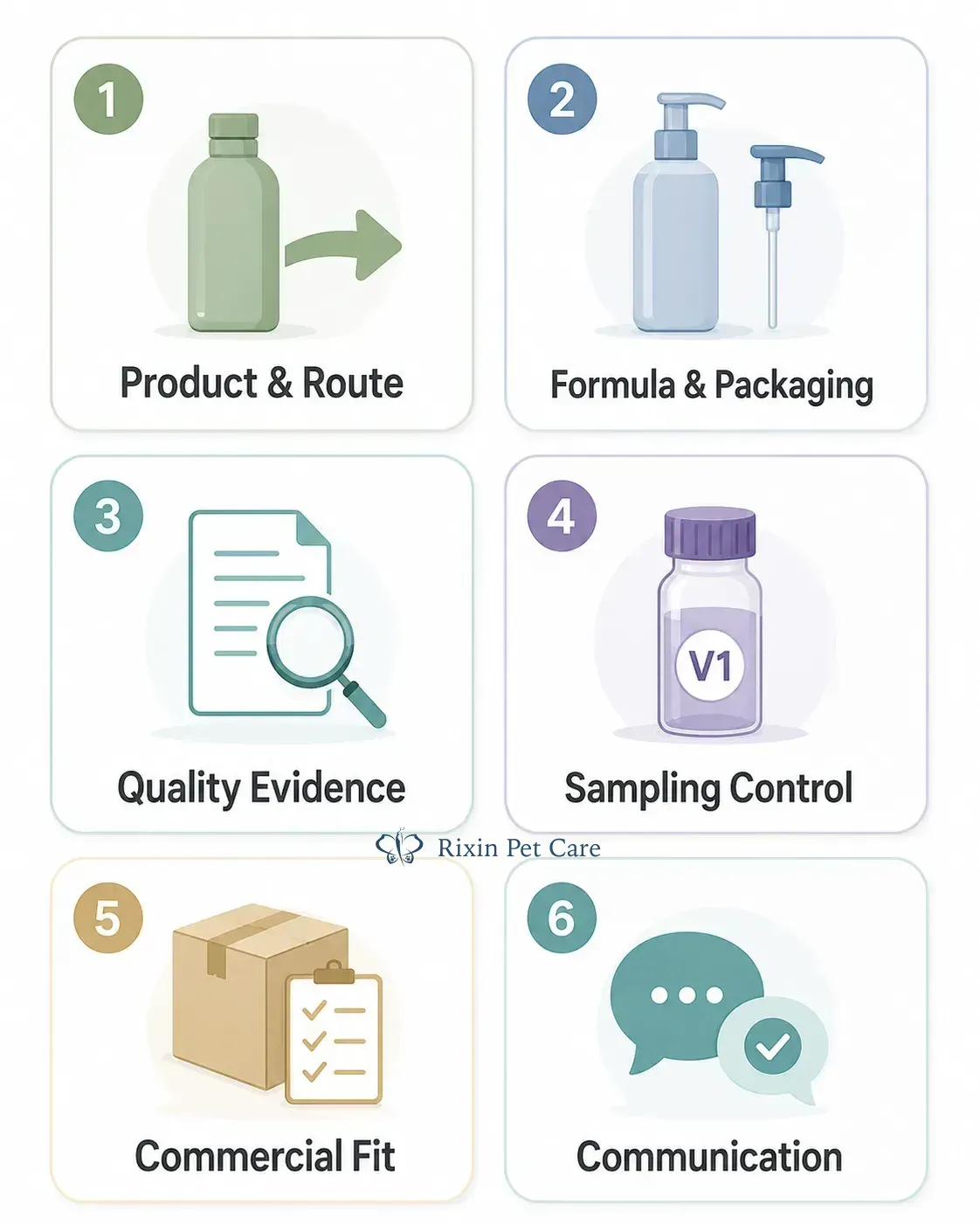
Do not let a weighted total override a failed gate or serious unresolved risk. High scores elsewhere cannot cancel out a project-critical failure.
Common Red Flags
Investigate further when a supplier:
- confirms everything without asking about the project;
- cannot explain experience with the required format;
- gives MOQ or timing without defining scope;
- provides certificates that cannot be connected to the actual site;
- lists documents without explaining what they cover;
- treats formula and packaging as separate decisions;
- provides samples without version control;
- leaves major quotation exclusions unclear;
- avoids explaining outsourced work;
- presents document or market review as guaranteed approval.
A red flag calls for clarification or stronger evidence. It is not always an automatic rejection.
Shortlist and Confirm in Writing
Use a staged process:
- Define the project.
- Build a relevant longlist.
- Apply gate checks.
- Send the same scope to suppliers that pass.
- Review evidence and open questions.
- Compare samples and commercial terms.
- Complete the scorecard.
- Select the preferred supplier.
- Confirm the pre-production scope.
Before final selection, confirm in writing:
- product and market scope;
- manufacturing and formula route;
- approved sample and specifications;
- packaging and artwork versions;
- MOQ and quotation scope;
- testing and document responsibilities;
- production start conditions and timeline;
- inspection, shipping, and buyer responsibilities;
- reorder and change-control terms.
Choose for Project Fit
The right private label pet grooming manufacturer is the supplier whose verified capabilities, process, commercial model, and responsibilities fit the product and launch plan.
Define the project, apply gates before scoring, record evidence beside every result, and resolve critical open questions before production preparation begins.
Ready to Discuss Your Pet Grooming Product Project?
Share your product type, target market, packaging direction, estimated quantity, and any support you need. A rough brief is enough to start a practical next-step discussion.