How Many Pet Grooming Products Should a New Brand Launch?
Written by: Rixin Pet Care Editorial Team
Reviewed by: Product Development Team for manufacturing context and claim-risk alignment.
This content is provided for product planning, packaging discussion and claim-risk awareness. It is not veterinary advice, treatment guidance or market authorization.
How many pet grooming products should a new brand launch? For a private label pet grooming brand, the best starting point is usually the smallest product line that gives every product a clear role and that the business can realistically support.
That may mean one anchor product, two connected products, or a small three-product line. The decision depends on the sales channel, available budget, quantity requirements, development workload, packaging, inventory, and how clearly the products fit together.
This content is for product planning, packaging discussion, and claim-risk awareness only. It is not veterinary advice, medical guidance, or market authorization.
Quick Answer
There is no universal ideal number of products for a new pet grooming brand.
- One anchor product can provide the strongest focus and the fewest product-planning decisions.
- Two connected products can work when the second product serves a distinct role in the same broader grooming routine.
- A small three-product line can make sense when all three products have clear roles and the business can support the added development, packaging, stock, and reorder work.
- A broader first assortment should have a specific business reason. A larger catalogue is not automatically a stronger launch.
A SKU means a stock keeping unit: a sellable product version that the business tracks and reorders. Before deciding how many SKUs to launch, first decide why each one needs to exist.
For the wider manufacturing journey, including product selection, manufacturing routes, MOQ, samples, cost, and supplier planning, read the private label pet grooming products guide.
Define Product Roles Before Product Count
Do not start by asking whether the line should contain one, three, or five products. Start by asking what role each product plays.
An anchor product is the main product around which the first launch is built. It should have the clearest purpose in the initial offer and be easy for the target buyer to understand.
A companion product adds a different but connected role. It should make the product line more useful without simply repeating the anchor product in another package.
A third product should meet the same test. It may address another grooming moment, customer need, or channel requirement, but it should not be added only to make the catalogue look larger.
Three products with unclear or overlapping roles can create more work without creating a stronger offer. One clearly positioned product can therefore be a more practical first launch than a larger line with no obvious structure.
If the product roles are clear but you are still deciding which formats fit them, review the pet grooming product range.
Compare Three First-Launch Structures
| Launch structure | When it can fit | Main advantage | Main trade-off |
|---|---|---|---|
| One anchor product | The brand is testing one clear product idea or has limited launch capacity | Strong focus and fewer moving parts | A narrower initial assortment |
| Anchor + companion | Two products serve different but connected roles | A more complete product story without a large range | More stock, packaging, and production decisions |
| Small three-product line | Each product has a clear role and the business can support the added scope | A broader routine or assortment | More quantity, artwork, approval, stock, and reorder complexity |
A one-product launch concentrates development work, inventory, buyer feedback, and marketing around one offer.
A two-product launch can make sense when the second product adds something clearly different. For example, a brand built around bath-time coat care may decide that one wash product and one companion coat-care product form a coherent first line.
A three-product launch requires the same discipline. The third SKU should add a new role rather than simply provide another variation of an existing idea.
This is a qualitative decision, not a numerical rule. A brand with one clear use case and limited operating capacity may reasonably start with one product. A brand with a well-defined connected routine, stronger launch resources, and enough inventory capacity may decide that two or three products make more sense.
What Every Extra SKU Adds to the Project
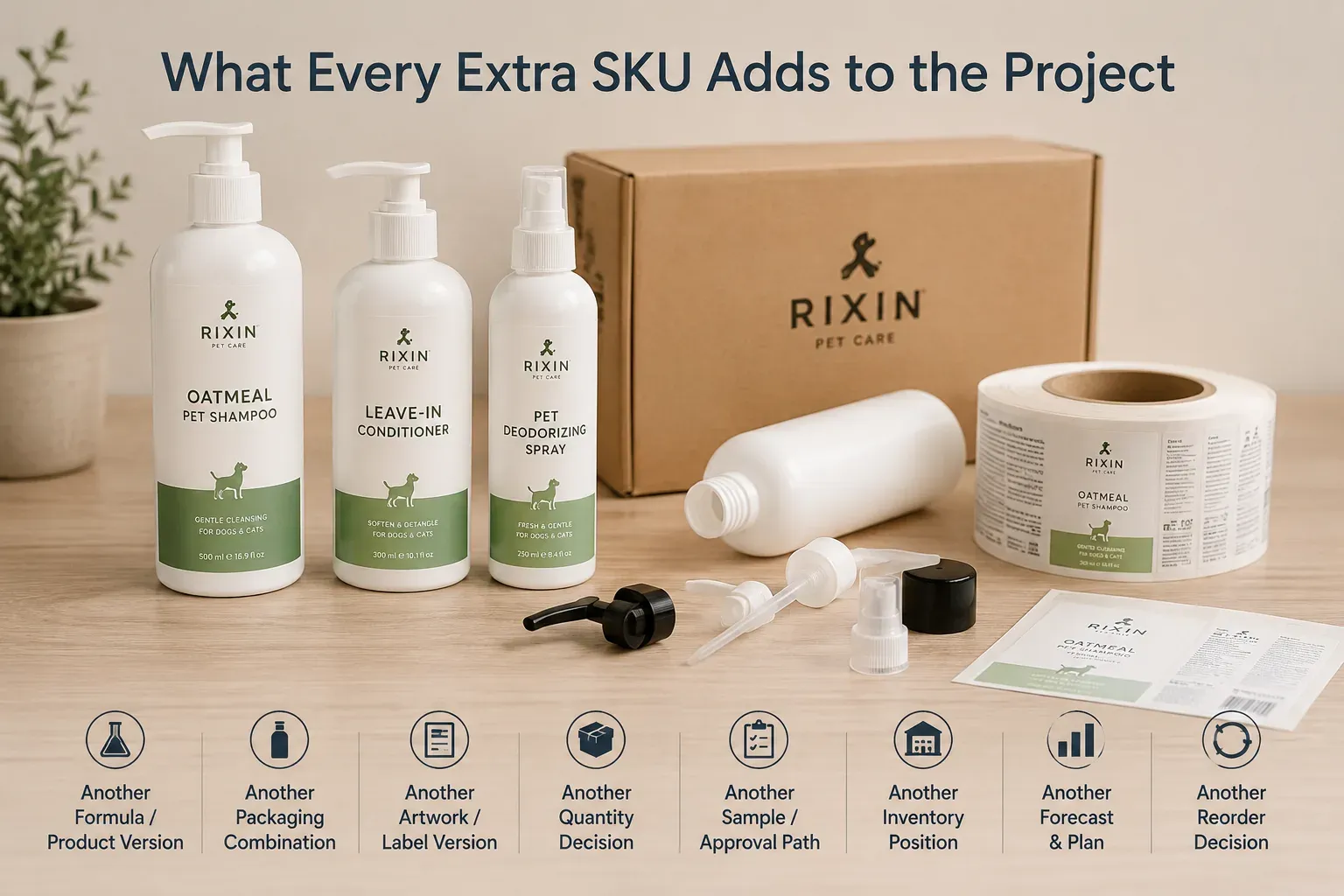
Adding another SKU means more than creating another product page.
Depending on the project, another sellable product may add:
- another formula or product version;
- another bottle, closure, pouch, or packaging combination;
- another artwork or label version;
- another quantity decision;
- another sample or approval path;
- another stock item to finance and store;
- another sales forecast;
- another reorder decision.
Some inputs may be shared. Two products might use the same bottle family, closure style, or brand design system.
Shared inputs may reduce duplicated work, but the products can still be separate sellable SKUs for quoting and inventory. The exact structure should be confirmed with the manufacturer because formula, packaging, printing, filling, and purchasing minimums can be handled differently from project to project.
If quantities are likely to influence the launch structure, use the private label pet grooming MOQ guide. For the wider budget implications, review the pet grooming product cost guide.
Use Six Gates to Choose the First Launch Size
Instead of choosing an arbitrary SKU target, test the proposed first line against six practical questions.
1. Does Every SKU Have a Distinct Role?
Explain the purpose of each proposed product in one sentence.
If two products solve essentially the same problem for the same buyer, ask whether both are necessary for the first order.
The purpose does not need to be complicated. What matters is that the buyer can understand why each product belongs in the line.
2. Does the Line Serve One Understandable Buyer or Grooming Routine?
The first launch does not need to cover every grooming need.
Ask whether the proposed products make sense together for the same target customer, brand idea, or broader grooming routine.
A random assortment can create more manufacturing and marketing work while making the brand harder to explain.
3. Can the Business Support the Quantity and Inventory?
Every additional SKU can create another stock commitment.
Before adding one, ask:
- Can the business finance the initial quantity?
- Can it store and manage another stock item?
- Can it forecast demand separately?
- Can it support another reorder when the timing differs from the other products?
The point is not to minimize SKU count at all costs. It is to avoid creating an assortment the business cannot manage after production.
4. Can the Team Manage the Development Work?
More products normally mean more decisions.
That can include samples, packaging, artwork, feedback, supplier communication, and approvals.
The workload can increase further when products use different development routes—for example, an established formula direction for one product and deeper customization for another—or when they require different packaging systems.
If the project team is already struggling to close the first product, adding more SKUs may make the launch less controlled rather than more complete.
5. Does the Sales Channel Justify the Extra Product?
Different business models can create different reasons for starting narrowly or offering a broader range.
An ecommerce seller, grooming salon, retailer, distributor, or importer may not need the same first assortment.
The important question is whether the channel creates a practical reason for another product—not whether a generic rule says the channel “needs” a certain number of SKUs.
The Pet Grooming Manufacturing Solutions hub explains how different business models can change project priorities.
6. Can the Brand Explain Why the Products Belong Together?
A buyer should be able to understand the relationship between the products without a long explanation.
If the products do not share a clear audience, grooming context, product story, or commercial reason, the first assortment may be too broad.
When most of these six questions have clear answers, a small connected line may be reasonable.
When several remain unresolved, reducing the first launch can make the project easier to define, manufacture, evaluate, and reorder.
Three Simple First-Line Examples
These examples show product-line structure, not universal product recommendations.
One Anchor Product
A brand may begin with one shampoo when the immediate goal is to establish one clear core product and keep the first development, packaging, stock, and marketing decisions concentrated.
The important point is not that shampoo is always the best first product. It is that the brand has chosen one clearly defined anchor.
Two Connected Products
A shampoo plus a conditioner or detangling product can create two different roles within the same broader coat-care direction.
The second product has a reason to exist because it extends the routine rather than merely increasing the number of SKUs.
A Small Three-Role Line
A small first line might include:
- one core wash product;
- one between-bath product;
- one additional grooming format.
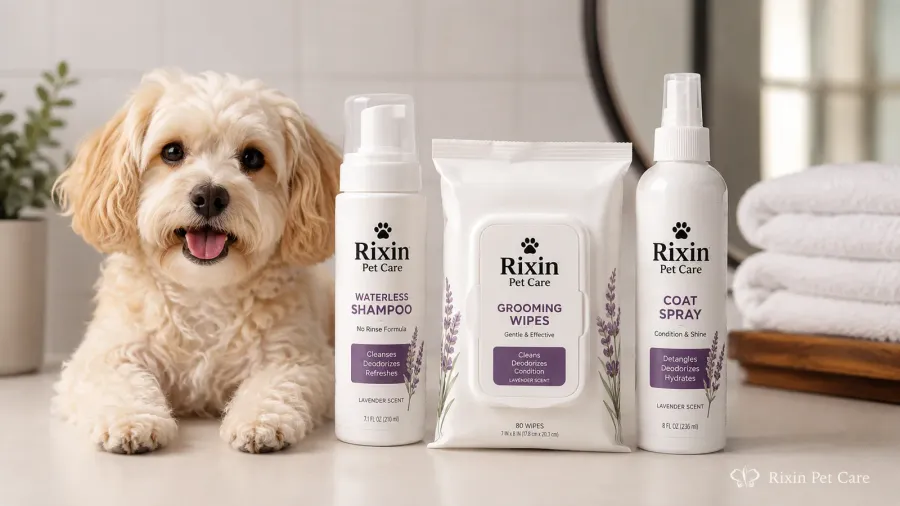
The exact formats depend on the project. If the line needs a between-bath role, the brand should compare the available format options separately instead of assuming that sprays, wipes, and other formats are interchangeable.
The useful question is not, “How many products make the brand look complete?”
It is:
Does every product add a clear role that the business can support?
Prepare the First-Line Manufacturer Brief
Once the launch structure is clear, give the manufacturer a clear project brief.
Include:
- the planned products;
- the role of each product;
- target market;
- sales channel;
- formula direction or benchmark, if known;
- packaging direction;
- estimated quantity per SKU;
- target launch timing;
- confirmed requirements;
- preferences;
- open questions.
An initial inquiry does not always require a finished technical specification. It should, however, contain enough information for the manufacturer to understand the intended first line and identify the decisions that still need to be made.
Use the pet grooming product brief guide when you are ready to organize the detailed inquiry.
Final Recommendation: Start With Clear Product Roles
Do not choose the first-line size because a larger catalogue looks more established.
Choose the smallest structure in which every product has a clear reason to exist and the business can realistically support the development, inventory, and repeat-order work behind it.
Once that structure is clear, the next step is to define the product requirements and prepare the project for manufacturer review.
Ready to Discuss Your Pet Grooming Product Project?
Share your product type, target market, packaging direction, estimated quantity, and any support you need. A rough brief is enough to start a practical next-step discussion.