What Can Be Customized in a Private Label Pet Shampoo Formula?
Written by: Rixin Pet Care Editorial Team
Reviewed by: Product Development Team for manufacturing context and claim-risk alignment.
This content is provided for product planning, packaging discussion and claim-risk awareness. It is not veterinary advice, treatment guidance or market authorization.
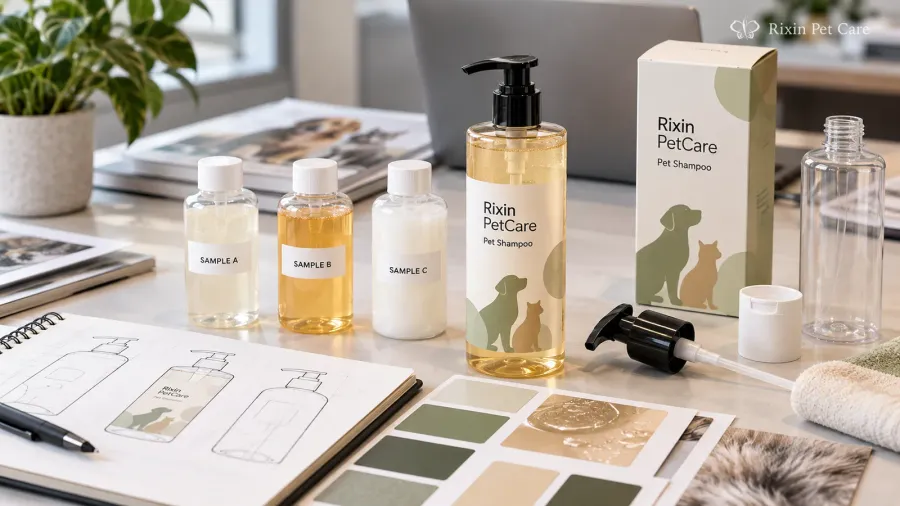
A private label pet shampoo formula can often be customized in several directions, including cleansing experience, lather, rinse behavior, coat feel, viscosity, fragrance, appearance, ingredient preferences, and ingredient exclusions.
But customization is not the same as choosing independent options from a menu.
A change to one part of the formula can affect other parts of the product, including foam, texture, sensory feel, stability questions, dispensing, packaging interaction, documentation, and the claims a brand may eventually want to use.
The most useful way to approach a custom shampoo project is therefore:
Define the desired direction → assess the formula as a system → make a physical sample → review the result → revise where necessary
The key distinction is:
Requested customization ≠ automatically approved final formula
For buyers still deciding whether to begin with an existing formula or pursue a more customized route, see our guide to ready-made vs custom pet grooming formulas.
What Parts of a Pet Shampoo Can a Buyer Ask to Customize?
The exact scope depends on the project, but a private-label shampoo brief may include directions such as:
| Customization area | What the buyer can define | What still requires review |
|---|---|---|
| Cleansing direction | Intended grooming use and desired cleansing experience | Formula balance and final sample behavior |
| Lather and rinse | Foam direction, spreadability, rinse experience | Interaction with the full formula |
| Coat feel | Lighter or richer finish, softness or manageability direction | Sensory result after rinsing and drying |
| Texture | Thinner or thicker direction, dispensing preference | Formula structure, packaging, and stability |
| Fragrance | Scent direction and intensity preference | Formula fit, sampling, and market considerations |
| Appearance | Clear, opaque, colored, or minimal-color direction | Formula feasibility and visual stability |
| Ingredients | Preferred ingredients or ingredient directions | Exact material, compatibility, formula impact, documentation |
| Exclusions | Materials, fragrance, or color directions to avoid | Functional consequences of removing or replacing materials |
| Intended positioning | Grooming, conditioning, deodorizing, or other market direction | Final formula, evidence, market, and claim review |
| Packaging | Bottle and dispensing direction | Flow, viscosity, closure, filling, and compatibility questions |
This table is a starting point, not a universal specification.
Each project still needs to be translated into an actual formulation brief.
First Decide How Much of the Formula You Actually Want to Change
Not every private-label shampoo project begins from the same point.
A project may start from:
- an existing formula with little or no formula adjustment;
- an existing formula with selected modifications;
- a more substantially customized formula direction.
These routes affect development scope differently.
For example, a buyer who mainly wants a different fragrance and packaging direction is describing a different project from a buyer who wants changes to cleansing feel, foam, conditioning, viscosity, ingredient system, and market positioning at the same time.
This article focuses on the second question:
Once customization is being considered, what exactly should the buyer define?
If the formula route itself has not yet been selected, the broader ready-made vs custom formula guide is the better starting point.
Cleansing Direction Can Be Customized
A buyer can describe the intended cleansing direction of the shampoo.
That might include questions such as:
- Is the shampoo intended for routine grooming?
- What type of ordinary visible soil is the product expected to encounter?
- Should the cleansing experience feel lighter or more substantial relative to the product concept?
- What kind of rinse-off experience is expected?
- What target animal and grooming context is being developed?
These descriptions help the formulation team understand the product concept.
They do not mean that cleansing performance can be adjusted through one independent “strength” setting.
Changes that affect cleansing can also change:
- lather;
- rinse behavior;
- coat feel;
- viscosity;
- sensory properties;
- other parts of the formula system.
For that reason, it is better to describe the intended use experience than to ask only for a shampoo to be “stronger” or “milder.”
A request such as:
We want a rinse-off shampoo for routine grooming that removes ordinary visible soil while leaving a lighter finished coat feel.
is more useful than:
Make the shampoo stronger.
The first statement gives the formulator a product direction without pretending to define the technical solution.
Lather and Rinse Experience Can Be Part of the Brief
Foam is an important part of how many buyers perceive a rinse-off shampoo, but more foam does not automatically mean better cleansing performance.
A buyer may still define preferences for:
- how quickly lather develops;
- how rich or light the foam should feel;
- how easily the product spreads through the intended coat;
- how manageable the shampoo feels during use;
- how easily the product rinses away;
- whether an undesirable coated feeling remains after rinsing.
These are valid development inputs.
However, lather should be evaluated as part of the complete shampoo experience rather than as a standalone performance score.
For example, increasing the desired foam direction should not be evaluated without also looking at rinse behavior and the finished coat experience.
When the physical sample is ready, these characteristics can be reviewed through the private label pet shampoo sample evaluation process.
Coat Feel and Conditioning Direction Can Be Customized
The buyer can also define what the coat should feel like after rinsing and drying.
Depending on the concept, the brief may describe preferences such as:
- lighter versus richer finish;
- softness direction;
- smoothness;
- manageability;
- reduced heavy or coated feel;
- reduced greasy feel;
- desired dry-coat sensory direction.
The useful input is the desired finished experience.
The buyer does not need to prescribe the exact technical solution.
For example:
We want the finished coat to feel soft and manageable without a heavy coated finish.
is a clearer product-development instruction than naming an ingredient and assuming that ingredient alone will create the desired result.
The final outcome still needs to be assessed in the physical formula.
Texture and Viscosity Are Customizable, but They Are Not Only Visual Choices
A buyer may prefer a shampoo that feels:
- thinner;
- thicker;
- richer;
- easier to pour;
- easier to dispense;
- less runny.
Viscosity also affects how the product flows through the selected bottle or closure and how controllable it feels during use.
This means a request such as “make it much thicker” should be reviewed in the physical product rather than treated as a purely visual preference.
A more useful instruction is:
The current sample dispenses too quickly from the selected bottle. We want a more controlled flow while keeping the existing rinse and coat-feel direction.
That gives the manufacturer both the problem and the parts that should remain unchanged.
Fragrance Direction Can Be Customized
Fragrance is often one of the easier characteristics for a buyer to describe because it is directly sensory.
A project may define:
- fragrance family;
- fragrance character;
- lighter or stronger fragrance direction;
- fragrances to avoid;
- a fragrance-free direction where appropriate for the project.
Even then, fragrance should ultimately be judged in the finished physical sample.
It is also useful to separate:
fragrance preference
from
market-facing fragrance claims
A buyer may prefer a low-fragrance or fragrance-free direction, but the final wording used on packaging still depends on the final formulation and the evidence supporting that wording.
Color and Product Appearance May Also Be Adjusted
The visual appearance of the shampoo can form part of the product brief.
Possible directions include:
- clear;
- translucent;
- opaque;
- colored;
- minimal-color;
- avoiding added color where that fits the project.
Appearance should still remain secondary to formula feasibility.
A requested appearance may interact with the selected ingredient system, fragrance, product texture, stability, or other formulation choices.
For this reason, a buyer should describe the target appearance without assuming that every visual combination can be produced while every other formula characteristic remains unchanged.
Can You Ask for Specific Ingredients?
Yes. A buyer can request that the formulation team evaluate a particular ingredient direction.
This is common in private-label development.
However, the important wording is:
evaluate an ingredient direction
rather than:
simply add an ingredient
The exact material matters.
Two raw materials described by a similar marketing term may differ in:
- exact ingredient identity;
- supplier;
- grade;
- supplied form;
- concentration;
- carrier system;
- specification;
- documentation;
- processing requirements.
A requested ingredient may also affect the rest of the formula.
Potential considerations can include:
- formula structure;
- viscosity;
- sensory feel;
- lather;
- appearance;
- stability;
- preservation strategy;
- packaging interaction;
- supplier documentation;
- finished-product wording.
An ingredient request therefore needs to be assessed inside the complete formula rather than approved from the ingredient name alone.
Most importantly:
The presence of an ingredient does not automatically prove a finished-product benefit.
Ingredient selection and finished-product claims are related questions, but they are not the same question.
Ingredient Exclusions Can Be Just as Important as Ingredient Additions
Customization is not only about what a buyer wants to add.
A brand may also define materials or directions it wants to avoid.
Examples may include:
- no added color;
- selected fragrance exclusions;
- selected ingredient exclusions;
- brand-positioning restrictions;
- channel-specific formulation preferences.
These requests should be identified early.
Removing something from an existing formula may sound simpler than adding something, but that is not always the case.
A material may have a functional role in the formula. If it is removed, the development team may need to determine whether another material or system should replace that function and whether the revised direction needs another physical sample.
For this reason:
“Remove X” can be a formulation project, not merely a deletion.
The Target Animal and Intended Use Should Be Defined Early
The formulation brief should clearly state what product is being developed.
Relevant information may include:
- intended target animal;
- rinse-off format;
- grooming use context;
- intended application area;
- expected usage direction;
- target market;
- sales channel.
This information helps the manufacturer assess the project correctly.
It should not be replaced by broad statements such as:
- safe for every dog;
- safe for all cats;
- suitable for every breed;
- suitable for all sensitive animals.
Those are market-facing claims that require a different level of support.
The development brief should first define the intended product.
Final labeling and claims can then be reviewed against the actual formula and target market.
Formula Changes Can Affect Packaging Decisions
Formula and packaging should not be finalized as two completely independent projects.
For a pet shampoo, relevant interactions can include:
- formula flow versus bottle opening;
- viscosity versus pump or closure behavior;
- dispensing control;
- closure or leakage observations;
- material compatibility questions.
For example, a viscosity direction that works well with one closure may create a different dispensing experience with another.
The buyer does not need to solve technical package compatibility before contacting the manufacturer. The practical point is simply that formula and package decisions should be reviewed together.
For deeper technical context, see our pet grooming formula and packaging compatibility guide.
Packaging, dispenser, label, and artwork decisions can also be reviewed through our pet grooming packaging and label design service.
Do Not Change Every Variable in Every Sample Round
One of the easiest ways to make a customization project harder to evaluate is to change too many things at the same time.
Before requesting a revision, separate feedback into four groups.
Must Change
Requirements that prevent approval of the current direction.
Examples might include:
- foam direction materially different from the brief;
- rinse experience not matching the target;
- coat feel too heavy;
- fragrance direction unacceptable;
- dispensing not workable with the selected package.
Keep Unchanged
Characteristics that are already acceptable.
For example:
Keep the current fragrance and rinse direction.
This is useful because it tells the development team not to reopen an accepted variable unnecessarily.
Preferred Direction
Improvements the buyer would like if technically practical.
These are useful, but they should not be mixed with non-negotiable requirements.
Future Consideration
Ideas that may belong in a later sample or even another SKU.
Separating these categories prevents a sample round from turning into an uncontrolled redesign.
When Does a Customization Change Need Another Physical Sample?
A new physical sample is generally useful when the change could materially affect how the shampoo looks, dispenses, behaves, or feels.
That may include changes to:
- cleansing direction;
- lather;
- rinse experience;
- coat feel;
- conditioning direction;
- viscosity;
- fragrance;
- appearance;
- ingredient system;
- dispensing;
- another physical part of the product experience.
For example, a label-text correction does not create the same sample requirement as changing fragrance, foam, viscosity, or coat feel.
Likewise, an ingredient change intended to alter the sensory experience should normally be evaluated through the resulting physical formula rather than approved only from a written description.
Once a revised sample is available, use product-specific criteria rather than a generic yes/no approval.
Our guide on how to evaluate private label pet shampoo samples covers that stage in more detail.
Documentation Follows the Final Formula, Not the Early Wish List
At the beginning of a project, the buyer may have a list of desired ingredients, exclusions, sensory characteristics, and marketing ideas.
That is not yet the same thing as the final approved formula.
As the project becomes defined, the manufacturer may need to align the final product version with the documentation and technical requirements relevant to that project.
Depending on the final formula, packaging, target market, and project scope, this may involve review of:
- ingredient information;
- formula version;
- product specifications;
- supplier information or documents where relevant;
- packaging information;
- technical testing requirements;
- target-market requirements.
The exact documentation package depends on the project.
A single document should not be assumed to establish every formula, safety, compatibility, or market requirement.
This is another reason to maintain clear version control during customization.
The formula used for documentation, testing, artwork review, and production planning should correspond to the approved project version.
Discuss Intended Claims Before the Formula Is Locked
A buyer should also tell the manufacturer what type of market-facing positioning is being considered.
Examples may include:
- grooming;
- conditioning;
- deodorizing;
- fragrance-free direction;
- ingredient-led positioning;
- coat-care positioning.
This does not mean every requested phrase will be appropriate for the final product.
The value of discussing the intended positioning early is that it allows formulation, packaging, documentation, and label review to move in the same direction.
The important distinction is:
Desired marketing direction ≠ automatically supportable final claim
Final wording depends on factors such as:
- the final formula;
- available supporting evidence;
- the intended market;
- label context;
- applicable claim review.
For claim and market-facing wording support, see our label, claim, and market review service.
How Should You Brief a Manufacturer About Shampoo Customization?
You do not need to write a formulation specification yourself.
A useful shampoo customization brief can stay focused on buyer decisions.
1. Product Identity
State:
- rinse-off pet shampoo;
- target animal or use context;
- target market;
- sales channel where relevant.
2. Must-Have Formula Direction
Describe priorities such as:
- cleansing direction;
- foam/lather direction;
- rinse behavior;
- coat feel;
- conditioning direction;
- texture;
- fragrance;
- appearance.
3. Ingredient Requirements
Separate:
- ingredients or ingredient directions to evaluate;
- exclusions;
- fragrance or color restrictions;
- other brand requirements.
4. Packaging Direction
Share the expected:
- bottle type;
- closure or dispenser;
- fill-size direction;
- packaging references where available.
5. Intended Positioning
Explain which product messages or claim directions the brand expects to explore.
These can then be reviewed before final label wording is approved.
6. Priority Level
For each requirement, label it:
- Must have
- Preferred
- Flexible
- Avoid
This is often more useful than presenting every request as equally non-negotiable.
For a complete project-input framework beyond shampoo formulation, see our guide to preparing a pet grooming product brief for a manufacturer.
What Does “Custom Formula” Not Mean?
A custom formula is not a promise that every requested change can be made independently.
In practical terms:
- requested ingredients still need formulation review;
- removing a material may require reformulation;
- packaging and formula decisions can interact;
- a requested ingredient does not by itself substantiate a finished-product claim;
- the first physical sample is not automatically the final approved version.
A better way to think about customization is:
The brand defines the target. The formulation process determines how that target can be translated into a workable product direction.
What Happens After the Customization Brief Is Submitted?
Once the manufacturer understands the product direction, the project can move into a more concrete development cycle.
That may include:
- reviewing the requested formula direction;
- identifying requirements that need clarification;
- evaluating ingredient or exclusion requests;
- aligning the likely formula route with packaging;
- preparing a physical sample;
- collecting structured buyer feedback;
- revising the formula where necessary;
- confirming the accepted sample direction;
- aligning documentation, testing, artwork, and claim review with the final project version.
The pet grooming formula development service is the main route for discussing a project-specific formulation direction.
If the project is specifically a rinse-off shampoo, the private label pet shampoo product page provides the commercial product route.
For broader category planning, see the private label pet grooming products guide.
When you are ready to turn your requirements into a defined OEM/ODM project, submit your project requirements with your formula priorities, packaging direction, target market, and any ingredients or exclusions you want reviewed.
Ready to Discuss Your Pet Grooming Product Project?
Share your product type, target market, packaging direction, estimated quantity, and any support you need. A rough brief is enough to start a practical next-step discussion.