Private Label & OEM Guides

Bulk Filling vs White Label vs Private Label Pet Grooming Products

RP Rixin Pet Care Editorial Team Published Updated 14 min read B2B Pet Care Insights

Written by: Rixin Pet Care Editorial Team

Reviewed by: Product Development Team for manufacturing context and claim-risk alignment.

This content is provided for product planning, packaging discussion and claim-risk awareness. It is not veterinary advice, treatment guidance or market authorization.
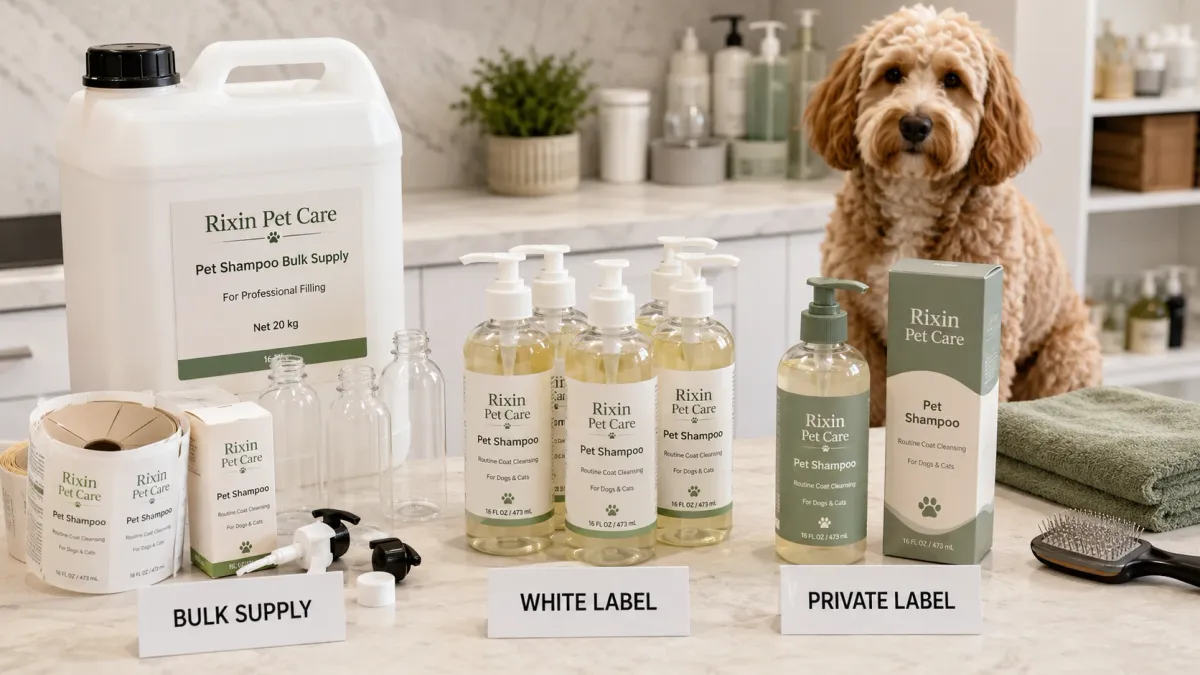
Bulk pet shampoo supply compared with white label and private label finished products

A salon chain, distributor, refill business, or brand may compare bulk formula, white label finished products, and private label products. The product category may look similar, but the responsibilities are different.

Here, bulk supply means the manufacturer ships product in a sealed large container while the buyer or local filler completes the final professional or retail packaging. A gallon or 5 L product that is already filled, sealed, labeled, and ready to use is a finished large-format product, not necessarily bulk supply for local filling.

The practical comparison is who controls filling, packaging, net contents, batch records, storage, release, complaints, and traceability-not only the quoted product price.

For the wider framework, read the complete private label pet grooming products guide. For cooperation-model definitions, see private label vs white label vs OEM pet products.

Quick Answer

  • Bulk pet grooming product supply fits buyers that already have suitable local filling, packaging sourcing, quality-control, storage, and traceability systems.
  • White label fits buyers that want a finished established product with limited formula changes and their own brand presentation.
  • Private label fits buyers that want the manufacturer to deliver a finished branded product with selected formula, packaging, or product-positioning adjustments.
  • Bulk supply is not automatically the lowest-cost route. It may reduce packaging work at origin while adding local filling, labor, loss, packaging, quality, storage, and administration costs.
  • A finished salon-size shampoo is not necessarily bulk supply for local filling.

The key question is not only who makes the formula, but who takes responsibility for the final filled and labeled product.

Bulk Supply vs White Label vs Private Label: Quick Comparison

Comparison AreaBulk SupplyWhite LabelPrivate Label
Product suppliedFormula in agreed large containersFinished established productFinished customized branded product
Final fillingBuyer or local filling partnerManufacturerManufacturer
Retail packagingBuyer usually manages itUsually manufacturerUsually manufacturer
Formula customizationDepends on the separate formula scopeUsually limitedCommonly moderate
Label applicationBuyer or local fillerUsually manufacturerUsually manufacturer
Local equipment neededUsually yesNoNo
Buyer QC responsibilityHigh after receiptLowerLower
Traceability complexityHigherLowerLower
Shipping formatPails, drums, jerry cans, totes, or agreed bulk formatsFinished unitsFinished units
Launch complexityHigh operationallyLowerModerate
Best suited forExperienced local operatorsFaster market testingDifferentiated brands wanting finished production

These are common commercial patterns rather than universal definitions. The formula, filling, packaging, testing, document, storage, release, and complaint-handling scope should be confirmed in writing for each project.

What Does Bulk Supply Mean for Pet Grooming Products?

Bulk supply commonly means the manufacturer produces the formula and fills it into pails, drums, jerry cans, totes, or another agreed large-container format. The buyer then converts that bulk batch into the final commercial unit.

Bulk formula for local filling

The original manufacturer may handle formula manufacturing, bulk-batch checks, release, container identification, and dispatch. The buyer or local filler handles receiving, storage, transfer, bottle sourcing, final filling, closure and seal application, labeling, lot assignment, release, and local distribution.

This division must be clear before a bulk quotation is compared with a finished-product quotation.

Finished professional large formats

A gallon, 5 L bottle, or other professional size that is already filled, sealed, coded, and labeled is a finished large-format product. It is not necessarily bulk formula for local filling.

For salon chains using high volumes internally, finished professional formats may offer simpler handling without transferring filling-line responsibility to each location.

Local contract filling

A buyer may import bulk formula and appoint a third-party filler in the target market. The original manufacturer, brand owner, and local filler should agree who controls incoming inspection, packaging compatibility, filling instructions, batch records, retained samples, release, labels, complaints, and leakage investigations.

Advantages and limitations of bulk supply

Bulk supply may support local packaging, multiple pack sizes, and use of an existing filling network. It may also reduce international shipment of retail packaging.

However, it creates more handoffs, inventory categories, local losses, records, and quality responsibilities. It is generally unsuitable for a first-time brand without a qualified filler and packaging supply chain.

What Are White Label Pet Grooming Products?

White label pet products commonly use an established finished-product direction. The manufacturer handles formula production, filling, selected standard packaging, batch preparation, and finished-product packing. The buyer controls its brand name, artwork, product name, and market presentation within the available options.

What the manufacturer handles

A quotation may include the finished formula, filling, bottle, closure, label application, batch identification, and outer packing. Confirm whether labels, cartons, design, freight packaging, and documents are included or separate.

Advantages and limitations

White label removes the need for local filling and reduces coordination between multiple suppliers. It can be practical for testing a shampoo, grooming spray, wipes, or paw-cleaning format.

The trade-off is narrower formula and packaging choice. Differentiation may depend more on brand, assortment, channel, bundles, and customer experience.

Who white label fits

It often fits independent salons, retailers testing a SKU, online sellers validating demand, and businesses that need a straightforward extension rather than a highly specific formula.

What Are Private Label Pet Grooming Products?

Private label commonly gives the buyer more control while the manufacturer still manages formula production, filling, packaging coordination, label application, and finished-product packing.

What can be customized

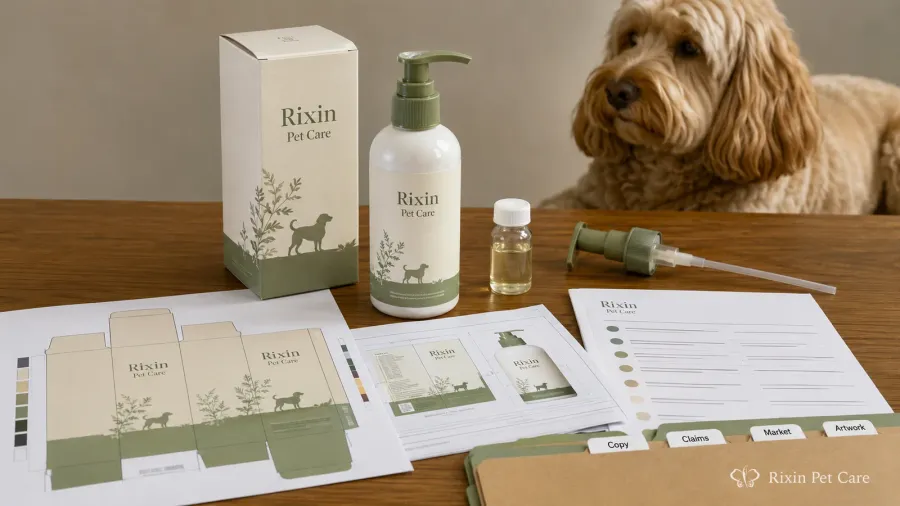
Possible adjustments include fragrance, viscosity, appearance, foam, rinse feel, product size, bottle, closure, label layout, carton, and connected line presentation.

These changes are linked. Viscosity can affect filling or pump output. Fragrance can affect appearance or packaging interaction. A new bottle can create a separate packaging minimum.

What the manufacturer handles

Keeping filling and packing within one manufacturing system can simplify approved-sample references, packaging specifications, batch records, coding, and shipment preparation.

Advantages and limitations

Private label offers more differentiation without requiring a local filling line. It can support retail-ready imports and consistent packaging across several products.

Development and packaging work may take longer than white label. Formula and packaging minimums may differ, and changes may require additional review.

Who private label fits

It often fits DTC brands, salon chains developing retail lines, established pet brands adding grooming products, and distributors that prefer finished customized units.

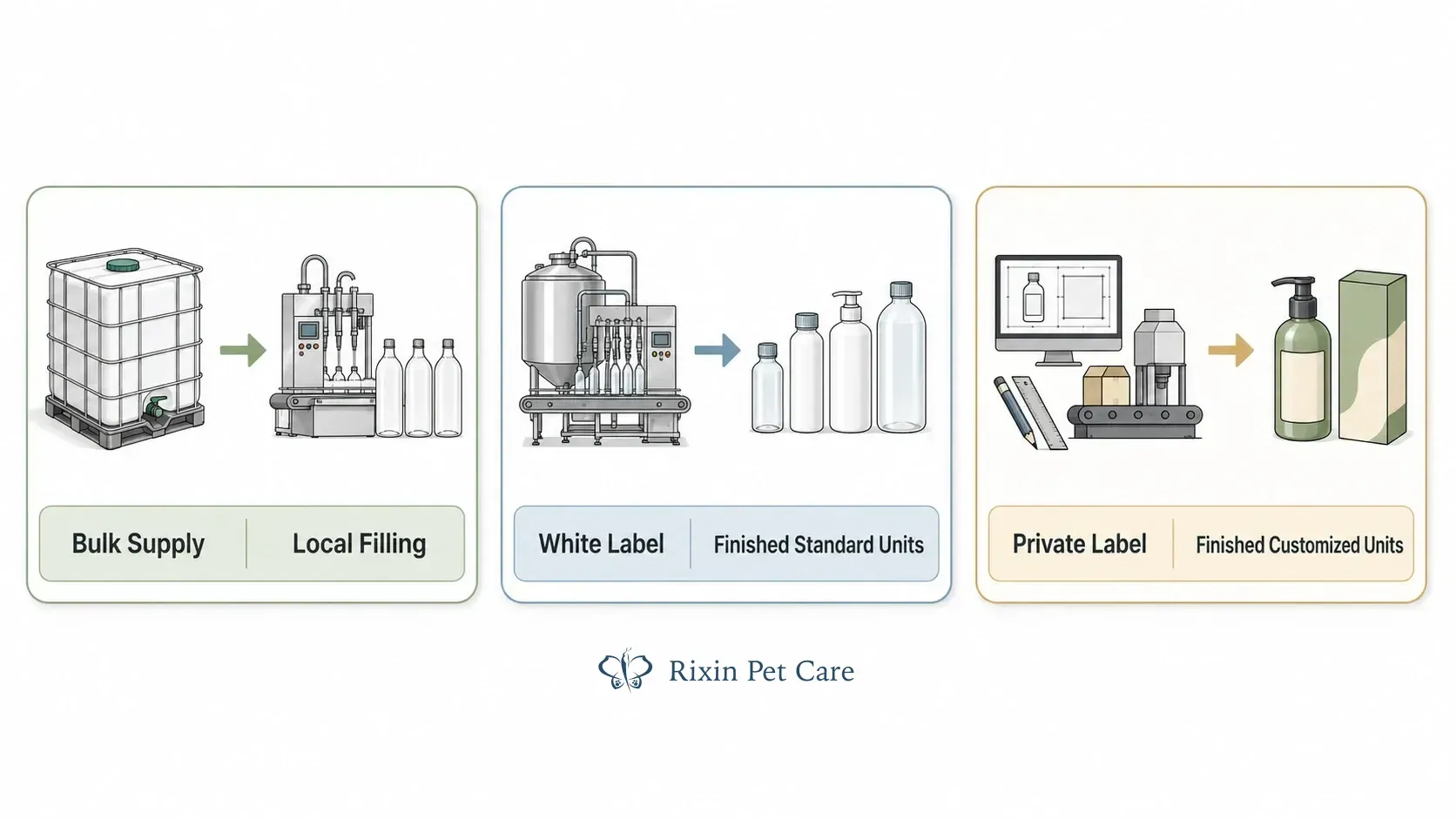
Who Handles Filling, Packaging, and Final Product Preparation?

This responsibility map is the practical difference between the three routes.

Responsibility map comparing bulk supply, white label, and private label filling routes

Formula manufacturing

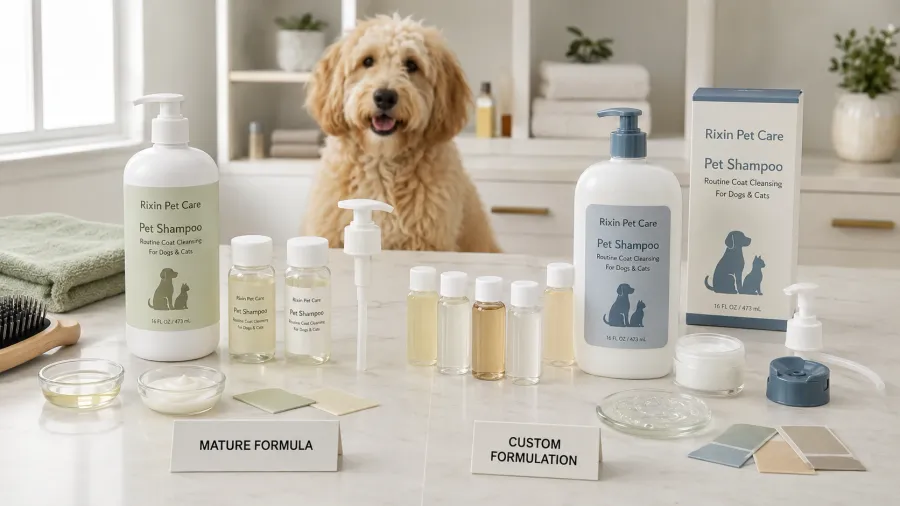
The original manufacturer commonly makes the formula in all three routes. In private label, it may also make agreed adjustments. In bulk supply, formula depth remains a separate decision: the product may be established, adjusted, or custom-developed.

Final filling

With bulk supply, the buyer or local filler controls transfer equipment, filling conditions, fill quantity, line setup, product loss, closure application, and seal integrity. With white label and private label, the original manufacturer usually completes filling before dispatch.

FDA cosmetics GMP material is not a universal legal standard for pet grooming products, but it is a useful quality reference because it addresses equipment status, batch identification, and code marks on finished packages. See the FDA’s GMP Guidelines and Inspection Checklist for Cosmetics.

Packaging procurement

Bulk buyers commonly source bottles, pumps, sprayers, caps, labels, cartons, and seals locally. White label commonly uses established options. Private label may allow broader selection, but bottle, closure, decoration, label, and carton minimums may each differ from the formula MOQ.

Label application

A local bulk-filling operation must control the correct artwork version, product-to-label match, lot information, net quantity, and application quality. White label and private label labels are commonly applied by the manufacturer when included in scope.

Final packing and dispatch

The bulk manufacturer dispatches large containers; the local operator completes retail packing and customer shipment. Finished white label and private label units are commonly packed for shipment by the manufacturer.

How Quality-Control Responsibilities Change

Bulk supply moves a major control point from the original manufacturer to the receiving and filling operation.

Quality control before bulk shipment

The manufacturer may control raw materials, batch production, in-process checks, agreed bulk specifications, sampling, release status, and large-container identification. Included tests and documents should be confirmed rather than assumed.

Receiving control

The buyer should define how it checks container condition, seals, batch number, quantity, transport damage, visible condition, documents, and storage exposure before filling.

Filling-line control

The local filler needs procedures for equipment condition, line clearance, container inspection, fill quantity, closure and seal checks, leakage, label control, and prevention of mix-ups.

For U.S. packaged-goods planning, NIST Handbook 133 shows why filling needs documented quantity control rather than a visual estimate. Target-market requirements still need separate review. See the 2026 edition of NIST Handbook 133.

Finished-product responsibility

A released bulk batch can still be affected by local storage, transfer, equipment, packaging, labels, and transport. The agreement should identify who approves the final batch, retains samples, reviews leakage and quantity, handles complaints, investigates mix-ups, controls rejected units, and authorizes distribution.

Traceability

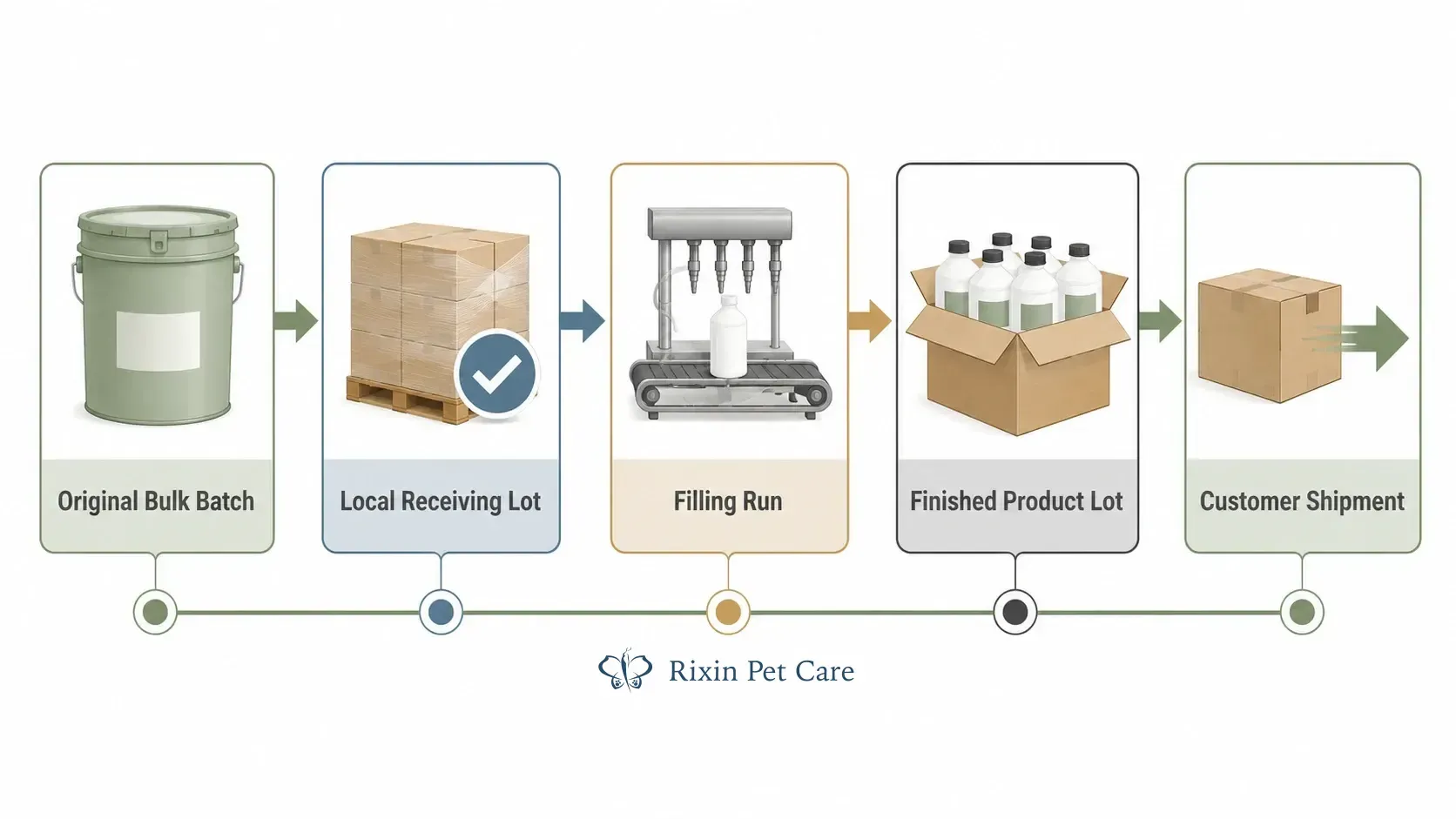
A practical chain may be:

Original bulk batch -> Local receiving lot -> Filling run -> Packaging lot -> Finished-product lot -> Customer shipment

GS1’s Global Traceability Standard supports the design of traceability systems, and batch or lot identification distinguishes one production group from another. The final unit should be linkable to the original bulk batch and local filling records. See the GS1 Global Traceability Standard.

Traceability chain linking bulk batch, local filling, packaging, and customer shipment

Can Your Local Operation Manage the Final Product?

Before choosing bulk supply, confirm the filling partner, packaging source, incoming inspection, batch control, finished-product release, storage, traceability, complaint process, and target-market label responsibility.

A lower bulk price does not compensate for an incomplete local operating system.

What Documents May Be Needed for Each Route?

Documents depend on the product, target market, formula, intended use, hazard classification, and agreed scope.

Bulk supply documents

Possible manufacturer documents include a bulk specification, batch COA, ingredient list, SDS where applicable, manufacturing reference, storage instructions, container identification, available shelf-life information, transport information, and agreed handling guidance.

The buyer or filler may need receiving, filling, packaging-material, quantity-check, label, finished-batch, release, and retained-sample records.

OSHA explains that an SDS communicates chemical properties, hazards, protective measures, and handling where its Hazard Communication Standard applies. Applicability depends on the product and jurisdiction. See OSHA’s Safety Data Sheets guidance.

White label documents

Possible documents include the finished specification, ingredient list, SDS where applicable, packaging specification, approved artwork, batch identification, and a COA where offered.

Private label documents

Additional records may include the approved formula version, approved sample reference, customized specification, packaging confirmation, label review record, and agreed test support.

Bulk COA vs finished-product control

A bulk COA describes the supplied batch against the listed parameters. It does not automatically confirm local fill quantity, closure, seal, label, package condition, or final-batch release.

How Shipping and Storage Differ

Shipping bulk product

Bulk supply may reduce shipment of retail bottles, pumps, labels, and cartons and allow local packaging sourcing. Large containers still require suitable pallets, unloading, movement, transfer equipment, leakage planning, local delivery, and empty-container management.

Shipping finished products

White label and private label units can usually move from receipt into finished-goods storage or distribution. The buyer avoids a second filling operation, but retail packaging increases shipment volume and packaging-damage exposure.

Storing bulk formula

Planning may need to cover agreed conditions, resealing, first-open date, transfer practices, remaining quantity, batch separation, and the allowed period between opening and filling. There is no universal temperature or open-container period for every formula.

Storing finished products

Finished units require protection of labels, cartons, closures, seals, and appearance, with separation by lot and checks for leakage or damage.

ISO 22716 connects production, control, storage, and shipment in its cosmetics GMP guidance. It is not presented as a universal pet-grooming regulation, but it is a useful quality reference for split bulk-filling projects. See ISO 22716.

How Each Route Affects MOQ, Cost, and Inventory

Compare total landed and operational cost, not only price per kilogram or unit.

Bulk supply cost structure

Bulk supply may reduce origin-side filling, labels, cartons, retail packing labor, and some shipment volume. It may add local filler fees, packaging, transfer loss, labor, equipment, storage, incoming checks, quantity control, batch administration, waste, and secondary transport.

White label cost structure

White label commonly has lower development complexity and more standard packaging. Confirm whether labels, cartons, artwork, freight, and documents are included.

Private label cost structure

Private label may include more samples, adjustments, packaging coordination, and document work. Formula MOQ, bottle MOQ, label minimum, carton minimum, and decoration minimum may not match.

Inventory implications

A bulk buyer may hold formula, bottles, closures, labels, cartons, work in process, and finished goods. White label and private label buyers mainly hold finished units. Bulk can reduce one inventory type while creating several others.

Inventory structure comparison for bulk, white label, and private label pet products

Which Supply Route Fits Different Buyers?

Independent pet salon testing retail products

Likely route: White label. The salon can test shampoo, coat spray, or another grooming format without creating a local filling operation.

Salon chain using large volumes internally

Likely route: Finished professional large formats. Manufacturer-filled gallon or 5 L units may be simpler than receiving bulk product and dividing it at individual locations.

Distributor with a local contract filler

Possible route: Bulk supply. This can work when the distributor has stable demand, a qualified filling partner, local packaging sources, and a documented responsibility map.

New DTC pet grooming brand

Likely route: Private label. The brand can develop retail-ready packaging and selected product differences without managing a local filling line.

Refill business

Possible route: Bulk supply or finished refill formats. The business needs suitable receiving, storage, transfer, container, lot-control, and local compliance systems. A refill concept is an operating model, not only a larger package.

Retailer launching a fast test SKU

Likely route: White label. The retailer can validate customer response before committing to deeper product or packaging development.

Established brand requiring differentiation

Likely route: Private label. The brand can control fragrance, sensory profile, packaging, and line presentation while keeping finished production with the manufacturer.

Bulk Supply, White Label, or Private Label: Decision Checklist

Choose bulk supply if:

  • You or a qualified partner can fill and release the final product
  • Packaging sourcing, storage, and traceability systems already exist
  • Demand justifies the additional local operation
  • Multiple local sizes create a real commercial benefit
  • Total operational cost has been assessed

Choose white label if:

  • Faster testing is the priority
  • Deep formula changes are unnecessary
  • Finished units and standard packaging are acceptable
  • You do not have local filling capability

Choose private label if:

  • You want finished branded units with selected customization
  • Fragrance, sensory profile, packaging, or positioning needs adjustment
  • Centralized filling and batch control are important
  • You can support moderate sampling and packaging development

Questions to Ask Before Choosing a Supply Model

  1. Is the quotation for bulk formula, finished large formats, or retail-ready units?
  2. Who performs final filling and approves the finished batch?
  3. Who sources bottles, closures, labels, cartons, and seals?
  4. Who confirms packaging compatibility?
  5. Which documents and retained samples are provided?
  6. Does the COA describe bulk formula or finished units?
  7. How is the final lot linked to the original bulk batch?
  8. What storage rules apply before and after opening?
  9. What equipment and transfer controls are needed?
  10. How are filling loss and unused product handled?
  11. Are formula and packaging minimums different?
  12. Who handles leakage, quantity, label, or product complaints?
  13. What is included in the price?
  14. Who is responsible for the final market label?
  15. Would finished salon-size packaging be simpler?

Frequently Asked Questions

What is the difference between bulk and private label pet grooming products?

Bulk product is supplied in a large container for local filling. Private label is commonly delivered as a finished branded unit made, filled, and packed by the manufacturer.

Is buying bulk pet shampoo always cheaper?

No. Local filling, packaging, labor, storage, loss, quality control, records, and secondary transport must be added before comparing total cost.

Is a gallon of pet shampoo considered bulk supply?

Not automatically. A manufacturer-filled, sealed, coded, and labeled gallon is a finished large-format product.

Can a salon refill smaller bottles from bulk shampoo?

Only when the salon or its partner can manage suitable storage, transfer, filling, quantity control, labeling, traceability, and applicable local requirements.

Who is responsible for quality after local filling?

The agreement should define this. The original manufacturer commonly controls the bulk batch; the local operation controls the filling and packaging steps it performs.

Does a bulk COA cover the locally filled product?

No. It does not automatically cover local fill quantity, closure, seal, label, package condition, or final-batch release.

Which route is best for a new pet grooming brand?

A new brand without filling infrastructure will usually find white label or private label more manageable.

Can bulk pet grooming products use a custom formula?

Yes. Bulk describes the delivery route, not formula depth. The formula may be established, adjusted, or custom-developed.

Compare the Full Supply Scope, Not Only the Product Price

The difference between bulk pet grooming products vs private label is not simply a large container versus a branded bottle. It is the location of final filling and the transfer of packaging, quality, storage, inventory, labeling, and traceability responsibility.

Bulk supply can provide useful local flexibility when the buyer has a qualified operation. White label can reduce launch complexity. Private label can combine finished production with more product and brand differentiation. None is automatically better for every buyer.

When requesting a project review, state whether you need bulk formula or finished units, the product type, target market, local filling capability, packaging responsibility, preferred size, expected quantity, and required documents.

External References

Ready to Discuss Your Pet Grooming Product Project?

Share your product type, target market, packaging direction, estimated quantity, and any support you need. A rough brief is enough to start a practical next-step discussion.
Back to Blog

Related Posts

View All Posts »