How to Prepare Pet Grooming Labels and Claims for Manufacturer Review
Written by: Rixin Pet Care Editorial Team
Reviewed by: Product Development Team for manufacturing context and claim-risk alignment.
This content is provided for product planning, packaging discussion and claim-risk awareness. It is not veterinary advice, treatment guidance or market authorization.
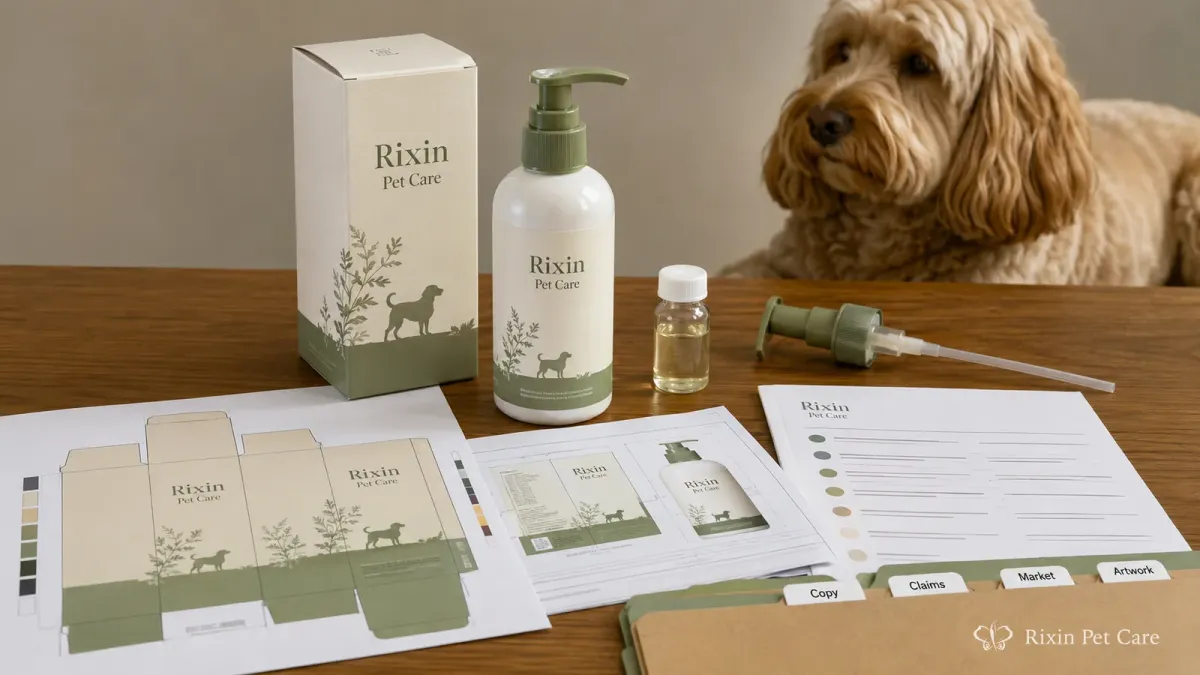
A brand can send an attractive label that still lacks confirmed directions, market context, claim questions, or correct formula and packaging references.
For private-label pet grooming buyers, label review should begin before artwork is treated as final. Give every reviewer one version-controlled set of product, formula, packaging, copy, claims, market, and artwork files.
Use the private label pet grooming products guide for the wider development path.
Manufacturer feedback can support formulation, packaging, production, and documentation discussions. It does not replace the brand’s qualified target-market legal, regulatory, or claim review.
This content is for product planning, packaging discussion, and claim-risk awareness only. It is not veterinary advice, medical guidance, or market authorization.
Quick Answer: What to Prepare Before Manufacturer Review
Prepare the review package in this order:
- Confirm the current product, formula, and packaging versions.
- Define the product identity and intended grooming use.
- Identify the target animal, application area, and use context.
- Draft directions, cautions, and warnings for review.
- List every proposed claim separately.
- Record the intended meaning and evidence question for each claim.
- Identify the target market, language, and sales channel.
- Place the copy into the current dieline or artwork version.
- Assign review and approval owners.
- Resolve open issues before approving artwork or printing.
Do not send conflicting files and expect the manufacturer to choose the final version.
What Manufacturer Review Can and Cannot Do
A manufacturer may help check whether:
- the product name matches the current formula or specification;
- the intended use fits the product format;
- the package can carry the proposed amount of copy;
- label dimensions match the selected component;
- directions match the pump, sprayer, foamer, cap, or wipe format;
- ingredient, specification, or document questions remain open;
- the artwork uses the current formula and packaging references;
- production or print instructions are unclear.
This check connects the artwork to the product. It does not replace legal, regulatory, evidence, or third-party target-market review.
The manufacturer reviews the defined project and records. The brand must assign final target-market review and approval.
Prepare the Minimum Project Context First
Before reviewing copy, record:
Product name or working name:
Product format:
Rinse-off or leave-on:
Target animal:
Application area:
Formula version:
Packaging version:
Target market:
Sales channel:
Launch language:
Current project stage:
The pet grooming product brief should contain much of this context. Include only the brief details needed to understand the current product and destination.
Copy may need revision after the formula, package, market, or channel is confirmed.
Define Product Identity and Intended Grooming Use
The product identity should tell the customer what the product is. It should not rely only on a brand mood or marketing name.
Possible descriptions include pet shampoo, conditioner, grooming spray, paw cleanser, hygiene spray, balm, or wipe. They are practical descriptions, not universal classifications.
Explain the intended grooming task in plain language. Check:
- Does the identity match the current formula and product format?
- Does the name imply a purpose the project has not evaluated?
- Does the product name contain a claim?
- Is the wording understandable to the intended customer?
- Is the identity consistent across the bottle, carton, specification, and project records?
Changing from a pump bottle to a fine-mist sprayer may require new directions, cautions, and application assumptions, not only a new dieline.
Define Target Animal, Application Area, and Use Context
Record the animal, application area, and use situation before drafting directions or claims.
Relevant questions may include:
- Is the product intended for dogs, cats, or both?
- Is it used on the coat, skin, paws, ears, eye area, or another defined area?
- Is it rinse-off or leave-on?
- Is it intended for professional or at-home grooming?
- Does the intended use depend on age, life stage, frequency, or another project-specific condition?
Phrases such as “for dogs” or “for external grooming use” may clarify context, but they are not complete wording for every market.
Ambiguous use context can cause the formula, directions, cautions, and claims to be reviewed against different assumptions.
Wash-Off vs Leave-On: Clarify the Use Route Before Label Review
A wash-off product and a leave-on product should not be reviewed against the same use assumptions. State the route explicitly in the project context, directions, artwork, and claim notes so every reviewer is working from the same intended use.
| Use route | Make clear in the review package |
|---|---|
| Wash-off | Application area, whether the coat or area should be wet, application sequence, rinse step, dispensing or package format, and proposed directions or cautions. |
| Leave-on | Application area, application method, that no rinse is intended, use context, dispensing or package format, and proposed directions or cautions. |
These are review inputs, not universal legal label requirements. Final wording depends on the defined product, intended use, target market, and qualified reviewer.
Prepare Clear Directions for Use
Directions should make the intended use sequence clear to all reviewers.
Depending on the format, the draft may need to explain:
- where to apply the product;
- whether the coat or area should be wet;
- whether the product is diluted;
- whether it is massaged, wiped, sprayed, foamed, or rinsed;
- whether it is rinse-off or leave-on;
- how the pump, sprayer, foamer, cap, or wipe is handled;
- what to do after use;
- whether storage or closure instructions are relevant.
Do not invent universal quantities, contact times, dilution ratios, or use frequencies.
Ask whether the formula and package support the described use, whether any step is ambiguous, and whether new caution or evidence questions arise.
The formula–packaging compatibility guide explains why directions and dispensing assumptions should match the intended package.
Prepare Cautions and Warnings for Review
Do not begin with a universal warning template. Begin with product-specific questions that require review.
These may involve:
- external-use positioning;
- contact with eyes or sensitive areas;
- ingestion;
- use on irritated or damaged areas;
- animal type or life stage;
- rinse-off requirements;
- storage;
- supervision;
- discontinuation or professional-contact wording;
- other formula-, use-, claim-, or market-specific concerns.
Use this workflow:
Identify the risk question
→ draft wording for review
→ name the reviewer
→ record the approved version
Final wording depends on the product, use, claims, market, and assigned reviewer. Manufacturer feedback may identify practical or technical concerns, not provide universal legal approval.
List Proposed Claims and Evidence Questions
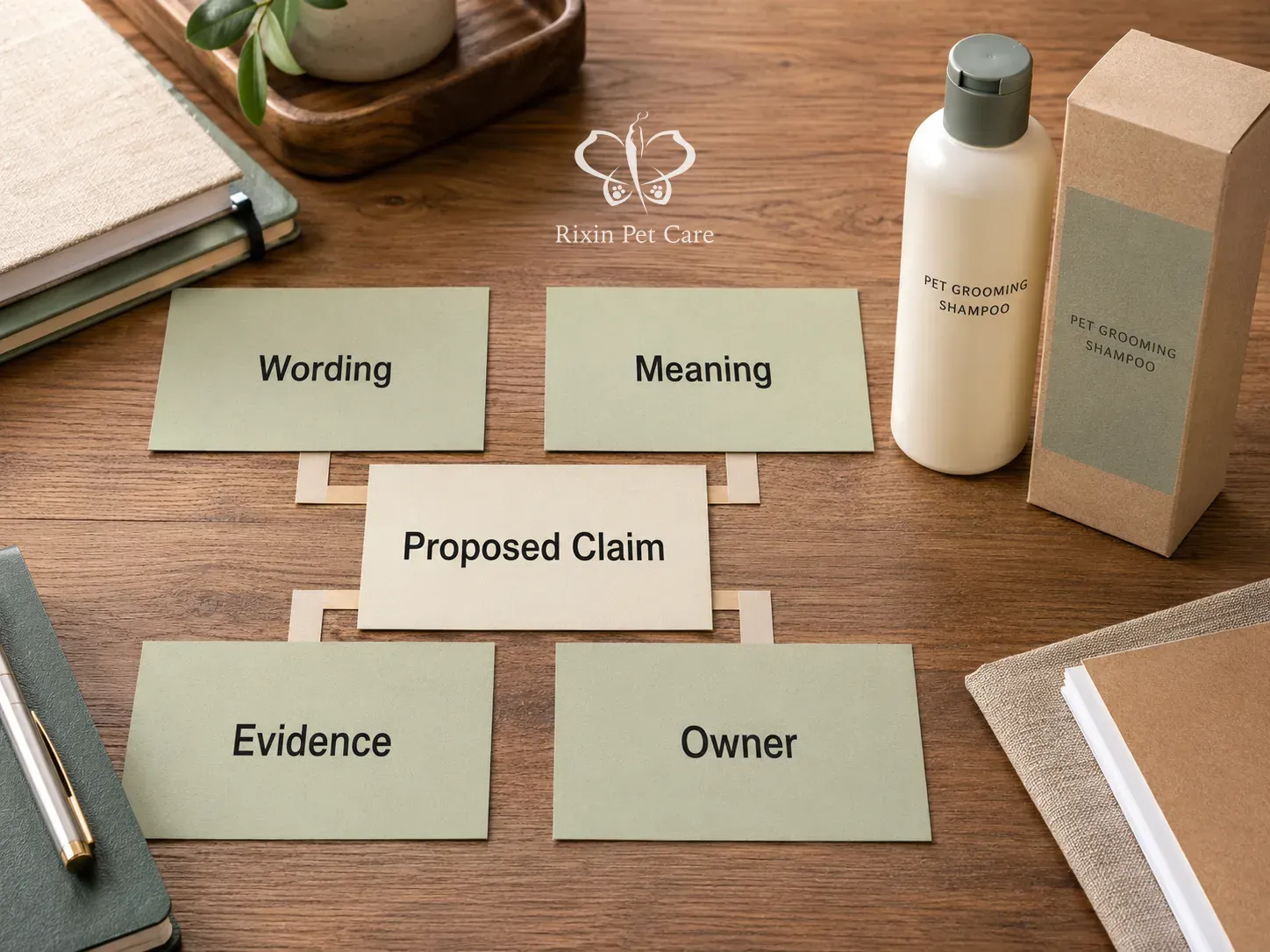
Do not bury proposed claims inside a finished design. List each one separately so reviewers can assess its meaning and status.
For every proposed claim, record:
Exact wording:
Intended consumer meaning:
Artwork location:
Formula version:
Target market:
Sales channel:
Evidence source or open question:
Manufacturer comment:
Qualified reviewer:
Status:
Claims may concern function, sensory experience, coat appearance, convenience, ingredients, suitability, sourcing, testing, safety, hygiene, endorsement, therapeutic meaning, or parasite control.
Some wording creates higher evidence or target-market review needs. Examples include therapeutic or pest-control implications, universal safety claims, endorsements or certifications, and quantified test results. Assess each proposed wording separately.
These examples are not automatically allowed or prohibited. Assess their meaning, evidence needs, market treatment, and reviewer for the defined project.
A proposed claim should not move into final artwork until its wording, intended meaning, evidence question, target market, and decision owner are recorded.
Record the Target Market, Language, and Sales Channel
The same artwork may not suit every destination. Record:
- country or market;
- language;
- responsible brand or entity;
- sales channel;
- retailer or marketplace requirements where relevant;
- professional or consumer use;
- package size;
- planned claims;
- assigned reviewer.
Target-market review may affect identity, directions, cautions, claims, ingredient presentation, language, and responsible-party information.
The manufacturer needs the destination context but does not own every market decision.
Control Formula, Packaging, Copy, and Artwork Versions
The review package should identify:
Product code:
Formula version:
Packaging version:
Dieline version:
Copy version:
Artwork filename:
Artwork version:
Language version:
Review date:
Reviewer:
Status:
A label reviewed for Formula V1 does not automatically cover Formula V2. Copy and directions may also need review after a bottle, closure, package, or claim change.
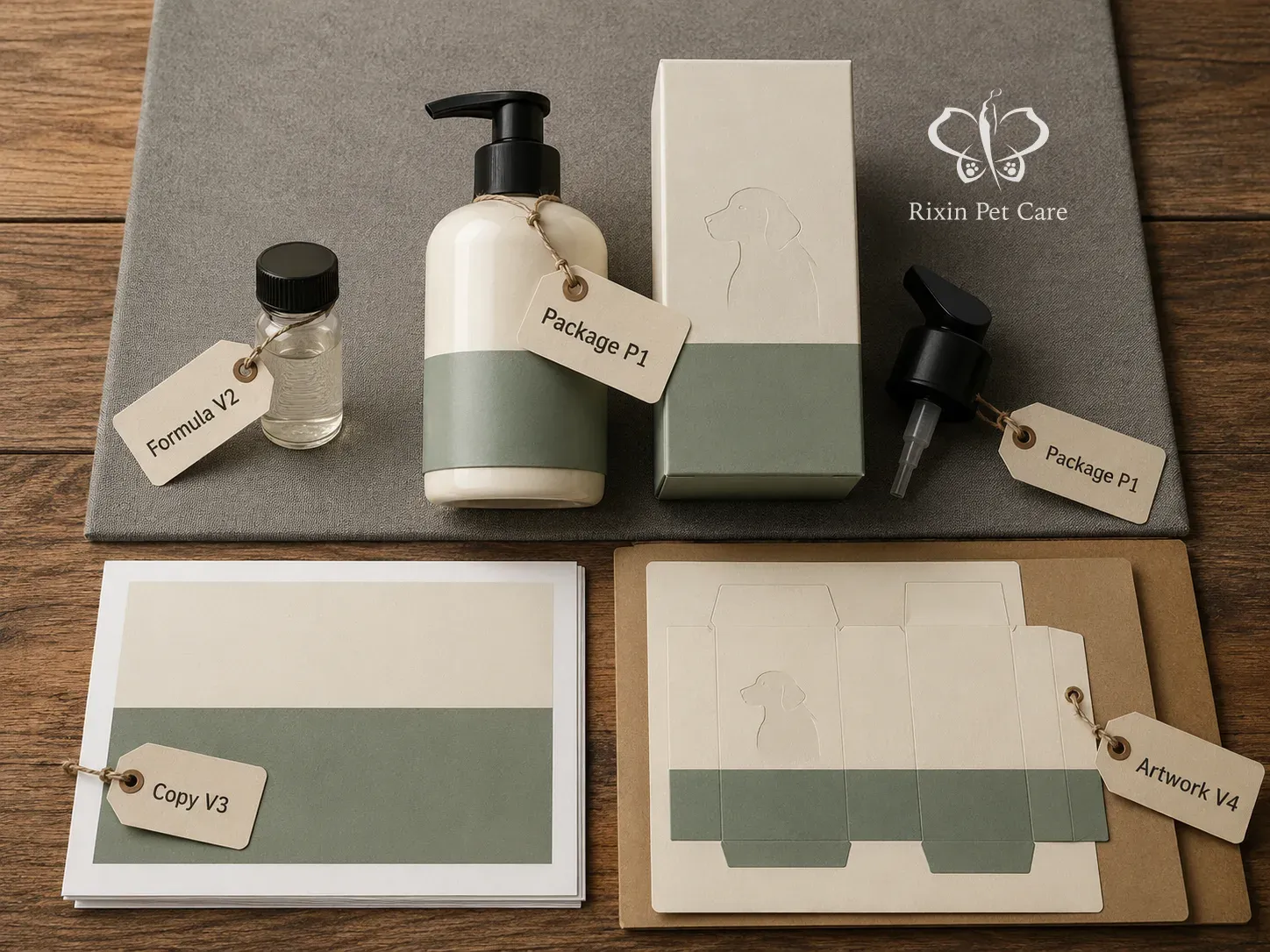
Avoid filenames such as final-final-new.pdf. Use a controlled naming pattern, for example:
productcode-market-language-copy-v03
productcode-packagep02-artwork-v05
These are examples, not mandatory formats.
The pet grooming manufacturer documents checklist explains why specifications, formula references, package references, and evidence records should match the artwork being reviewed.
Assign Review and Approval Responsibilities
Participants may include the brand, manufacturer, formulator, suppliers, designer, printer, laboratory, advisers, distributor, importer, retailer, or marketplace reviewer.
For each issue, confirm:
Who prepares the draft?
Who checks project consistency?
Who checks technical evidence?
Who checks the target market?
Who approves the wording?
Who approves the artwork?
Who releases the file for printing?
Who retains the final version?
Do not assume the manufacturer is the legal approver.
Assign an owner for technical consistency, target-market review, artwork approval, and print release; receiving the artwork is not approval.
Label and Claim Review Checklist
PROJECT CONTEXT
Product:
Product format:
Product code:
Formula version:
Packaging version:
Target animal:
Application area:
Rinse-off or leave-on:
Target market:
Language:
Sales channel:
Current project stage:

LABEL COPY
Brand name:
Product identity:
Intended grooming use:
Directions:
Cautions:
Warnings:
Storage wording:
Other project-specific fields:
Open wording questions:

PROPOSED CLAIMS
Claim wording:
Intended meaning:
Artwork location:
Formula version:
Target market:
Evidence source or question:
Manufacturer comment:
Qualified reviewer:
Status:

ARTWORK CONTROL
Dieline version:
Copy version:
Artwork filename:
Artwork version:
Language version:
Date sent:
Reviewers:
Open changes:
Current status:

RESPONSIBILITY
Draft owner:
Technical reviewer:
Target-market reviewer:
Artwork approver:
Print-release owner:
Final file owner:

FINAL CHECK
Matches current formula?
Matches current package?
Matches current claims list?
Open evidence questions resolved?
Open market questions resolved?
One approved file identified?
Approval date:
This checklist organizes review; it does not certify compliance or approve claims.
Before Artwork Approval
Before treating artwork as final, confirm that the copy, claims, formula, packaging, market, and version references belong to the same project.
If the wording is ready for a target-market check, use claim and market review support before release.
Assign unresolved questions and release one controlled file for the next stage.
Ready to Discuss Your Pet Grooming Product Project?
Share your product type, target market, packaging direction, estimated quantity, and any support you need. A rough brief is enough to start a practical next-step discussion.