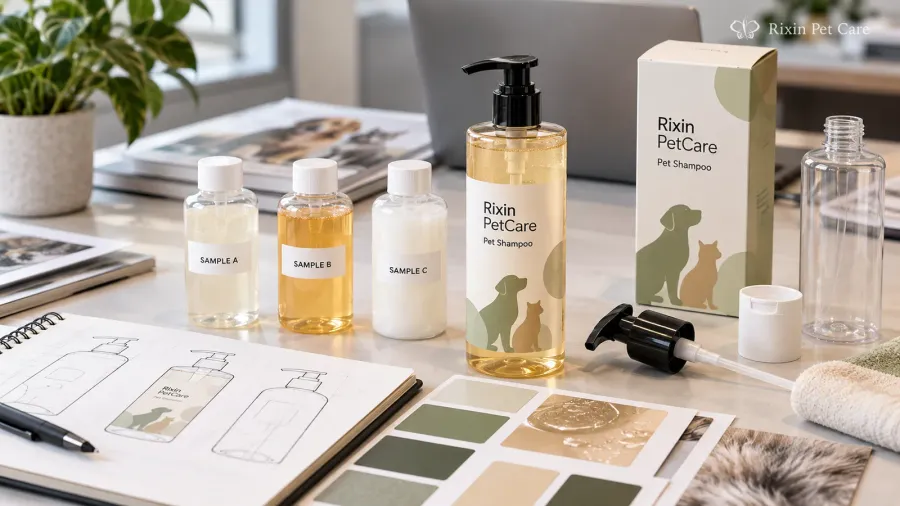
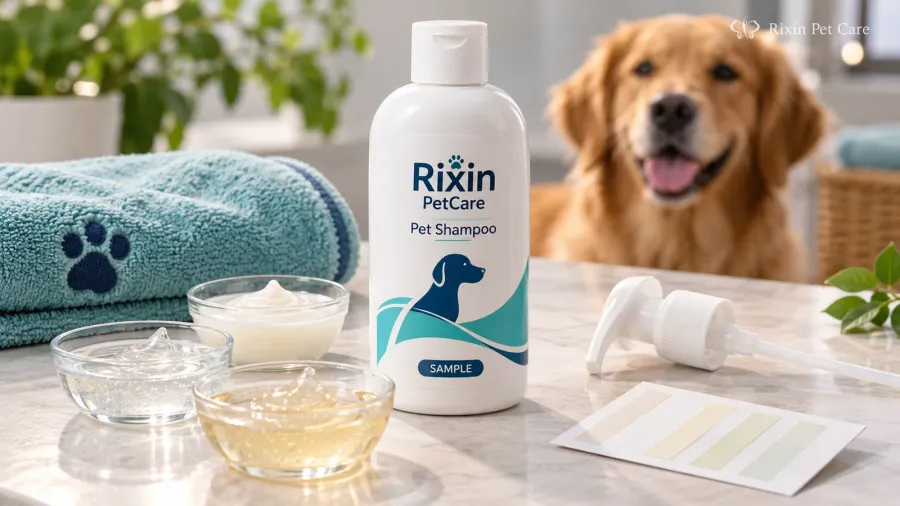
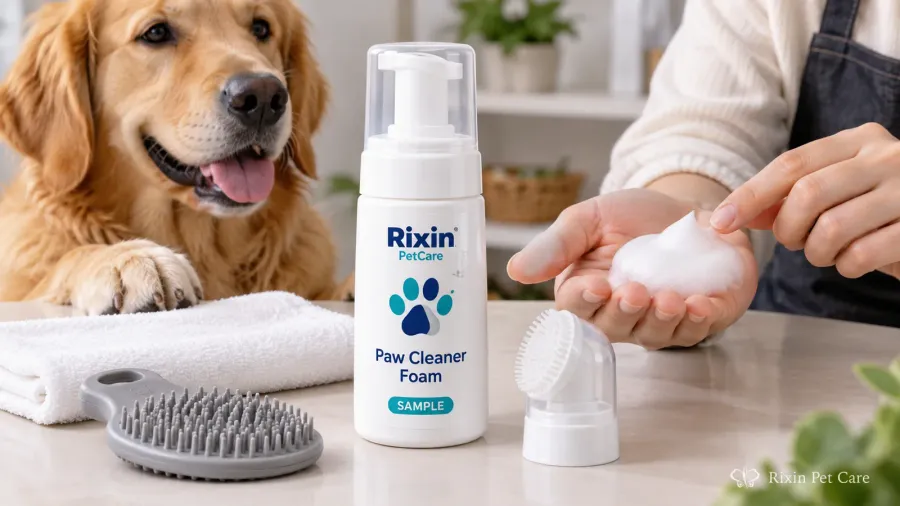
How to Evaluate a Private Label No-Rinse Pet Shampoo Sample Before Approval
Written by: Rixin Pet Care Editorial Team
Reviewed by: Product Development Team for manufacturing context and claim-risk alignment.
This content is provided for product planning, packaging discussion and claim-risk awareness. It is not veterinary advice, treatment guidance or market authorization.
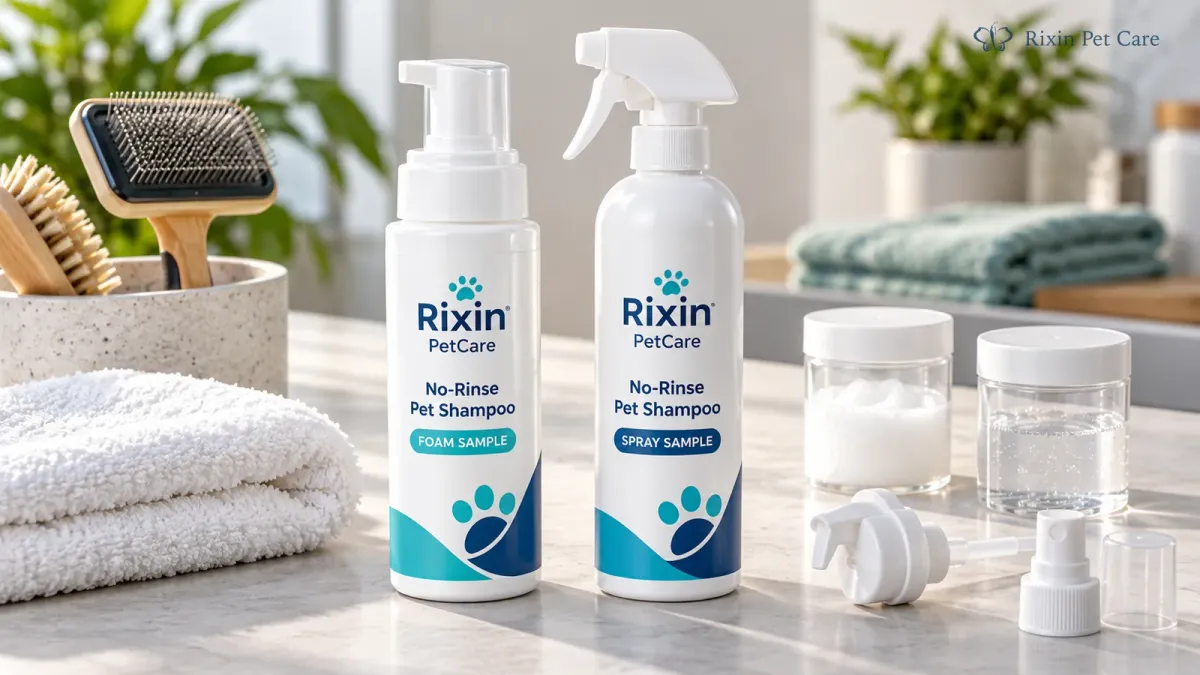
A private label no-rinse pet shampoo sample should not be approved only because the first pump produces attractive foam or the product smells good when it is applied.
For this type of product, much of the useful evaluation happens after application.
Because there is no conventional rinse step, a brand should review the complete use experience: how the product dispenses, how much wetness it creates, how easily it spreads, what happens during towel-off or brushing when applicable, how it dries, and what remains on the coat afterward.
That makes no-rinse sample evaluation different from evaluating a conventional rinse-off shampoo.
If you are still deciding whether your project should use a waterless shampoo, grooming wipe, or coat spray, start with our waterless shampoo vs wipes vs coat spray guide. If the project has already moved into a no-rinse shampoo direction, the next question is whether the physical sample actually supports the intended product experience.
What Should You Evaluate in a No-Rinse Pet Shampoo Sample?
A practical review usually needs to cover five parts of the use experience:
| Review stage | What to observe |
|---|---|
| Dispensing | Foam or spray consistency, priming, dripping, sputtering, coverage, and handling |
| Application | Controlled wetness, spreadability, distribution, and ease of use |
| Towel / brush / dry-down | How the product behaves through the agreed no-rinse routine |
| Finished coat | Stickiness, greasiness, visible residue, clumping, remaining moisture, and intended coat feel |
| Package interaction | Pump or sprayer performance, leakage, closure handling, and other visible use issues |
These are buyer observations, not technical test results.
The purpose is to decide whether the sample is moving toward the intended commercial product direction and to give the manufacturer useful revision feedback.
For broader guidance on sample identity, version control, review conditions, feedback records, and approval decisions, see our private label pet grooming sample evaluation guide.
Start by Confirming the Exact No-Rinse Product Route
Do not begin by asking whether the sample is simply “good” or “bad.”
First confirm what product you are actually evaluating.
A no-rinse pet grooming project may use different application and dispensing routes, including:
- foaming pump formats;
- fine-mist spray formats;
- trigger spray formats;
- other project-specific leave-on or wipe-off directions.
The agreed use method also matters.
Depending on the product concept, the routine may involve applying and distributing the product before towel drying, brushing, allowing it to dry, or following another agreed sequence.
There is no reason to force every no-rinse formula into one universal application method.
Before review, confirm:
- the exact sample version;
- whether the route is foam or spray;
- the intended application method;
- the target animal and grooming context defined in the brief;
- the current dispenser;
- the intended packaging direction;
- the key sensory targets already agreed with the manufacturer.
Also remember that “waterless” or “no-rinse” describes how the product is intended to be used. It does not automatically mean that the formula itself contains no water.
Evaluate the Dispenser Before Judging the Formula
With a no-rinse product, the dispenser is part of the use experience.
A formula may feel very different when delivered through a foaming pump than when applied through a fine-mist or trigger sprayer.
That is why dispensing should be reviewed early rather than treated as a packaging detail at the end of development.
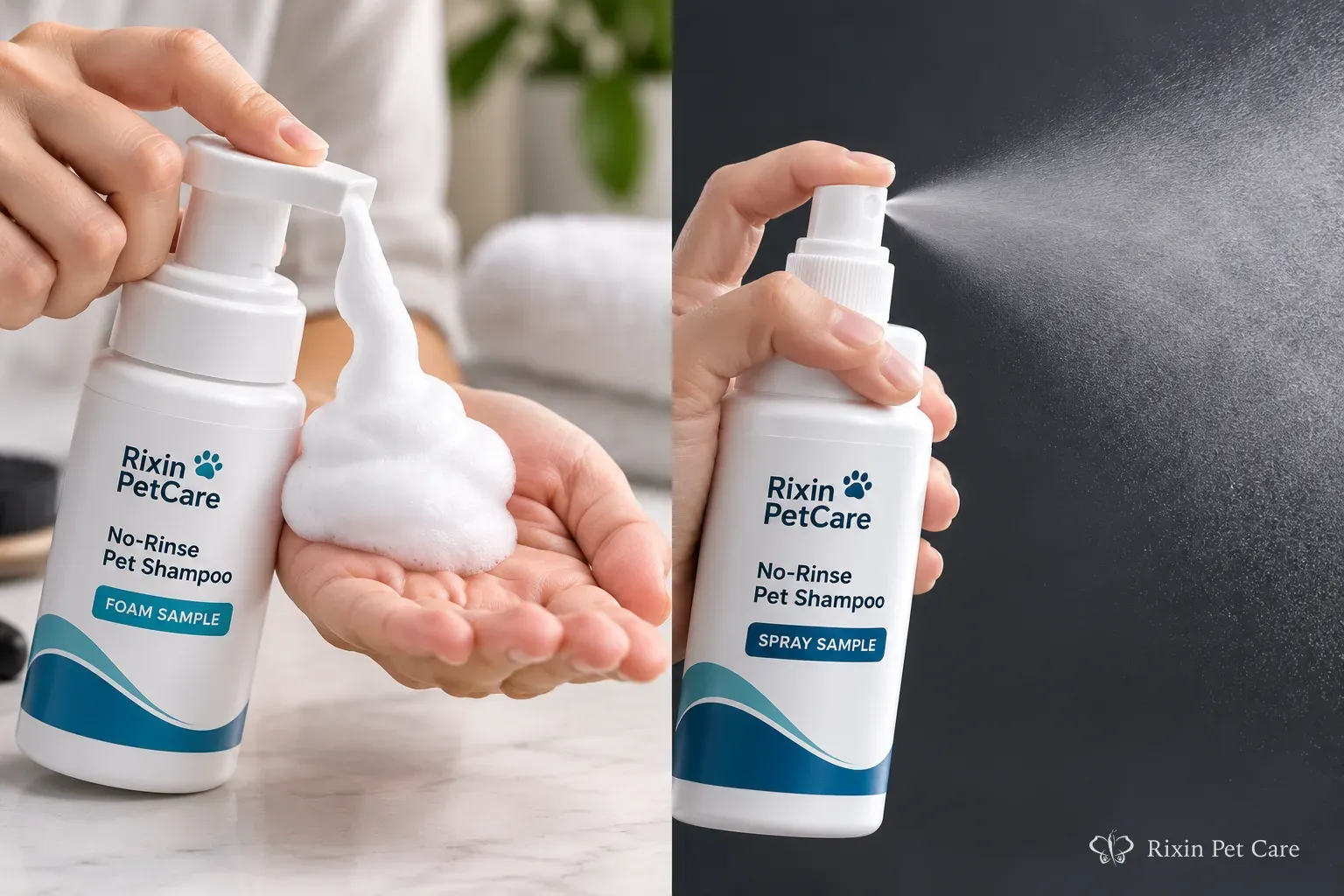
For a Foaming Pump Sample
Observe whether the pump produces the intended type of foam consistently.
Relevant questions may include:
- Is the foam soft and reasonably uniform?
- Does it appear excessively watery relative to the agreed direction?
- Does the pump deliver a similar output from one normal stroke to the next?
- Does the foam collapse before it can be distributed as intended?
- Is there excessive liquid runoff?
- Does the pump sputter?
- Is priming straightforward?
- Is the package comfortable to operate during the intended grooming routine?
There is no universal “correct” foam density.
A dense foam may suit one project while another brief may call for a lighter application. The sample should be compared with the approved product direction, not with an arbitrary industry ideal.
For a Spray Sample
Review the actual spray behaviour rather than only the formula in the bottle.
Look at:
- spray pattern;
- coverage;
- droplet size as a practical observation;
- excessive localized wetness;
- dripping;
- actuator consistency;
- ease of targeted application;
- ease of covering a larger coat area when that is part of the intended use.
A spray that applies much more liquid than expected can change the entire no-rinse experience even when the underlying formula has not changed.
Check Whether the Product Creates Controlled Wetness
A no-rinse shampoo still needs enough product to be distributed through the intended grooming area, but the sample should not be judged simply by how wet the coat becomes.
The more useful question is:
Does the application level support the intended no-rinse routine?
During review, observe:
- whether the product can be distributed through the intended area;
- whether application creates more wetness than expected;
- whether foam or spray remains easy to control;
- whether the product stays where it is applied;
- whether it spreads without requiring excessive product;
- whether the application experience matches the intended quick-use or grooming format.
For example, a buyer may find that a sample cleans or refreshes in the desired direction but applies too wet for the planned positioning.
That is useful revision feedback.
“Make it stronger” is much less useful.
Check Whether the Sample Achieves the Intended Grooming Result
Good dispensing and a comfortable application are not enough if the finished result does not match the product brief.
Under the agreed review conditions, compare the treated area with the intended grooming direction for the project.
Useful observations may include:
- whether the treated area looks cleaner or more refreshed in the intended direction;
- whether visible surface soil or an unwanted coat appearance is reduced to the degree expected for the project concept;
- whether the coat looks appropriately groomed after the agreed routine;
- whether the finished appearance supports the intended product positioning.
Keep this assessment observational.
A buyer may record that a sample produces a more visibly refreshed coat than an earlier version. That does not establish a quantified cleansing-efficacy claim or prove performance under standardized testing.
The purpose is to answer a practical development question:
Does the physical sample appear to perform the grooming role defined in the brief well enough to continue development?
Buyer-observed grooming results and validated efficacy claims are not the same thing.
Follow the Agreed Application Method Before Evaluating Dry-Down
Do not compare no-rinse samples using different application routines and then treat the results as directly comparable.
Follow the agreed method for the sample.
That may involve:
- dispensing or spraying the product;
- distributing it through the intended coat area;
- massaging where appropriate to the product direction;
- using a towel or brush where specified;
- allowing the coat to reach its normal finished state.
The exact sequence depends on the project.
If the agreed method uses a towel, observe how the product behaves during towel handling. If brushing is part of the intended routine, evaluate that step as well.
Questions may include:
- Does the product remain excessively wet during the routine?
- Is it easy to distribute before it begins to dry?
- Does the towel pick up an unexpected amount of product?
- Does brushing become difficult?
- Does the coat continue to feel heavily coated during dry-down?
These observations should be recorded before moving to the most important stage: the finished coat.
Make the Dry Finish a Major Approval Criterion
For a no-rinse shampoo, the product experience does not end when application stops.
The finished coat is one of the most important parts of sample evaluation.
Once the product has reached the normal finished state under the agreed review method, check for:
- sticky feel;
- greasy or oily feel;
- visible residue;
- powder-like or white residue;
- coat clumping;
- heavy or coated feel;
- unexpected stiffness;
- remaining moisture;
- brushability where relevant;
- softness or lightness relative to the brief.
A sample can look attractive immediately after dispensing and still produce an undesirable finished feel.
That is why it is useful to separate application observations from post-dry observations.
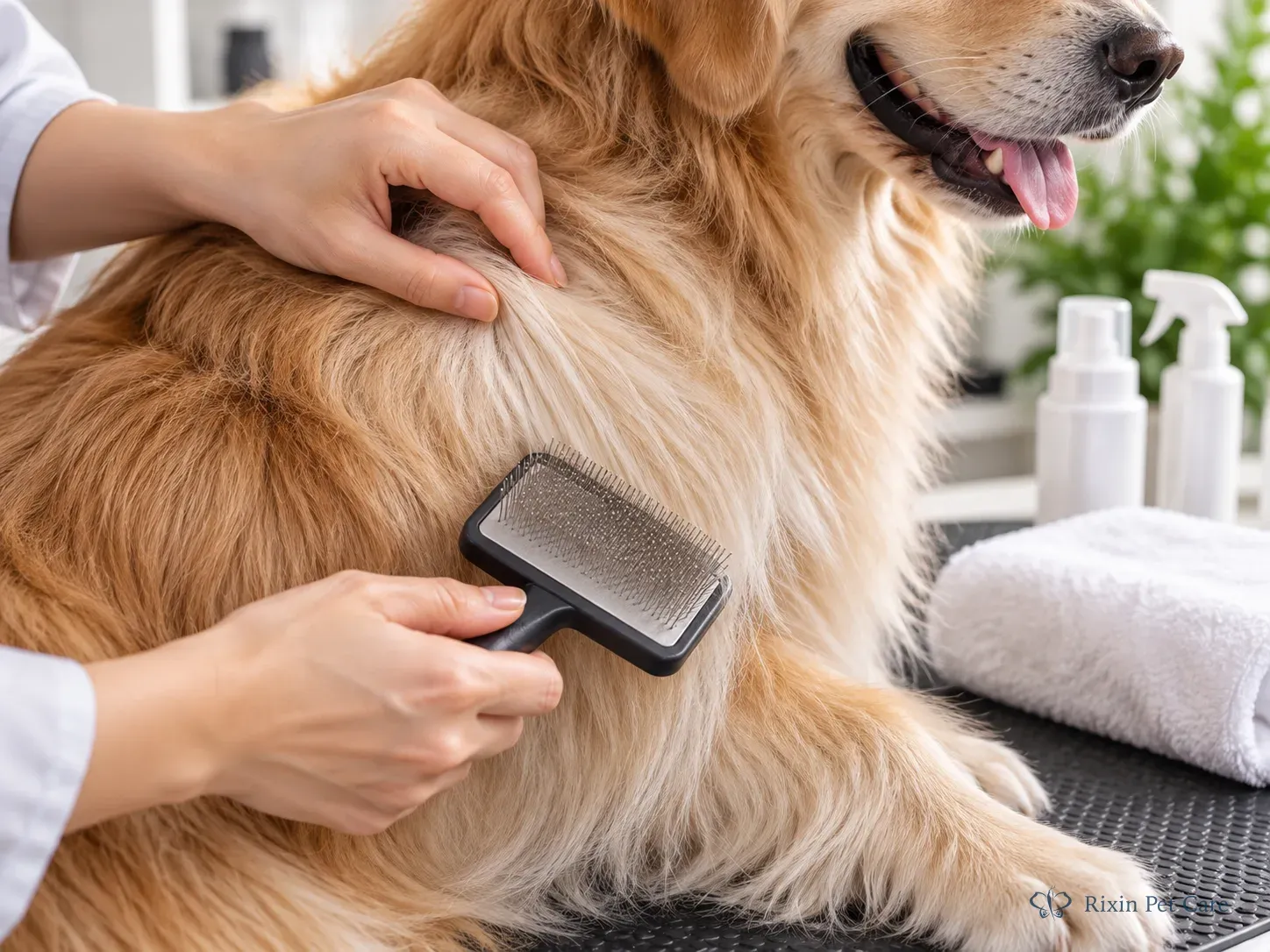
For example:
Sample B produces a more uniform foam than Sample A, but the coat feels sticky after normal dry-down.
That feedback gives the manufacturer two different pieces of information instead of one vague approval or rejection.
The same principle applies to visible residue.
If a brand wants a clean-looking finished coat, any noticeable white residue, product build-up, or clumping after the agreed routine should be documented clearly.
This does not mean the buyer has performed a formal residue test. It means the buyer observed something during a controlled product review that may require further formulation work.
Review Fragrance Again After the Coat Dries
Fragrance can change across the application cycle.
Do not evaluate it only when the product first leaves the bottle.
Review at least two moments:
- during or immediately after application;
- after the coat reaches its normal dry state.
You may find that a fragrance feels appropriate during use but remains stronger than intended afterward. The opposite can also happen: an initially noticeable fragrance may become much lighter after dry-down.
Compare the result with the approved fragrance direction.
Useful feedback is specific:
Fragrance intensity during application is acceptable, but it remains stronger than the target after the coat dries.
Less useful feedback is:
The fragrance is too strong.
The first version gives the development team a clearer review context.
If the project is intended to be fragrance-free, evaluate the sample against that agreed direction rather than introducing a fragrance preference during sample review.
Evaluate the Formula and Package as One Use System
Once the delivery route and finished product experience have been reviewed, consider whether the selected formula and package work together as a practical use system.
Observable issues during normal sample handling—such as inconsistent delivery, product collecting around the closure, leakage, or another package-related problem—should be recorded because they may affect the next packaging or formulation decision.
These observations can identify questions that need further review.
They do not establish long-term formula–package compatibility.
Formal compatibility, stability, transport, and other project-specific technical assessments are separate from what a buyer can see during ordinary sample use. Our formula and packaging compatibility guide explains that distinction in more detail.
If the sample direction is promising but the delivery package still needs adjustment, the project may need package review rather than a complete formula restart. Rixin’s pet grooming packaging and label design service covers packaging route, dispensing and artwork preparation as part of development.
Turn Sample Reactions Into Manufacturer-Usable Feedback
A sample review is most useful when feedback describes what actually happened.
Instead of:
The foam is bad.
Use:
Compared with Sample A, Sample B produces a wetter foam and more liquid runoff during normal application. We want the next sample to move toward the drier, more uniform foam direction of Sample A.
Instead of:
It feels greasy.
Use:
After following the agreed application method and allowing the coat to dry normally, the treated area has a heavier, greasier feel than our target.
Instead of:
The spray does not work.
Use:
The current sprayer produces large localized droplets and leaves the application area wetter than intended for the quick-use concept.
Instead of:
The scent is wrong.
Use:
The initial fragrance is close to the target, but it remains stronger than desired after dry-down.
A useful product-specific feedback note usually includes:
Observation → review context → comparison or reference → desired direction
The general sample evaluation guide covers the broader process for organizing sample versions and consolidating feedback.
When Should You Request Another Physical Sample?
Not every comment requires a completely new development cycle, but material changes to the product experience should usually be reviewed in physical form before final approval.
A revised sample may be appropriate when changes affect:
- formula feel;
- controlled wetness;
- dry-down;
- residue;
- fragrance;
- foam behaviour;
- spray behaviour;
- dispenser choice;
- packaging route.
For example, changing from a spray to a foaming package is more than an artwork change. It changes how the buyer interacts with the formula.
Similarly, a meaningful formula revision intended to reduce sticky after-feel should be evaluated after the new sample dries rather than approved only from a written formulation explanation.
The goal is not to maximize the number of sample rounds.
It is to make sure that the version being approved is the version whose actual use experience supports the project direction.
What Can a No-Rinse Sample Review Not Prove?
A physical sample is important, but it cannot answer every technical or market question.
A buyer’s use review alone does not establish:
- microbiological quality;
- preservative-system performance;
- stability;
- shelf life;
- long-term formula–package compatibility;
- transport performance;
- production-batch conformity;
- irritation or sensitivity performance;
- universal suitability across animals;
- market authorization;
- claim substantiation.
Those questions may require different documentation, testing, technical review, or market-specific assessment depending on the project.
This distinction matters because a sample can feel commercially promising without the project being technically or commercially ready for production.
Likewise, an observable package issue does not automatically identify its technical cause.
Use sample review to identify what the buyer experiences. Use the appropriate technical work to determine why it happens and whether the final system is acceptable.
For projects that need formula revision, Rixin’s pet grooming formula development service can support the next development round within the agreed product brief.
A Practical No-Rinse Sample Review Record
Before approving a direction, confirm that your review notes cover the areas that matter to the specific project.
Product Identity
- correct sample version;
- foam or spray route;
- agreed application method;
- intended package direction.
Dispensing
- pump or sprayer consistency;
- foam or spray presentation;
- priming;
- dripping or sputtering;
- visible leakage.
Application
- controlled wetness;
- spreadability;
- ease of distribution;
- ability to follow the intended grooming routine.
Grooming Result
- visible grooming or cleansing direction relative to the brief;
- finished coat appearance;
- whether the treated area supports the intended product concept.
Dry-Down
- towel or brush handling where applicable;
- remaining moisture;
- time and behaviour through the normal review process.
Finished Coat
- stickiness;
- greasiness;
- visible or white residue;
- clumping;
- heavy or coated feel;
- intended coat feel;
- brushability where relevant.
Fragrance
- initial impression;
- fragrance after normal dry-down;
- fit with the agreed direction.
Next Revision
- what should remain unchanged;
- what should be adjusted;
- whether a new physical sample is required;
- whether the package route is still appropriate.
This checklist is for organizing buyer observations. It is not a substitute for technical testing or formal product approval.
What Happens After the Sample Direction Is Accepted?
Once the no-rinse experience is moving in the right direction, the project can become more specific.
The next stage may include confirming:
- the exact accepted sample version;
- foam or spray route;
- fragrance direction;
- bottle and dispenser;
- fill-size direction;
- remaining packaging questions;
- artwork inputs;
- documentation requirements;
- testing requirements;
- market-facing wording that still requires review.
If these decisions are not yet organized into a manufacturer-facing project definition, use the pet grooming product brief guide to record the product route, intended use, packaging direction, quantities, and open questions before the next review.
If you are still comparing no-rinse product formats, review our private label waterless pet shampoo options. For broader product-line planning, the private label pet grooming products guide shows how different grooming formats can fit into a private-label range.
When you are ready to move from sample evaluation into a defined OEM/ODM project, submit your project requirements so the formula, dispensing, packaging, and next development steps can be reviewed together.
Ready to Discuss Your Pet Grooming Product Project?
Share your product type, target market, packaging direction, estimated quantity, and any support you need. A rough brief is enough to start a practical next-step discussion.