Private Label vs White Label vs OEM Pet Products: What Is the Difference?
Written by: Rixin Pet Care Editorial Team
Reviewed by: Product Development Team for manufacturing context and claim-risk alignment.
This content is provided for product planning, packaging discussion and claim-risk awareness. It is not veterinary advice, treatment guidance or market authorization.
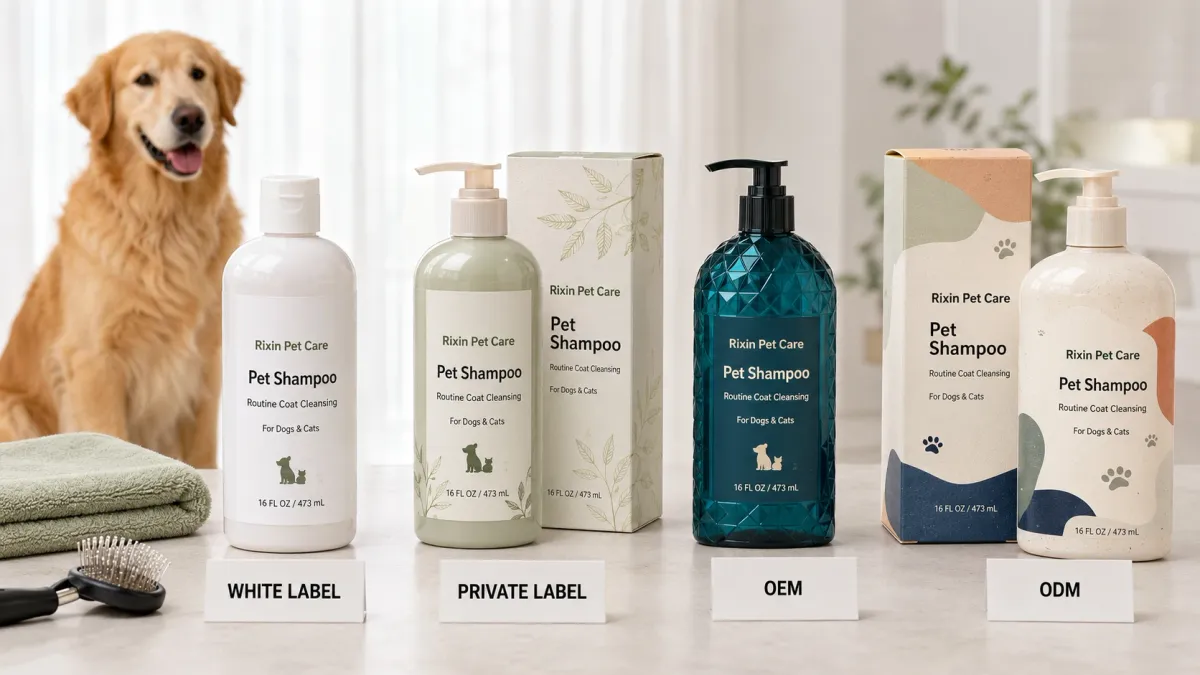
A pet grooming buyer may receive several proposals for a shampoo, grooming spray, wipe, or paw cleanser, yet each supplier may describe the project differently. One may call it white label, another private label, and another OEM.
These terms are useful, but they are not universal specifications. The buyer still needs to confirm what already exists, what may change, who controls each decision, and what must be approved before production.
This guide compares private label vs white label pet products, including OEM and ODM, so you can choose the manufacturing route that fits your project. For the wider sourcing and development path, use the complete private label pet grooming products guide.
Quick Answer
- White label usually starts with an existing product and allows limited changes around branding and available presentation options.
- Private label commonly starts from an established formula direction that can be adjusted within agreed limits.
- OEM usually follows a more detailed buyer brief, benchmark, formula, or target specification.
- ODM gives the manufacturer a larger role in proposing the product concept or development direction.
The practical question is not which term sounds more advanced. It is what the written scope includes: the starting formula, permitted changes, buyer input, manufacturer input, ownership terms, approvals, and responsibilities.
White Label, Private Label, OEM, and ODM Compared
| Area | White Label | Private Label | OEM | ODM |
|---|---|---|---|---|
| Starting point | Existing product or formula | Established formula direction | Buyer brief, benchmark, formula, or specification | Manufacturer-led or jointly developed concept |
| Product changes | Limited | Selected adjustments | Broader buyer-led development | Depends on the agreed concept |
| Buyer input | Lower | Moderate | Higher | Moderate |
| Manufacturer input | Available product and production options | Production plus selected development support | Translation of a defined buyer target | Stronger concept and product-direction support |
| Typical fit | Category or channel testing | New brands and line extensions | Brands with defined product requirements | Buyers needing more concept support |
| Main risk | Limited differentiation | Assuming every requested change is included | Starting with an unclear or changing brief | Accepting a concept without defining control and approval |
These are common patterns, not fixed legal or industry definitions. Two suppliers may use the same term for different scopes.
What Are White Label Pet Products?
White label pet products usually begin with an existing product direction that may also be available to other buyers. The brand owner applies its own name and market presentation, while the underlying formula and production route remain largely established.
A supplier may still offer approved choices for fill size, stock bottle, closure, existing fragrance, label, carton, or bundle. These options do not automatically make the formula exclusive or deeply customized.
White label can fit a seller testing a familiar category, a salon adding retail products, or a retailer filling an assortment gap. Its main benefit is lower development complexity. Differentiation may come more from branding, channel, assortment, and customer experience.
What Are Private Label Pet Products?
Private label commonly begins with an established formula direction that can be adjusted within agreed limits.
Depending on the project, selected changes may include fragrance, appearance, viscosity, foam, rinse feel, fill size, stock packaging, or line presentation. The manufacturer should confirm which changes are available and what additional review they require.
Private label often fits new brands and line extensions that need more control than white label without defining a completely new technical target.
For an overview of how Rixin structures this type of project, review the private label pet grooming process.
The cooperation model and the formula route are separate decisions. A private label project may use a ready-made base with selected adjustments, while another project may require broader development. Review that distinction in Ready-Made Formula vs Custom Formulation for Pet Grooming Products.
What Does OEM Mean for Pet Products?
OEM usually means the manufacturer works from a more detailed buyer requirement. The project may begin with:
- a product brief;
- a physical benchmark;
- an established formula requiring broader changes;
- a buyer-owned formula;
- a target specification;
- a defined package or application requirement.
OEM does not necessarily mean developing a formula from zero. It means the buyer provides a clearer target, and the parties define the development and production scope needed to meet it.
This route suits brands that need stronger control and can provide timely decisions, consolidated feedback, and a stable brief. Use the pet grooming product brief guide to organize the required inputs.
For more detail on Rixin’s custom project route, review OEM and custom pet grooming manufacturing.
What Are ODM Pet Products?
ODM usually gives the manufacturer a larger role in shaping the initial product concept. The buyer may define the audience, channel, positioning, and commercial direction, while the manufacturer proposes a product format, formula route, packaging direction, or connected product line.
The project may become more buyer-led after concept selection. The written scope should still define who controls changes, samples, packaging decisions, technical approval, and final product approval.
How Buyer Control Changes Across the Models
White label usually gives the buyer the least control over the underlying product. Private label allows selected changes within an established route. OEM gives the buyer more influence over the technical target. ODM gives the manufacturer more responsibility for proposing the starting concept.
More customization is not automatically better. It can add decisions, cost, and development work without creating a meaningful commercial difference.
Choose the level of control the product actually needs. Packaging, positioning, assortment, and channel can create useful differentiation even when the formula starts from an established direction. For a deeper commercial breakdown, use the private label pet grooming cost factors guide.
Formula Ownership and Exclusivity Are Separate Questions
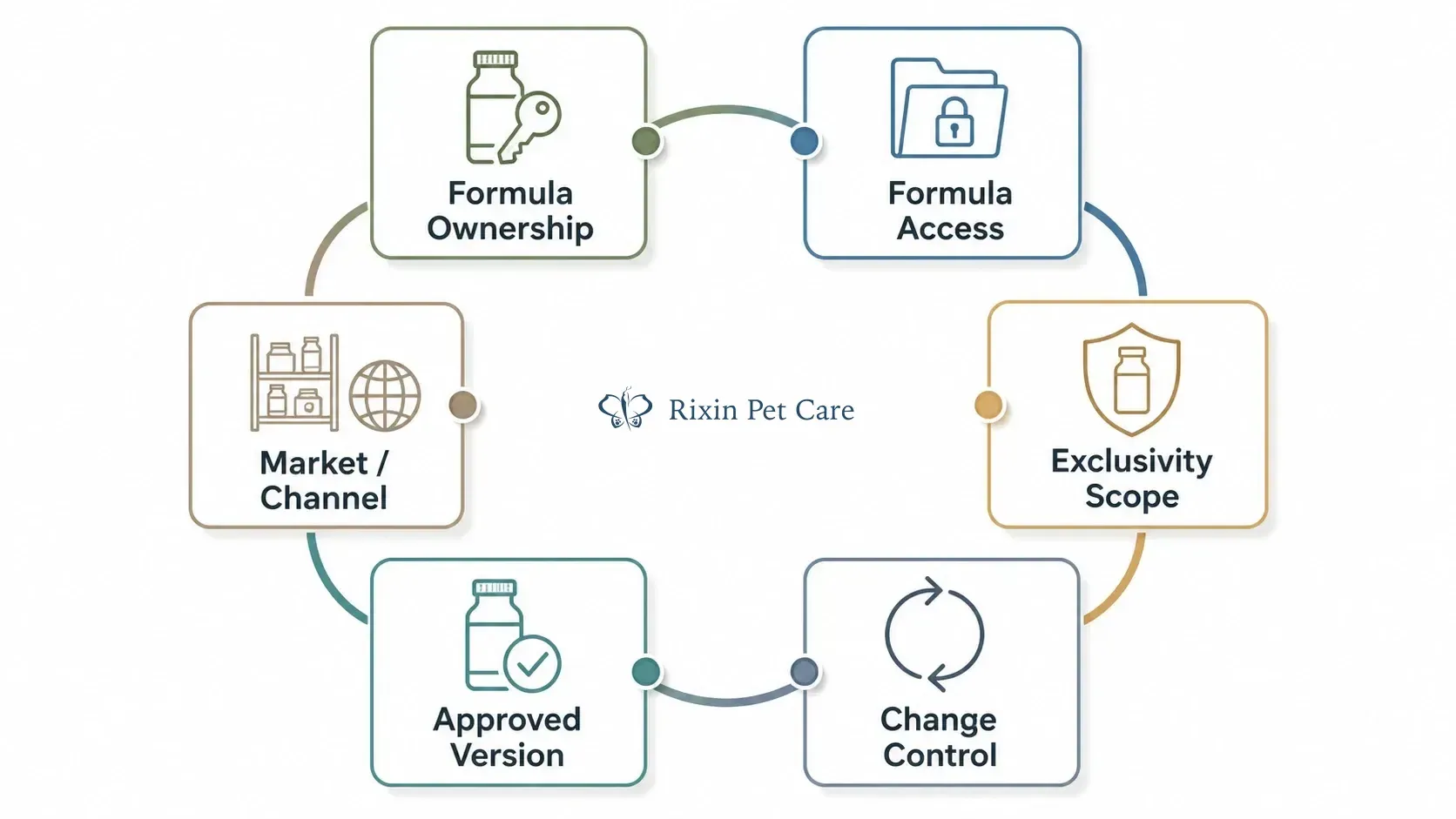
A product carrying your brand name does not automatically give you ownership of the formula, unrestricted technical access, or market exclusivity.
The manufacturer may retain the base formula. The buyer may provide a formula. Or the parties may agree on limited usage or exclusivity. Restrictions may apply to a specific version, market, channel, period, or order quantity.
Confirm the following in writing:
- formula ownership or permitted use;
- confidentiality obligations;
- access to technical information;
- change-control responsibility;
- exclusivity scope and limitations.
WIPO explains that confidential formulas and other commercially valuable information may be protected as trade secrets when reasonable confidentiality measures are used. See the WIPO trade secret FAQs.
Five Questions for Choosing the Right Model
1. What already exists?
Ask whether the supplier is offering an existing product, an adjustable formula direction, a development route based on your brief, or a manufacturer-proposed concept.
2. What must be different?
Define whether the required difference is branding, fragrance, texture, application, packaging, product size, formula target, or the complete technical specification.
3. How much buyer input can the project support?
Deeper OEM work requires a stable brief, timely decisions, and consolidated feedback. A simpler route may be more suitable when approval responsibilities are unclear.
4. What level of control is commercially necessary?
Decide whether you need control over branding only, selected product characteristics, a defined product target, or the complete technical specification.
5. What is included in the written scope?
Confirm the starting formula, permitted changes, samples, packaging coordination, approval responsibilities, ownership terms, and production deliverables.
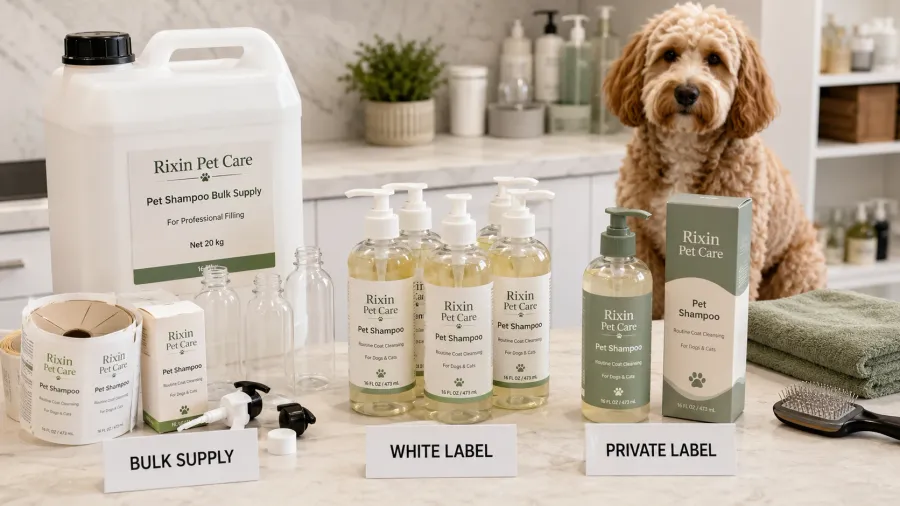
Bulk supply for local filling is a separate sourcing route rather than another name for white label or OEM. Review it in Bulk Pet Grooming Products for Local Filling.
Which Route Fits Different Projects?
| Project situation | Likely starting route |
|---|---|
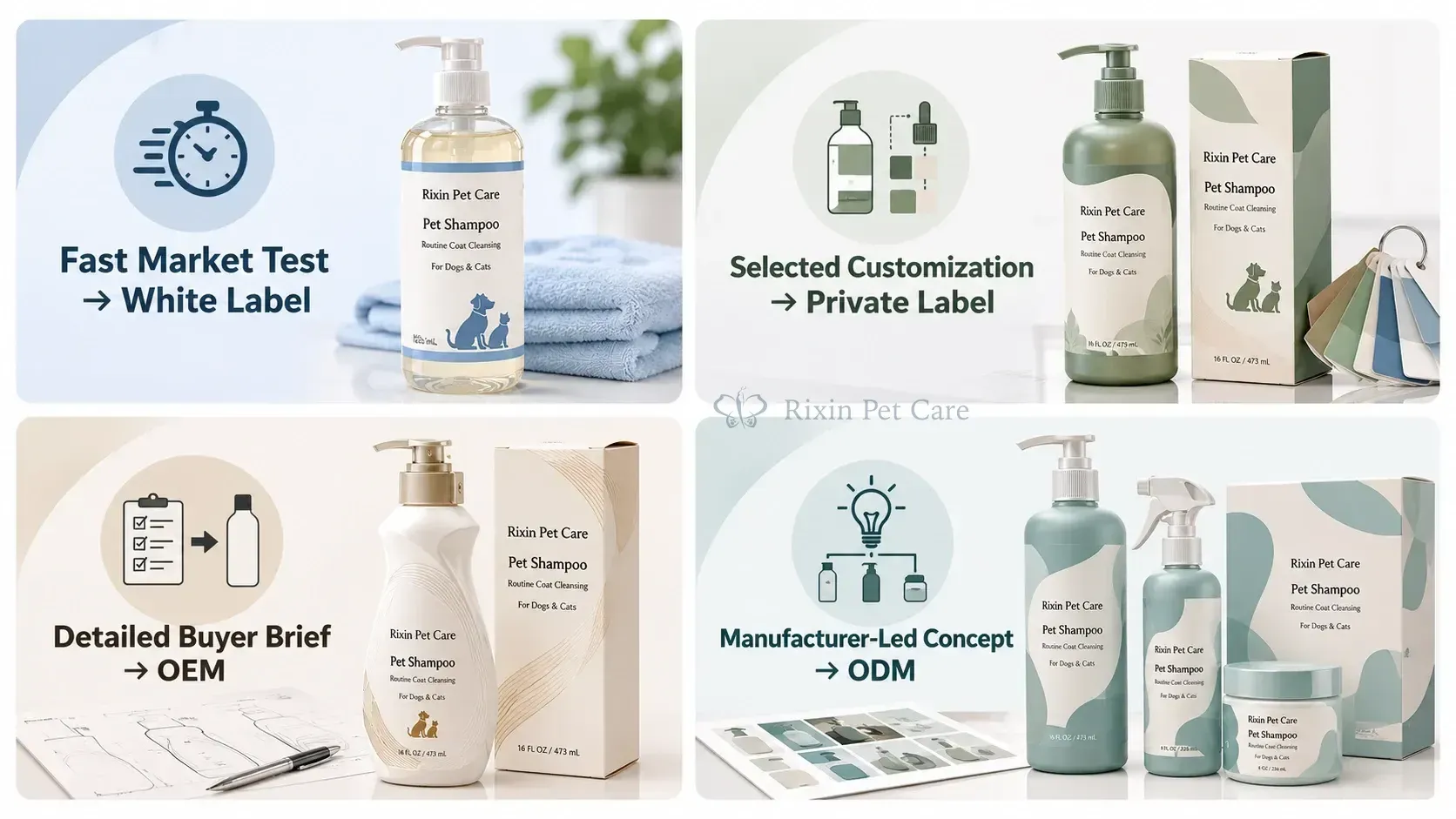
| Testing a familiar category with limited development | White label |
| Launching a branded line with selected product or packaging changes | Private label |
| Recreating a defined sensory, application, or technical target | OEM |
| Entering the category without a finished product concept | ODM |
| Receiving product in large containers for local filling | Bulk supply, assessed separately |
This table is only a starting point. The final scope, approval responsibilities, and ownership terms still need written confirmation.
Common Model-Selection Mistakes
Common mistakes include:
- assuming every supplier uses the terms identically;
- treating private label as automatic formula ownership;
- requesting OEM without a stable brief;
- choosing deeper customization without a defined commercial reason;
- assuming packaging, documents, or exclusivity are included;
- comparing proposals that cover different work.
Once the likely model is clear, compare manufacturers against the same project definition. The guide on how to choose a private label pet grooming manufacturer explains the separate supplier-selection decision.
Choose the Work Scope, Not the Label
The central question is not which model name sounds more advanced. It is which route gives the brand the necessary control without adding work that does not improve the product or commercial offer.
Compare the starting point, permitted changes, buyer input, manufacturer input, ownership terms, approval responsibilities, and production scope. Then choose the simplest model that can meet the documented project requirements.
This content is for product planning, packaging discussion, and claim-risk awareness only. It is not veterinary advice, medical guidance, or market authorization.
Ready to Discuss Your Pet Grooming Product Project?
Share your product type, target market, packaging direction, estimated quantity, and any support you need. A rough brief is enough to start a practical next-step discussion.