Private Label & OEM Guides

What Affects the Cost of Private Label Pet Grooming Products?

RP Rixin Pet Care Editorial Team Published Updated 23 min read B2B Pet Care Insights

Written by: Rixin Pet Care Editorial Team

Reviewed by: Product Development Team for manufacturing context and claim-risk alignment.

This content is provided for product planning, packaging discussion and claim-risk awareness. It is not veterinary advice, treatment guidance or market authorization.
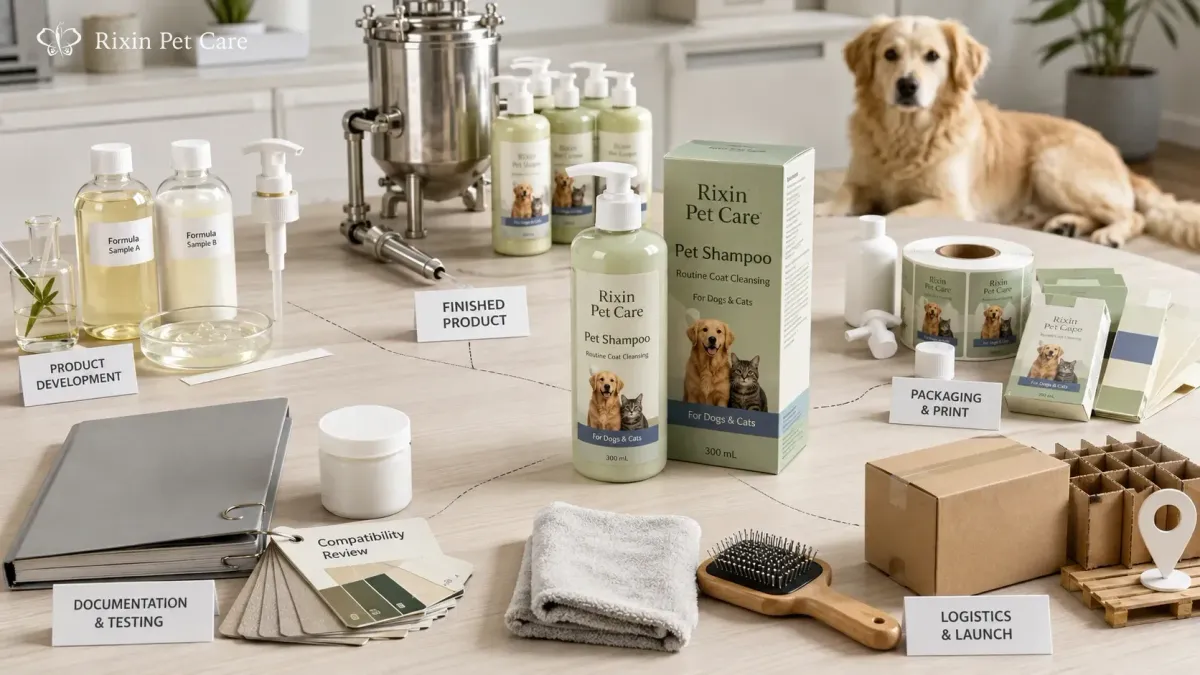
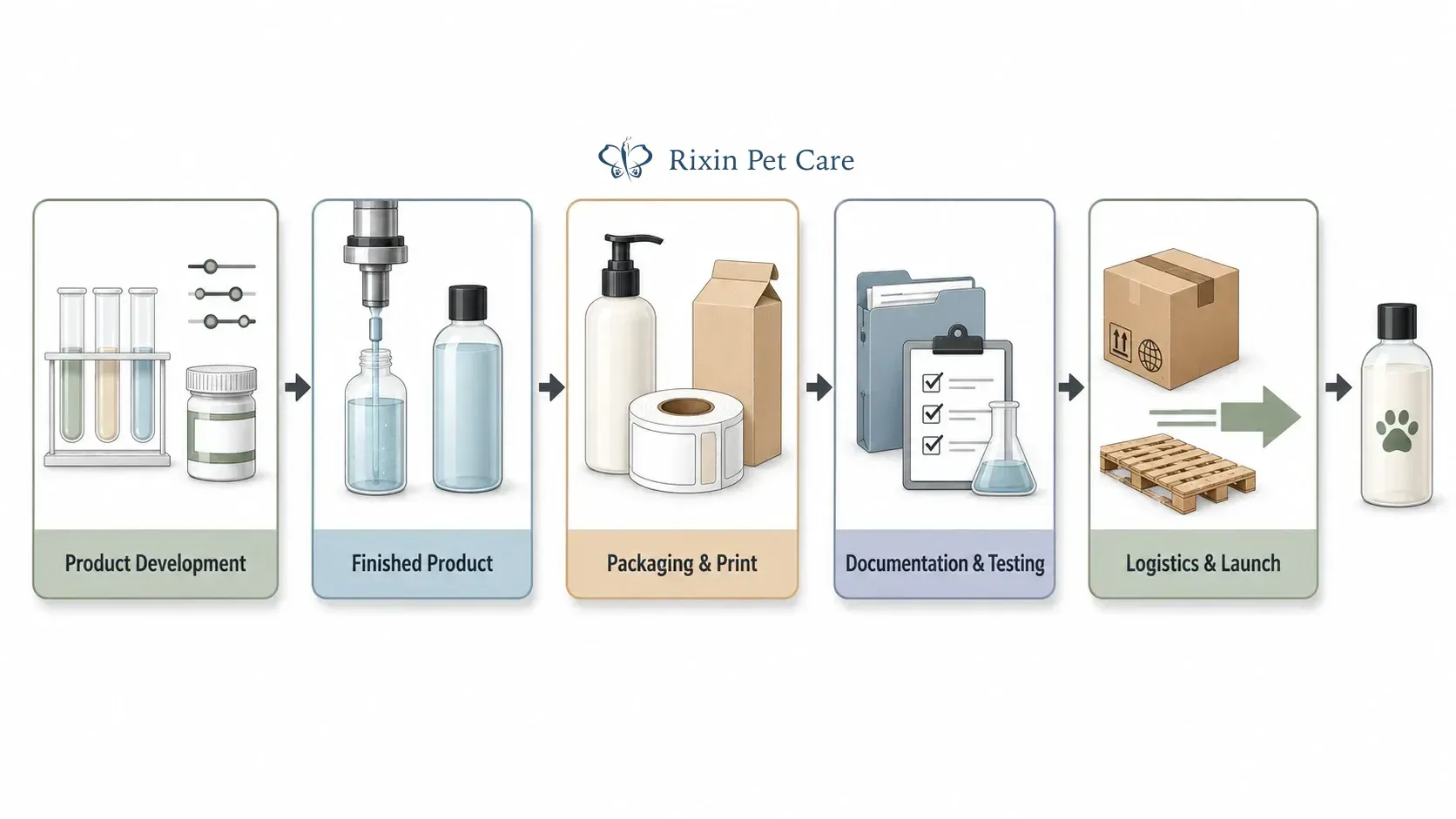
Five cost layers behind a private label pet grooming product project

Two manufacturers can quote the same general product category and return very different prices. That does not automatically mean one supplier is expensive and the other is competitive.

They may be quoting different projects.

One quotation may use a mature formula, a stock bottle, a pressure-sensitive label, one sample round, and a factory-gate delivery term. Another may include formula adjustments, a selected fragrance, a pump and printed carton, several sample rounds, agreed testing support, additional documents, inspection, and freight to a named destination.

Until those differences are removed, the prices are not directly comparable.

A useful review of private label pet grooming product cost should cover five connected layers:

Product Development → Finished Product → Packaging & Print → Documentation & Testing → Logistics & Launch

This framework helps brand owners compare quotations against the same specification instead of selecting the lowest visible unit price and discovering the missing items later.

For a wider overview of manufacturing routes, sampling, MOQ, supplier review, and launch planning, read the complete guide to private label pet grooming products.

Quick Answer

The cost of a private label pet grooming product depends on more than the formula inside the bottle.

A complete project may include:

  1. Product development — formula route, benchmark review, samples, revisions, and project-specific development work.
  2. Finished product — bulk manufacturing, filling, line setup, quality checks, coding, assembly, and finished-unit packing.
  3. Packaging and print — bottles, closures, pumps, sprayers, labels, cartons, decoration, and any dies, plates, cylinders, or molds.
  4. Documentation and testing — agreed specifications, batch documents, SDS where applicable, testing support, compatibility work, and market-specific wording review where included.
  5. Logistics and launch — inspection, export packing, freight, insurance, customs clearance, duties, taxes, local handling, warehousing, and final delivery.

The most useful question is not only:

“What is the price per bottle?”

It is:

“What formula, package, quantity, document, testing, and shipping scope is included in that price?”

There is no universal price for every shampoo, spray, cleanser, wipe, fragrance, package, market, or order quantity. A manufacturer needs a defined project scope before preparing a meaningful quotation.

A Five-Layer Cost Framework

Cost LayerTypical ScopeMain Buyer Question
Product developmentFormula route, samples, benchmark work, revisionsWhat work is included before production?
Finished productBulk manufacturing, filling, coding, packing, line setupWhat is included in the finished-unit price?
Packaging and printBottle, closure, label, carton, decoration, toolingAre all components and artwork versions included?
Documentation and testingSpecifications, batch files, agreed evaluations, wording reviewWhich items are included, optional, or buyer-managed?
Logistics and launchInspection, freight, insurance, import charges, local deliveryWhere does the supplier’s responsibility and cost stop?

A clear quotation should also show whether each charge is:

  • One-time or recurring
  • Per formula, fragrance, size, artwork, or SKU
  • Included in the unit price or quoted separately
  • Payable to the manufacturer or another provider
  • Confirmed or still open because the specification is incomplete

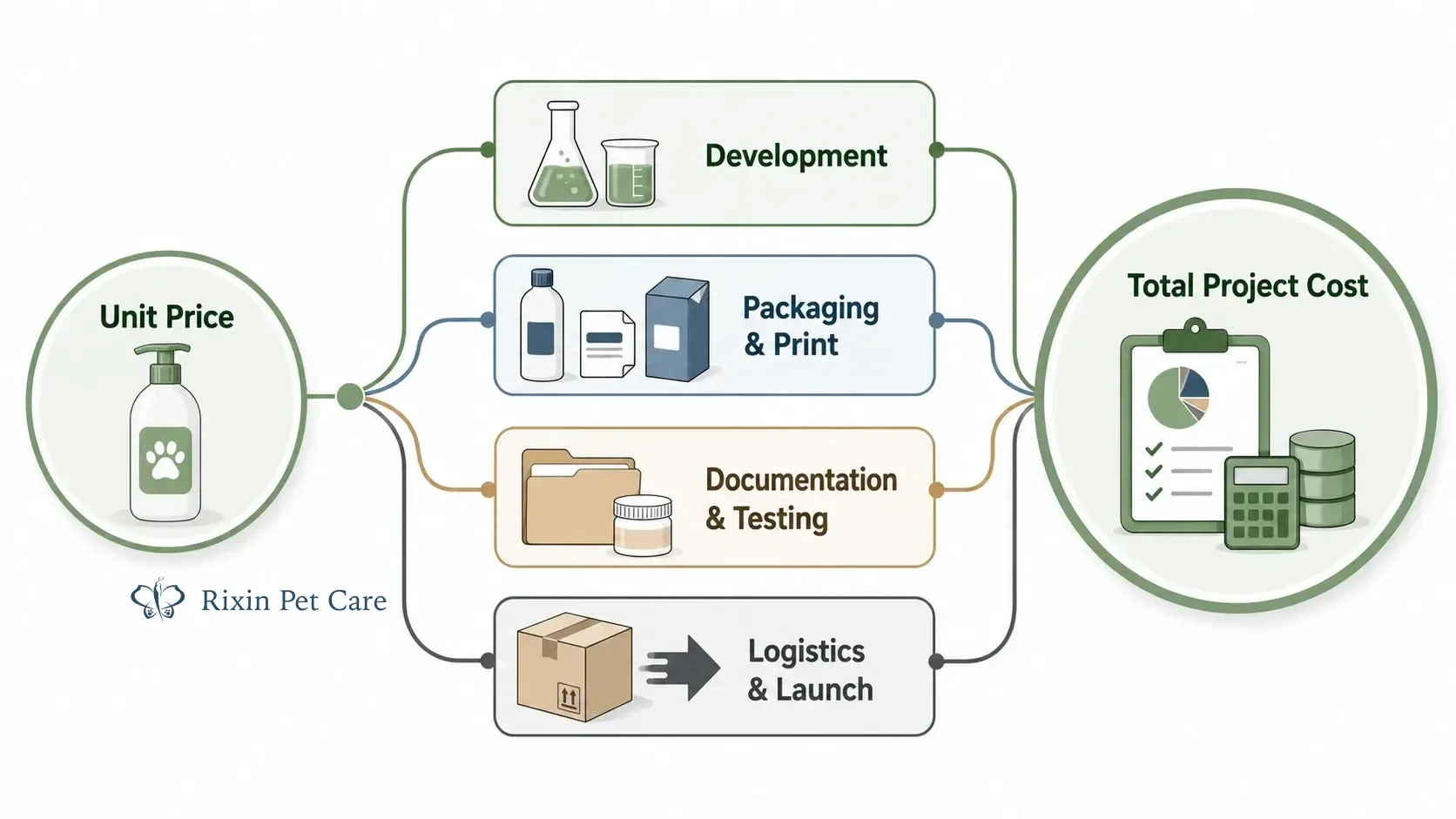
Five-layer cost framework for private label pet grooming product projects

Unit Price vs Total Project Cost

A unit price is the amount assigned to one finished unit under a stated order scope. It may include the formula, filling, selected packaging, label application, coding, and packing. It may also exclude some of those items.

A total project cost includes the other purchases and work needed to reach the agreed delivery point and prepare the product for launch.

These figures answer different questions.

What a unit price may include

Depending on the quotation, the unit price may include:

  • Agreed formula
  • Bulk manufacturing
  • Filling
  • Bottle or primary package
  • Pump, sprayer, cap, or closure
  • Label and label application
  • Batch coding
  • Finished-product assembly
  • Basic export-carton packing
  • Agreed in-process or release checks

Never assume this scope. Ask the supplier to state it in writing.

What may be charged separately

Separate charges may include:

  • Formula development
  • Extra sample rounds
  • Sample freight
  • Special ingredients or fragrance
  • Packaging samples
  • Printed cartons
  • Direct printing or decoration
  • Dies, plates, cylinders, screens, or molds
  • Selected laboratory work
  • Additional document preparation
  • Third-party inspection
  • Pallets or special freight packing
  • International freight and insurance
  • Duties, taxes, customs brokerage, and destination handling

A low unit price can therefore sit inside a high total project cost. A higher unit price may include work that another supplier lists separately.

Factory price is not landed cost

A factory quotation ends at the point stated in the commercial terms. Landed cost follows the goods through the agreed transport and import stages to the buyer’s receiving location.

Do not use EXW, FCA, FOB, CIF, DAP, or DDP as though they describe the same cost boundary. The quotation should state the selected Incoterms® rule, named place or port, and version.

The International Chamber of Commerce explains that Incoterms® rules allocate key delivery tasks, costs, and risks between buyer and seller. They do not replace a complete sales contract. Review the official Incoterms® 2020 information.

A planning equation

For internal budgeting:

Total project cost = development + finished goods + packaging and print + documentation and testing + logistics and launch

A brand may then estimate:

Landed cost per expected sellable unit = total cost to the receiving point ÷ expected sellable units

Expected sellable units may differ from ordered units when a project includes retained samples, photography units, inspection units, permitted quantity variation, or a transit-loss allowance. This is a planning calculation, not a customs or accounting rule.

Unit price compared with development, packaging, testing, logistics, and total project cost

Formula Route and Development Cost

The formula starting point affects how much work is required before production.

Mature formula route

A mature formula route starts from an established product structure or manufacturing process. The brand may accept it largely as presented or request a limited set of changes.

Work may still include:

  • Reviewing the intended grooming use
  • Confirming target pet and application area
  • Selecting a fragrance direction
  • Reviewing appearance, viscosity, foam, rinse, and residue preferences
  • Confirming dispensing and packaging direction
  • Preparing samples
  • Recording the approved version

A mature formula route may reduce development scope, but it does not automatically make the finished product generic. Packaging, artwork, product naming, fill size, sales channel, scent, and assortment strategy can still create a distinct market offer.

Selected customization

Selected customization may include changes to:

  • Fragrance
  • Color or appearance
  • Viscosity
  • Foam profile
  • Rinse preference
  • Coat after-feel
  • Ingredient direction
  • Fill size
  • Dispensing format

A small request can create several technical tasks. A viscosity change may affect mixing, filling, pump output, and sample approval. A fragrance change may affect appearance, viscosity, product odor during storage, and packaging interaction.

The manufacturer should identify which requests fit an established production route and which create additional development work.

Deeper OEM development

A deeper OEM project may begin with:

  • A detailed product brief
  • A physical benchmark
  • A buyer-owned formula or specification
  • A defined sensory target
  • A new product format
  • Several connected products that need coordinated development

This route may involve more technical review, sample materials, revision rounds, scale-up work, and formula-packaging coordination.

The cooperation label alone does not determine cost. The actual development scope does.

For more information, review Pet Grooming Formula Development.

Ingredient and Fragrance Direction

An ingredient affects cost through more than its price per kilogram. Purchase minimums, supplier availability, usage level, shelf life, documentation, storage, processing, and compatibility can all matter.

Regularly used vs project-specific materials

Materials already used in the manufacturer’s regular production system may be easier to source in practical quantities. A buyer-selected specialty material may require:

  • A separate supplier
  • A larger supplier purchase quantity
  • Longer procurement time
  • Specific storage conditions
  • Additional incoming information
  • Purchase of more material than the first batch consumes
  • A plan for unused inventory

Ask who owns unused material, how long it may be stored, and whether it can be used in a future production run.

Ingredient percentage is not the only driver

A material used at a low percentage may still create substantial project cost when it has a large purchase minimum, short shelf life, special transport requirements, or a limited supplier base.

A higher-use material may be commercially efficient when it is regularly stocked and used in several products.

This is why two ingredient lists cannot be compared accurately without sourcing and processing context.

Fragrance direction

Fragrance can affect:

  • Supplier purchase quantity
  • Sample count
  • Formula appearance
  • Viscosity
  • Product odor during storage
  • Formula variation count
  • Label accuracy
  • Batch and SKU planning

A standard fragrance, buyer-selected fragrance, custom fragrance direction, and fragrance-free direction may each create a different project scope.

Launching one shampoo in three scents may require separate sample approvals, formula codes, batch planning, labels, inventory forecasts, and component allocation.

Product Format and Filling Complexity

Product format affects equipment, line preparation, filling speed, process checks, expected loss, cleaning, and packing work.

Bottled rinse-off products

A pet shampoo project may involve:

  • Bulk transfer
  • Fill-volume setup
  • Bottle feeding
  • Closure application
  • Seal or liner application where selected
  • Labeling
  • Coding
  • Leakage checks
  • Finished packing

A thicker product may fill differently from a lower-viscosity liquid. A small retail bottle may use a different setup from a larger salon or refill format.

Review common product decisions on the Private Label Pet Shampoo page.

Sprays, pumps, and foaming formats

Fine-mist sprayers, trigger sprayers, pumps, and foaming pumps need suitable formula viscosity and component performance.

Cost may be affected by:

  • Component price
  • Dip-tube cutting
  • Sprayer or pump output
  • Closure torque
  • Overcap assembly
  • Formula transfer requirements
  • Priming and leakage review
  • Additional component inspection

A cheaper dispensing component may create higher operational cost if it is not suitable for the formula or transport route.

Wipes and pouches

A wipes quotation may combine:

  • Formula
  • Substrate
  • Sheet dimensions
  • Thickness
  • Fold pattern
  • Wipe count
  • Liquid load
  • Pouch film
  • Printed rollstock
  • Resealable label or lid
  • Forming, filling, and sealing

Ask whether substrate, formula, film, print setup, closure, and finished packing are all included.

Production setup and actual yield

Each production run may require line clearance, machine adjustment, coding setup, in-process checks, and cleaning. These tasks exist even when the order is relatively small.

Actual finished yield may also be affected by:

  • Formula retained in mixing or transfer equipment
  • Filling adjustment
  • Start-up and shutdown loss
  • Retained samples
  • Damaged packaging components
  • Rejected units
  • Permitted quantity variation

Ask how ordered quantity, planned production quantity, and actual shippable quantity are handled in the quotation and purchase terms.

Packaging Components

Packaging can create as much cost variation as the formula.

Primary packaging is a component system

A bottle quotation may need to include:

  • Bottle
  • Pump, sprayer, cap, or closure
  • Overcap
  • Dip tube
  • Liner or gasket
  • Plug or reducer
  • Tamper-evident feature
  • Label
  • Coding area
  • Assembly work

Confirm each component instead of relying on a general packaging description.

Stock packaging

Stock packaging uses existing molds, available colors, and established specifications. It may reduce tooling and purchasing complexity, but material, color, neck size, closure, and availability still need confirmation.

A stock package can still support a recognizable product line when it uses:

  • Clear label hierarchy
  • A coordinated color system
  • A consistent bottle and closure family
  • Purposeful fill sizes
  • Strong product photography
  • A connected SKU architecture

Special-order packaging

A standard component that is not currently stocked may require a supplier production lot, longer lead time, or purchase of excess pieces.

The quotation should state:

  • Quantity purchased
  • Quantity used for the first order
  • Quantity remaining
  • Ownership of the remaining inventory
  • Storage conditions and duration
  • Reorder availability
  • What happens if the component is changed or discontinued

Custom packaging

Custom color, shape, decoration, or molding may add:

  • Color matching
  • Pre-production samples
  • Tooling
  • Larger component commitments
  • Longer approval stages
  • Additional acceptance criteria
  • Storage of unused components

Custom packaging should solve a functional or commercial problem. It should not be selected only because it sounds more premium.

For packaging planning support, visit Pet Grooming Label and Packaging Design.

Labels, Cartons and Decoration

Printing cost depends on more than artwork dimensions.

Pressure-sensitive labels

Label cost may change with:

  • Material and adhesive
  • White, clear, metallic, or textured stock
  • Laminate or coating
  • Shape and cutting die
  • Number of colors
  • Print process
  • Roll direction
  • Application method
  • Number of artwork versions
  • Quantity per design

A front-and-back label system also differs from one wraparound label.

Printed cartons

Carton cost may include:

  • Board material
  • Structural design
  • Printing
  • Cutting die
  • Coating
  • Foil
  • Embossing or debossing
  • Window or insert
  • Assembly
  • Packing labor

A retail carton can also change product dimensions, case count, pallet efficiency, and freight volume.

Direct decoration

Screen printing, hot stamping, shrink sleeves, coatings, and other decoration routes may create separate setup, tooling, registration, and production requirements.

A stock bottle with a label may be more practical for an early order when the brand expects wording, barcode, distributor, or design changes.

Artwork versions multiply scope

The same physical product may need different labels or cartons for:

  • Different scents
  • Different sizes
  • Different languages
  • Different markets
  • Different distributors
  • Retail and professional channels

Ask whether printing minimums and setup charges apply per artwork or can be combined across compatible versions.

Samples and Revision Rounds

Several types of samples may be involved in one project.

Formula samples

A formula sample may require ingredients, fragrance, small-batch preparation, sample filling, internal review, coding, packing, and courier delivery.

Packaging samples

A packaging sample may be:

  • An empty stock component
  • A color reference
  • A decorated prototype
  • A carton proof
  • A printed label proof
  • A filled compatibility sample
  • A production-standard sample

These samples do not represent the same cost or level of approval.

Define revision scope

Ask the manufacturer to state:

  • Number of formula rounds included
  • Number of variants in each round
  • Whether packaging samples are included
  • Whether sample freight is included
  • What counts as a revision
  • What happens when the product brief changes
  • Whether an approved reference sample is retained

“Reduce the scent strength” is different from changing the product type, benchmark, ingredient direction, package, and target market after development has started.

Specific feedback controls cost more effectively than broad comments such as “make it more premium.”

Testing and Documentation

Testing and documentation should be defined according to the formula, format, package, intended grooming use, target market, buyer, importer, retailer, distributor, and sales channel.

There is no identical package that applies to every pet grooming project.

Possible project discussions

Depending on the project, the quotation may address:

  • Product or formula specification
  • Ingredient information
  • Batch COA
  • SDS where applicable
  • Stability support
  • Microbial testing
  • Preservative challenge testing
  • Packaging compatibility
  • Filling and package checks
  • Artwork and wording review
  • Market-specific document review
  • Retailer or distributor requests

The quotation should identify what is standard, project-specific, internally completed, externally coordinated, optional, or buyer-managed.

Changes may affect the evaluation scope

A mature formula in an established package may have a different review scope from a newly adjusted formula in a new dispensing system.

Changes to fragrance, preservative system, viscosity, ingredients, packaging material, closure, or intended use may affect the agreed evaluation plan. Do not assume that information from an earlier version automatically applies to a changed formula or package.

Public wording should be reviewed before printing

Formula direction, intended use, available support, target market, label wording, product-page copy, and advertising should be considered together.

For U.S. planning, the FDA describes products intended solely to cleanse or beautify animals as animal “grooming aids.” See the FDA’s Compliance Policy Guide on Animal Grooming Aids.

The FTC states that objective express and implied advertising claims should have a reasonable supporting basis. See the FTC Policy Statement Regarding Advertising Substantiation.

These references do not determine the requirements for every country or product. Final classification, wording, files, and responsibilities should be reviewed for the actual formula, intended use, and target market.

Quantity and Production Efficiency

Order quantity affects unit cost because fixed and semi-fixed work is distributed across the production run.

Possible setup work includes:

  • Production scheduling
  • Formula preparation
  • Line clearance
  • Filling setup
  • Label and coding setup
  • In-process checks
  • Cleaning
  • Packing preparation
  • Documentation
  • Pallet preparation

When the same work is spread across fewer finished units, the cost per unit may increase.

A larger order is not automatically lower risk

A larger quantity may reduce some unit costs but increase:

  • Finished-goods inventory
  • Storage requirements
  • Working-capital use
  • Forecast risk
  • Artwork-change exposure
  • Component obsolescence
  • Slow-moving SKU exposure

The commercially useful order is one the brand can finance, receive, store, sell, and reorder.

Quantity should be defined per variant

A quotation should state quantity by:

  • Formula
  • Fragrance
  • Fill size
  • Packaging combination
  • Artwork
  • SKU
  • Production run

For a detailed explanation of overlapping formula, packaging, print, and SKU minimums, read the private label pet grooming MOQ guide.

Molds, Plates, Cylinders and Setup Charges

Some costs support production but are not part of the recurring material cost.

Examples may include:

  • Bottle or closure mold
  • Mold insert
  • Carton or label cutting die
  • Printing plate
  • Screen
  • Gravure cylinder
  • Color-matching setup
  • Coding setup
  • Pouch setup
  • Prototype tooling

Questions to ask about tooling

  1. What is the charge for?
  2. Is it one-time or recurring?
  3. Who owns the tool?
  4. Where is it stored?
  5. How long is it retained?
  6. Can it be transferred?
  7. Can another supplier use it?
  8. Does ownership include exclusivity?
  9. Who pays for maintenance or replacement?
  10. What happens when the design changes?

Paying a tooling charge does not automatically mean the brand owns the tool, receives exclusivity, or can move it to another supplier. These terms should be documented.

Separate setup from unit cost

A quotation is easier to review when it separates:

  • One-time development charges
  • One-time tooling charges
  • Recurring setup charges
  • Per-unit materials and production
  • Optional packaging or service upgrades

This also makes reorder pricing easier to understand.

Inspection, Freight and Incoterms

Shipping scope can substantially change the apparent project price.

Inspection

Inspection may include:

  • Manufacturer’s own finished-product checks
  • Buyer-appointed inspection
  • Third-party pre-shipment inspection
  • Carton-count verification
  • Packaging and appearance sampling
  • Loading supervision
  • Document review

Clarify who arranges and pays for each activity and what happens if an issue is identified.

Freight preparation

Freight-related cost may include:

  • Export cartons
  • Dividers or protective materials
  • Pallets and stretch wrap
  • Shipping labels and marks
  • Domestic transport to a port or airport
  • Export handling
  • Freight forwarding
  • Main carriage
  • Insurance
  • Destination handling
  • Final delivery

Retail packaging also affects logistics. An oversized pump, large cap, rigid carton, or inefficient case pack may increase shipping volume without changing the formula.

Incoterms® scope

An Incoterms® rule should be shown with a named place or port and the applicable version, for example:

FCA [named place], Incoterms® 2020

The rule helps allocate delivery tasks, costs, and risks. It does not by itself define the product specification, payment terms, ownership transfer, quality acceptance, or every local charge.

Compare quotations only after confirming:

  • Incoterms® rule and version
  • Named place or port
  • Export-clearance responsibility
  • Main-freight responsibility
  • Insurance responsibility
  • Import-clearance responsibility
  • Destination charges
  • Final delivery point
  • Risk-transfer point

Duties, Taxes and Local Handling

Landed cost may continue after international freight.

Possible destination-side costs include:

  • Customs broker
  • Import declaration
  • Duty
  • Import tax
  • Government fees
  • Port or terminal handling
  • Customs examination
  • Storage
  • Demurrage or detention
  • Drayage
  • Delivery appointment
  • Warehouse receiving
  • Pallet handling
  • Relabeling or other local work
  • Final domestic delivery

The actual amount depends on destination, product classification, origin, customs value, shipment route, importer structure, and current rules.

For U.S. imports, U.S. Customs and Border Protection provides official information on basic importing and exporting and determining duty rates.

A destination-cost estimate should not be presented as a guaranteed landed amount unless the shipment scope, route, importer responsibilities, classification basis, and commercial terms support that statement.

The buyer should identify the importer of record and obtain destination-specific guidance where required.

Why Two Manufacturer Quotes May Look Very Different

Two quotations can differ because the scopes are different, not only because the suppliers use different margins.

Scope AreaLower Quotation May ExcludeHigher Quotation May Include
FormulaExisting formula with no changesFormula adjustment or deeper development
SamplesOne basic sample or later billingDefined rounds and packaging samples
IngredientsRegular materialsProject-specific material or fragrance purchase
PackagingBottle only or basic stock packComplete component set, selected closure, seal, or carton
PrintingLabel or setup not includedLabel, carton, decoration, proofs, and setup
TestingStandard internal checks onlyAgreed project-specific or third-party support
DocumentsBasic production filesAdditional buyer, channel, or market work
QuantityOne larger SKUSmaller quantities or several variants
ToolingCharged laterIncluded or clearly itemized
InspectionBuyer-managedThird-party inspection included
FreightFactory-gate scopeExport handling, freight, insurance, or delivery
Import costsBuyer-managedSome destination coordination or estimates

Neither structure is automatically better. The correct choice depends on the work the brand needs and the responsibilities each supplier accepts.

How to Compare Quotations on the Same Scope

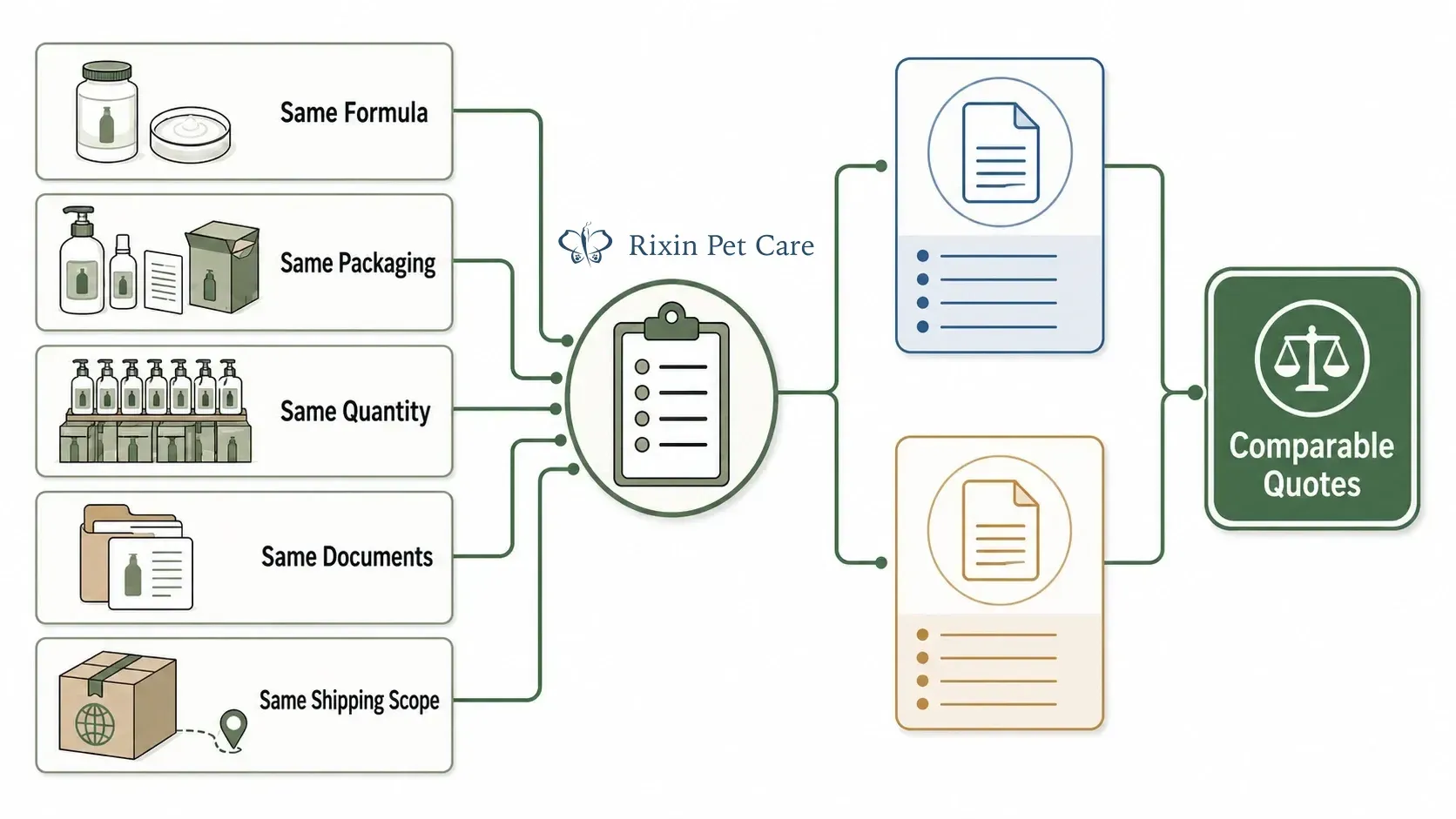
Use one written comparison specification for every supplier.

1. Freeze the product definition

State:

  • Product type
  • Formula starting point
  • Intended grooming use
  • Target pet
  • Fragrance
  • Appearance and viscosity
  • Fill size
  • Package and closure
  • Label and carton route
  • Quantity per SKU
  • Target market
  • Requested documents
  • Requested testing support
  • Delivery term and destination

When the scope changes, request a revised quotation rather than comparing an old price with a new project.

2. Separate one-time and recurring charges

Create separate totals for:

  • Development
  • Samples
  • Tooling
  • First production run
  • Repeat production run
  • Packaging inventory
  • Documentation and testing
  • Freight and import

This prevents a one-time mold or development charge from distorting every reorder comparison.

3. Ask what is included in the unit price

Request a line-by-line answer for:

  • Formula
  • Filling
  • Bottle
  • Closure
  • Label
  • Carton
  • Decoration
  • Coding
  • Assembly
  • Inner and outer packing
  • Quality checks
  • Documents

4. Confirm quantity and excess-material rules

Ask whether the quotation is based on ordered units, planned units, actual finished units, or a permitted shipment variation.

Also confirm what happens to:

  • Unused formula
  • Excess bottles and closures
  • Remaining labels and cartons
  • Special raw materials
  • Printed pouch film

5. Confirm the delivery boundary

Record the Incoterms® rule, named place, included freight, insurance, destination charges, and final delivery point.

6. Record exclusions and open items

A responsible quotation may still contain open costs because packaging, artwork, testing, or destination information is incomplete.

Do not replace an open item with an assumed zero.

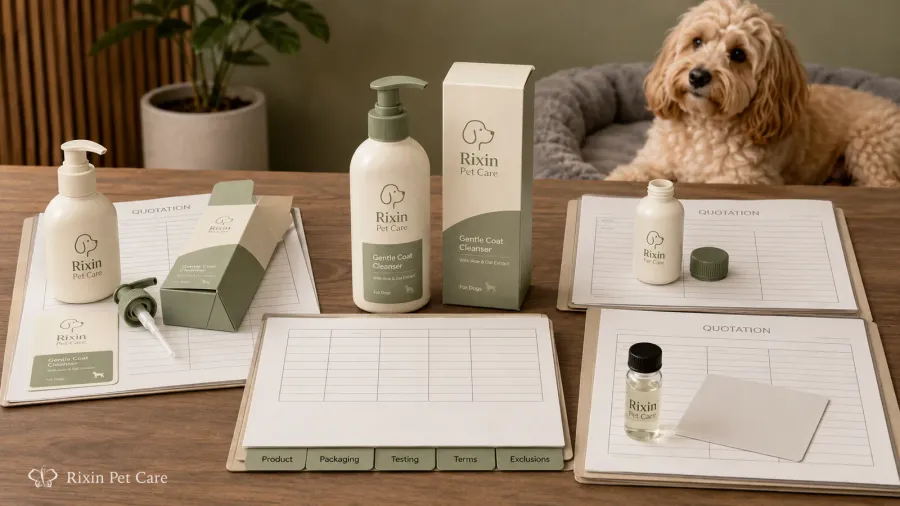
Manufacturer quotations compared using the same formula, packaging, quantity, documents, and shipping scope

7. Review reorder conditions

Ask:

  • Which one-time charges disappear on reorder?
  • Does the same MOQ apply?
  • Are the same components expected to remain available?
  • How long may stored materials be used?
  • Does an artwork change create new setup cost?
  • How is the approved formula version controlled?
  • How long is the quotation valid?

Ways to Control Cost Without Making the Project Generic

Cost control works best when it removes low-value complexity while protecting the product characteristics the buyer can explain and sell.

Start with one clear hero SKU

Launching one well-defined product can reduce duplicated sample work, formula variants, labels, cartons, inventory, and marketing tasks.

Add a second SKU when it has a clear role in the range, not only to make the assortment appear larger.

Use a mature formula structure selectively

A mature formula can be paired with a distinct fragrance direction, sensory target, package system, brand voice, channel, fill size, and grooming routine.

A brand does not need to change every ingredient to build a recognizable offer.

Put customization where the buyer notices it

Prioritize characteristics that affect:

  • Dispensing
  • Foam or spread
  • Rinse
  • Residue
  • Coat after-feel
  • Fragrance strength
  • Package usability
  • Product-line consistency

Avoid paying for a hidden change that has no clear functional or commercial value.

Share components across the range

Using one bottle family, closure system, label material, carton structure, or case size across several products may improve purchasing and operational efficiency.

The products can still use different names, artwork, and color coding.

Use stock packaging with disciplined artwork

A well-selected stock package can reduce molds, component lead time, and unused inventory. Clear hierarchy, coordinated typography, and a consistent color system can provide differentiation without a new bottle shape.

Limit first-order variants

Every scent, size, language, and artwork version can create another sample, batch, print run, component allocation, forecast, and slow-moving inventory risk.

Confirm wording before printing

Late label changes can create replacement labels, carton write-offs, relabeling work, and production delays.

Review product name, intended grooming use, directions, caution text, ingredient presentation, and proposed wording before print approval.

Match documents to the actual project

Ask the importer, retailer, distributor, marketplace, warehouse, and internal quality team what they require.

Do not purchase an undefined package described only as “all documents.” Do not remove a required item only to reduce the first quotation.

Compare landed and operational cost

A package that is slightly cheaper at origin may create more leakage, slower filling, inefficient case packing, or higher freight volume.

Evaluate the component together with filling, packing, storage, freight, receiving, and customer-service implications.

Preserve an upgrade path

An early product may use:

  • Stock packaging now and custom color later
  • A label now and direct decoration later
  • One size now and a salon format later
  • One scent now and additional variants later
  • A mature formula now and deeper development for a future SKU

A staged plan can protect working capital while allowing the product line to develop.

Cost Comparison Worksheet

Copy this worksheet and send the same completed scope to each manufacturer.

PRIVATE LABEL PET GROOMING COST COMPARISON WORKSHEET

A. PROJECT IDENTIFICATION

Brand or company:
Product:
Target market:
Primary sales channel:
Target launch date:
Quotation currency:
Quotation date:
Quotation validity:
Supplier:
Quotation version:

B. PRODUCT SCOPE

Product format:
Intended grooming use:
Target pet:
Formula starting point:
Benchmark, if any:
Fragrance:
Appearance:
Viscosity:
Foam, rinse, residue, or after-feel direction:
Fill size:
Estimated quantity per SKU:
Number of formulas:
Number of fragrances:
Number of sizes:
Number of artwork versions:
Total number of SKUs:

C. LAYER 1 — PRODUCT DEVELOPMENT

Formula review included: Yes / No / Not stated
Formula development charge:
Number of sample rounds included:
Number of variants per round:
Additional revision charge:
Sample containers included:
Packaging samples included:
Sample courier included:
Benchmark review included:
Pilot or scale-up work included:
Other development charges:
Open development items:

D. LAYER 2 — FINISHED PRODUCT

Bulk formula included:
Filling included:
Line setup included:
Coding included:
Label application included:
Carton assembly included:
Finished packing included:
Expected quantity basis:
Permitted shipment variation:
Retained or inspection samples:
Quality checks included:
Finished-unit price:
Other recurring charges:
Open production items:

E. LAYER 3 — PACKAGING AND PRINT

Bottle or primary package:
Closure, pump, or sprayer:
Overcap, liner, plug, or seal:
Label:
Carton:
Decoration method:
Inner packing:
Export carton:
Pallet:
Packaging quantity purchased:
Packaging quantity used:
Excess packaging ownership:
Excess packaging storage:
Label or carton minimum per artwork:
Mold charge:
Die charge:
Plate, screen, or cylinder charge:
Color-matching charge:
Other setup charge:
Open packaging items:

F. LAYER 4 — DOCUMENTATION AND TESTING

Product specification included:
Ingredient information included:
Batch COA included:
SDS included where applicable:
Stability support:
Microbial testing:
Preservative challenge testing:
Packaging compatibility:
Third-party laboratory:
Artwork or wording review:
Market-specific document review:
Retailer or distributor documents:
Testing and documentation total:
Open document or testing items:

G. LAYER 5 — LOGISTICS AND LAUNCH

Incoterms rule and version:
Named place or port:
Inspection included:
Origin transport included:
Export clearance included:
Main freight included:
Insurance included:
Import clearance included:
Duty included:
Import tax included:
Broker included:
Destination handling included:
Final delivery included:
Warehouse receiving:
Other local handling:
Open logistics items:

H. COST SUMMARY

One-time development total:
One-time tooling total:
Recurring production total:
Packaging and print total:
Documentation and testing total:
Inspection total:
Freight and insurance total:
Estimated duties, taxes, and local charges:
Other buyer-side launch costs:
Estimated total project cost:
Expected sellable units:
Estimated landed cost per sellable unit:

I. COMMERCIAL TERMS

Payment terms:
Production lead-time basis:
Packaging lead time:
Freight-estimate validity:
Reorder MOQ:
Reorder unit-price basis:
Stored-material terms:
Formula use or ownership terms:
Tooling ownership:
Artwork ownership:
Order-change or cancellation terms:
Main exclusions:
Open questions:

Do not fill missing lines with zero. Mark them as not included, not stated, buyer-managed, or pending confirmation.

Frequently Asked Questions

How much does it cost to make a private label dog shampoo?

There is no universal private label dog shampoo cost. A useful quotation needs a formula route, fragrance, viscosity, fill size, bottle, closure, label or carton, quantity per SKU, requested documents, testing scope, and delivery term.

What is normally included in a pet shampoo manufacturing price?

It may include formula manufacturing, filling, bottle, closure, label application, coding, finished packing, and agreed quality checks. It may exclude development, cartons, decoration, tooling, selected evaluations, additional documents, inspection, freight, duties, taxes, and local handling. Confirm every item in writing.

Why does a lower MOQ often have a higher unit cost?

Production, filling, and printing setup work is spread across fewer units. A smaller order may also use short-run packaging or carry separate setup charges. Read the pet grooming MOQ guide for the full minimum structure.

Is custom formulation always more expensive?

Not in the same way for every project. Cost depends on the starting formula, requested changes, materials, samples, packaging, evaluation plan, and production route. A limited adjustment differs from deeper OEM development.

Are samples included in the production price?

Sometimes, but not always. Ask how many formula rounds, variants, packaging samples, and courier shipments are included and what creates an additional charge.

Does the unit price include packaging?

It may include all packaging, only primary packaging, or no packaging. Confirm the bottle, closure, overcap, liner, seal, label, carton, decoration, coding, assembly, and export packing separately.

Does every pet grooming product need the same testing and documents?

No. Scope depends on the formula, format, package, intended grooming use, target market, buyer, importer, sales channel, and proposed public wording. Ask which items apply to the actual project and who is responsible for them.

What is the difference between factory cost and landed cost?

Factory cost covers the scope up to the stated handover point. Landed cost may include origin handling, international freight, insurance, customs clearance, duties, taxes, destination handling, and final delivery. The exact boundary depends on the written commercial terms and named place.

Why can two manufacturers quote different prices for the same shampoo?

They may be quoting different formulas, packages, quantities, sample work, documents, testing support, tooling, quality scope, delivery terms, or payment conditions. Compare the same written specification rather than the product name alone.

What information should I provide for a more useful quotation?

Provide one defined formula direction, fragrance, sensory target, fill size, package, label or carton route, quantity per SKU, target market, required documents, requested testing support, launch target, shipping term, and destination.

How should a new brand estimate the cost to start a pet grooming brand?

Separate product development, finished goods, packaging and print, documentation and testing, and logistics and launch. Then add buyer-side expenses such as brand design, photography, listings, warehousing, insurance, and local distribution where relevant. Do not use the factory unit price as the complete launch budget.

Can a manufacturer provide a landed quotation?

A manufacturer or logistics partner may estimate a broader delivery scope when destination, shipment details, route, importer responsibilities, Incoterms® rule, and current charges are known. Duties, taxes, customs examination, storage, and other destination costs may still require separate confirmation.

Request Pricing Against One Defined Scope

A useful quotation starts with a useful project definition.

Prepare one formula direction, one packaging specification, quantity by SKU, requested document and testing scope, and a named shipping destination. Ask each supplier to quote the same requirements and identify what is included, excluded, optional, or still open.

Request pricing against one clearly defined formula, packaging, quantity, document, and shipping scope.

External References

Ready to Discuss Your Pet Grooming Product Project?

Share your product type, target market, packaging direction, estimated quantity, and any support you need. A rough brief is enough to start a practical next-step discussion.
Back to Blog

Related Posts

View All Posts »