Pet Grooming Manufacturer Documents: A Brand Checklist
Written by: Rixin Pet Care Editorial Team
Reviewed by: Product Development Team for manufacturing context and claim-risk alignment.
This content is provided for product planning, packaging discussion and claim-risk awareness. It is not veterinary advice, treatment guidance or market authorization.
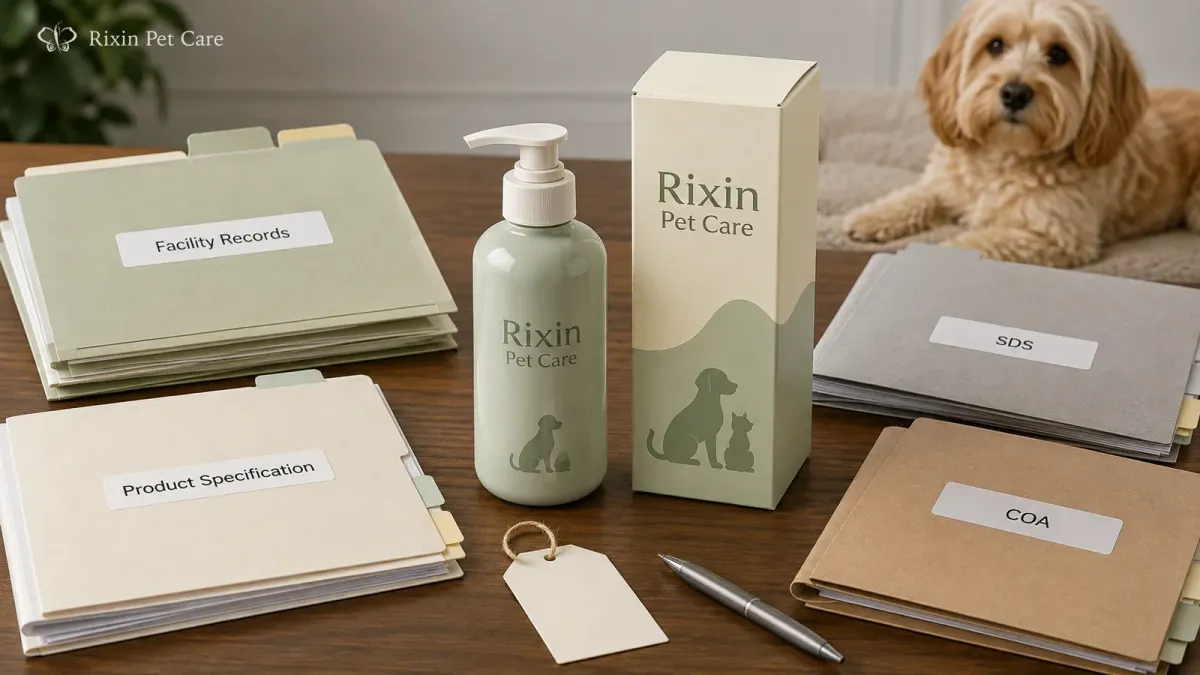
A buyer can receive several manufacturer documents and still not know whether they apply to the current formula, package, batch, market, or proposed claims.
For private-label pet grooming buyers, the useful question is not only which documents exist. It is what each document is for, what it covers, and whether it matches the project.
Requirements vary by product, packaging, market, claims, project stage, and responsibility split. Use the complete private label pet grooming products guide for the wider development path.
This guide supports document planning and supplier discussion. It does not determine market authorization or replace qualified legal, regulatory, testing, or compliance review.
Quick Answer: How to Request Documents for Your Project
Build a project-specific document request in this order:
- Define the product, packaging, target market, and proposed claims.
- Identify the decision each document should support.
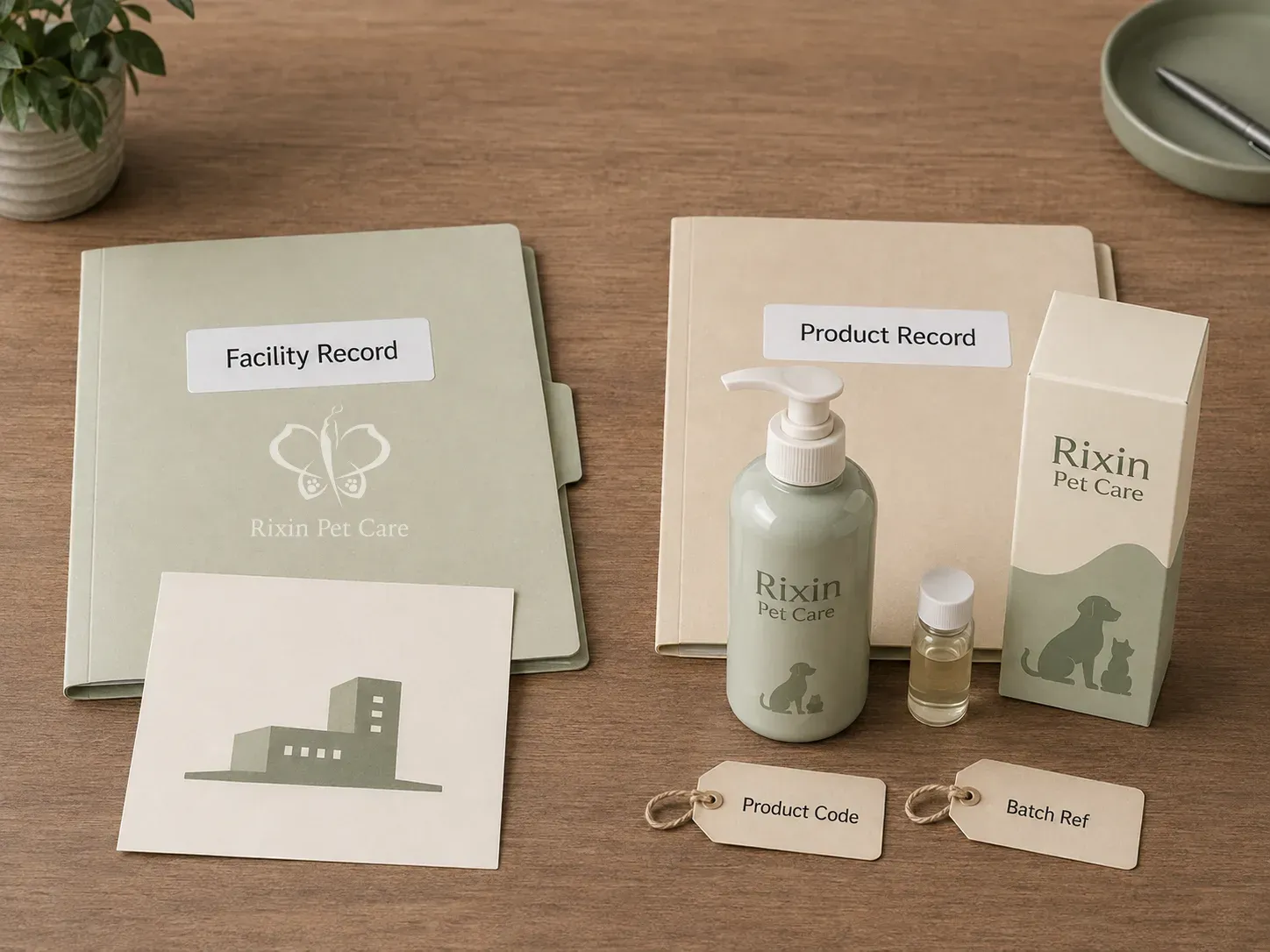
- Separate facility-level records from product-level records.
- Request the document name, purpose, issuer, date, and scope.
- Confirm the formula, packaging, product, or batch version it refers to.
- Confirm whether it is available now or created later.
- Confirm who prepares, pays for, reviews, and retains it.
- Record gaps before artwork, production, shipment, or launch decisions.
Possible categories include facility records, product specifications, ingredient information, SDS, COA and batch records, technical reports, packaging specifications, and artwork or label records. Not every category is required for every project.
Start with the Decision the Record Must Support
Do not begin with a copied list of document names. Begin with the decision that needs support.
A document can support a supplier decision, product review, batch check, artwork approval, or an external request.
For each request, ask:
Which document is needed?
What decision should it support?
Which product or facility does it apply to?
Which formula, package, or batch should it reference?
Who needs to review it?
When is it required?
The pet grooming product brief should provide the project context. Without a defined product, market, packaging direction, and proposed claims, a manufacturer cannot reliably determine which records are relevant.
Facility-Level vs Product-Level Documents
Facility-Level Records
Facility-level records relate mainly to the manufacturing site, company, process system, audit, or certification scope.
They may help a buyer understand the site or management system. They do not automatically describe or approve one specific product.
When you choose a private label pet grooming manufacturer, check the facility name, address, scope, issuer, issue date, and expiry date where relevant.
Product-Level Records
Product-level records relate to a defined product, formula, specification, packaging system, test item, or batch.
Check them against:
- product name or internal code;
- formula version;
- packaging version where relevant;
- batch or lot where relevant;
- issue date;
- issuer;
- stated scope.
A current facility certificate cannot replace a missing product-specific record. A product record also does not prove the scope of the entire facility.
Product Specifications, Formula, and Ingredient Information
A product specification usually identifies agreed product characteristics or requirements used during development, manufacturing, review, or batch-related control.
Depending on the project, it may cover identity, appearance, odor, texture, packaging, fill level, defined attributes, and document version. Fields and limits are project-specific.
Formula or ingredient information can also vary in depth. A buyer may receive an ingredient list, formula reference, fragrance or color reference, or selected supplier information. Access to a complete confidential formula should not be assumed.
Confirm:
what information will be supplied
which product version it describes
in what format it will be supplied
when it becomes available
under what confidentiality terms
how the buyer may use it
Before relying on it, check that the product code and formula version match the product being reviewed.
SDS, COA, and Batch Records
SDS
An SDS is a safety-data document used for defined hazard communication, handling, storage, transport, or workplace purposes where applicable.
Do not assume every finished product requires the same SDS treatment in every market or channel. Confirm the product identity, version, issuer, issue date, and intended use of the document.
An SDS does not by itself prove:
- finished-product market authorization;
- efficacy or claim support;
- formula stability;
- formula–packaging compatibility;
- batch conformity;
- suitability for every destination.
COA
A Certificate of Analysis generally reports defined results or conformity information for a specified material or batch.
Check:
- what item it covers;
- batch or lot number;
- specification or methods referenced;
- reported results;
- issue date;
- issuer;
- whether it covers a raw material, bulk product, or finished product.
For example, a COA for an earlier bulk batch does not automatically support a later finished product made with a revised formula and different packaging.
A COA can support a defined batch review, but it does not cover every quality, safety, regulatory, claim, or market question.
Other records may relate to production, inspection, release, or traceability. Agree their purpose and availability.
Stability, Compatibility, and Testing Records
Technical records are highly project-dependent. Possible categories may relate to formula stability, microbiological review, formula–packaging compatibility, transport or packaging review, or claim-related evidence.
Do not rely on a report title alone. Ask:
What question was evaluated?
Which formula version was used?
Which packaging version was used?
Who performed the work?
When was it performed?
What scope and conditions are stated?
What does the record not cover?
The formula–packaging compatibility guide explains why the intended formula, container, closure, liner, seal, and dispenser may need to be reviewed as one system.
Check that the report uses the current formula and package versions. A record for a different bottle, pump, fragrance level, or formula may not answer the current question.
Packaging, Artwork, and Label Records
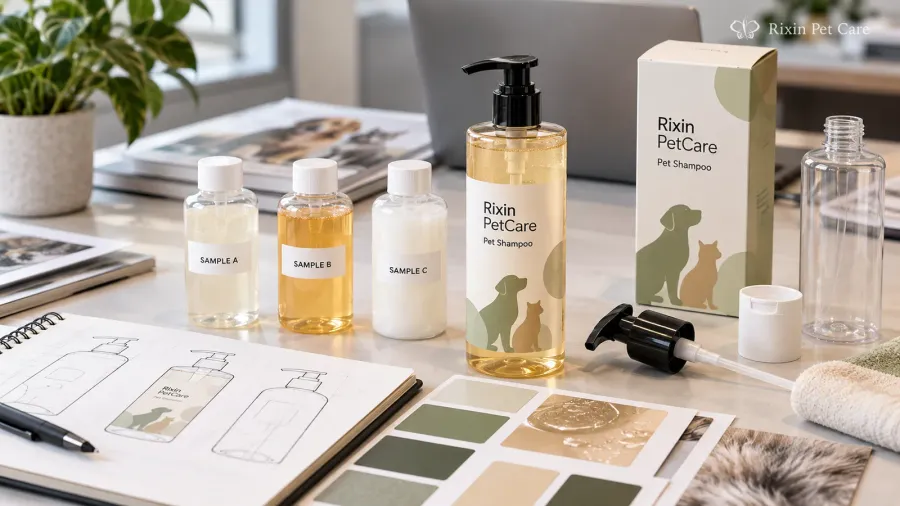
Packaging documentation may include references for the container, closure, pump, sprayer, foamer, cap, liner, seal, material, dimensions, label area, carton, insert, decoration, and print setup.
Artwork records may include:
- artwork file and version;
- copy version;
- label dimensions;
- carton dieline;
- approval history;
- print or decoration reference.
Example: Keep a Shampoo or Waterless Launch on One Version Set
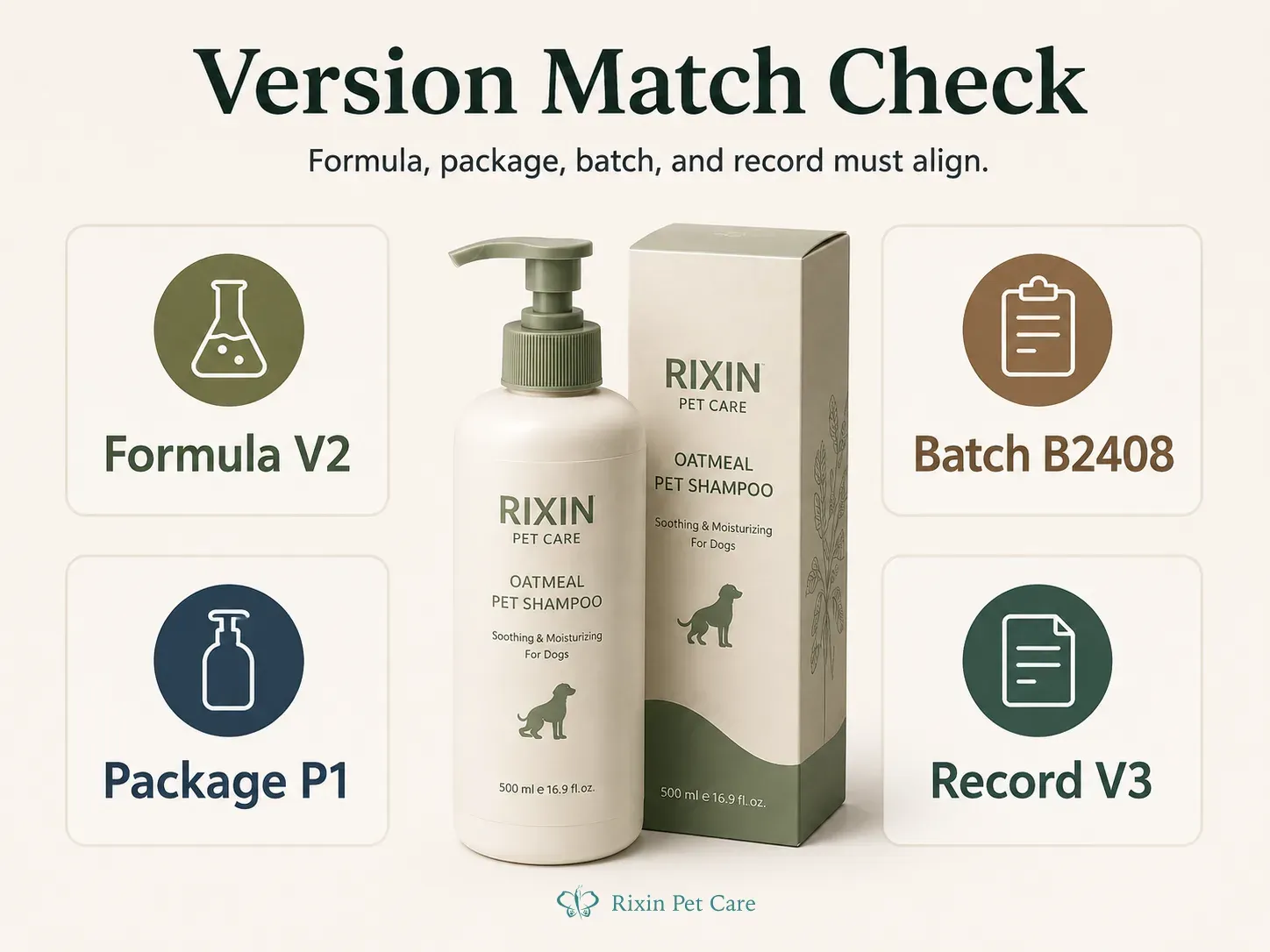
For a rinse-off shampoo, the working handoff may identify the same formula version, bottle and closure or pump reference, packaging version, approved dieline, copy or artwork version, and any compatibility or testing record being used for review. When batch or production records are created later, they should also point back to the defined product and version set.
For a waterless spray or foam, use the same principle, but make the dispenser reference explicit. The working set should identify the intended sprayer or foamer so a record tied to a different dispensing component is not treated as if it automatically covers the current package.
A compact version map can help reviewers keep the files aligned:
Formula V2
Package P1
Dieline D3
Artwork A4
Compatibility Record C2
This is an example naming pattern, not a required document set or universal format. The exact records vary by project; the important point is that the documents being reviewed refer to the same defined product and version set.
Version control matters. A supplier component sheet may describe an empty bottle but not the final filled system. A packaging specification does not prove formula compatibility by itself. Artwork approval does not prove regulatory compliance.
Agree separately who reviews product identity, directions, cautions, claims, and target-market requirements before label approval.
Confirm the Issuer, Version, Timing, and Responsibility
For every requested document, confirm four areas.
Issuer
The issuer may be the manufacturer, raw-material supplier, packaging supplier, laboratory, consultant, certification body, buyer, or another party. Issuer roles and scopes differ.
Version and Reference
Check the facility, product code, formula version, packaging version, artwork version, batch or lot, document version, issue date, and expiry date where applicable.
Timing
Agree whether the document is:
- available before quotation;
- available during development;
- created after formula confirmation;
- created after testing;
- issued after batch manufacture;
- available before shipment;
- prepared or reviewed separately by the buyer.
Document timing can affect the pet grooming product development timeline.
Responsibility
Confirm who requests, prepares, pays for, reviews, approves the related decision, and retains the final record. Also confirm whether updates are included after formula, package, artwork, or market changes.
What a Document Does Not Prove
A file name alone does not prove that the document:
- applies to the current formula;
- applies to the final packaging;
- covers the current batch;
- is current;
- was issued by the correct party;
- supports a proposed claim;
- satisfies a target market;
- authorizes sale;
- replaces professional review;
- covers later product changes.
Use the final checklist to confirm the facility or product, formula, package, batch, market purpose, and decision linked to each record.
Buyer Document Request Checklist
PROJECT CONTEXT
Product:
Product format:
Formula version:
Packaging version:
Target market:
Sales channel:
Proposed claims:
Current project stage:

DOCUMENT REQUEST
Document name or category:
Decision it should support:
Facility-level or product-level:
Product or facility reference:
Formula version:
Packaging version:
Batch or lot reference:
Issuer:
Issue date:
Expiry date where relevant:
Language or format:
Who will review it?
When is it required?

COMMERCIAL AND RESPONSIBILITY SCOPE
Already available?
Created later?
Included in quotation?
Additional fee?
Prepared by manufacturer?
Prepared by supplier or laboratory?
Prepared or reviewed by buyer?
Update needed after a product change?
Final record owner:

REVIEW RESULT
Matches current project scope?
Missing information:
Open questions:
Next action:
Decision owner:
Decision date:
This is a planning and supplier-communication checklist, not a universal compliance or market-authorization checklist.
Before You Send the Request
Before sending the request, complete the project context fields and assign an owner for each open question. Then ask the manufacturer which records are available now, which depend on final formula or packaging decisions, and who will review them.
Confirm what each record covers, which version it applies to, who issued it, when it will be available, and which project decision it is meant to support. This helps identify missing information before it delays artwork, production, shipment, or market review.
If the checklist identifies open records or ownership questions, testing and documentation support can help organize the project-specific next steps.
Ready to Discuss Your Pet Grooming Product Project?
Share your product type, target market, packaging direction, estimated quantity, and any support you need. A rough brief is enough to start a practical next-step discussion.