Private Label Pet Grooming MOQ: What Brand Owners Need to Know
Written by: Rixin Pet Care Editorial Team
Reviewed by: Product Development Team for manufacturing context and claim-risk alignment.
This content is provided for product planning, packaging discussion and claim-risk awareness. It is not veterinary advice, treatment guidance or market authorization.
A supplier says the minimum order is 2,000 units. That sounds clear until the brand asks the more important question:
What exactly does the 2,000-unit minimum apply to?
It could mean 2,000 units per formula, per fragrance, per package size, per label design, per SKU, or per production run. The bottle supplier, pump supplier, label printer, carton printer, or pouch converter may also set separate minimums.
A private label pet grooming MOQ is therefore not always one number. It is a group of production and supply-chain minimums that must be aligned around a defined product.
For the broader product-planning framework, including first-SKU selection, manufacturer evaluation, samples, documentation, and launch planning, read the complete private label pet grooming products guide.
For a wider comparison of development routes, review ready-made vs custom pet grooming formulas. A mature formula route, selected customization, deeper OEM development, standard packaging, custom packaging, and wipes or pouch formats may all create different MOQ structures.
Quick Answer
A private label pet grooming MOQ is the smallest commercially workable quantity for a defined project scope. That scope may include one formula, one fragrance, one fill size, one packaging combination, and one artwork version.
There may be several minimums because bulk formula, filling, bottles, closures, labels, cartons, wipes materials, and custom inputs are produced or purchased through different systems.
Before accepting an MOQ, confirm whether it applies:
- Per formula
- Per fragrance
- Per package size
- Per label or carton design
- Per SKU
- Per production run
The lowest advertised MOQ is not automatically the lowest-risk launch route. Brand owners should compare quantity, unit cost, customization, excess components, inventory exposure, and reorder practicality together.
What Does MOQ Mean in Pet Grooming Manufacturing?
MOQ means minimum order quantity. In pet grooming manufacturing, it is the minimum amount a manufacturer or component supplier is prepared to produce, fill, print, purchase, or supply for one defined order.
“Pet shampoo” is not a complete order definition. A meaningful MOQ discussion should identify:
- Formula starting point
- Fragrance direction
- Fill size
- Bottle and closure
- Label or decoration method
- Carton or no-carton route
- Number of artwork versions
- Number of SKUs
A 300 mL shampoo in a stock bottle with a pressure-sensitive label may have a different minimum from the same shampoo in a custom-colored bottle with a printed carton. Grooming wipes may be affected by substrate, sheet dimensions, wipe count, pouch film, closure, and printed rollstock.
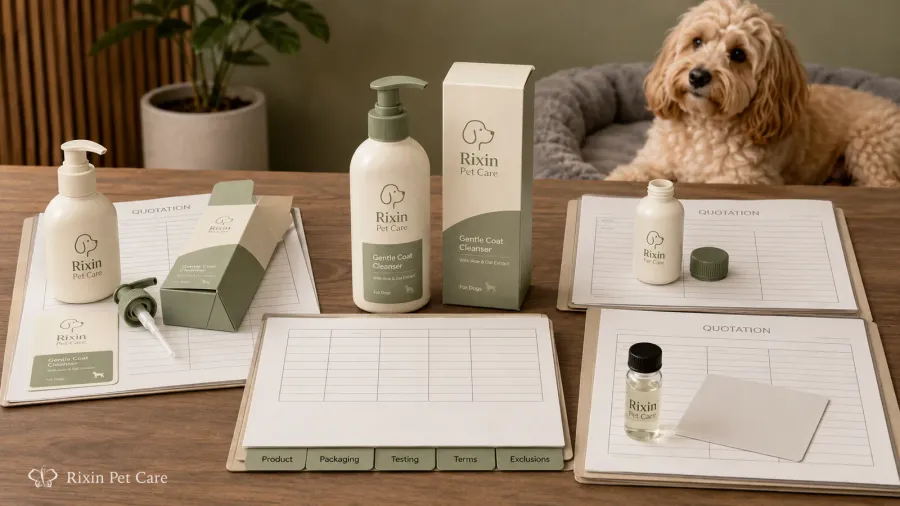
Always attach a pet product minimum order quantity to a written specification or quotation scope.
Why There May Be More Than One MOQ
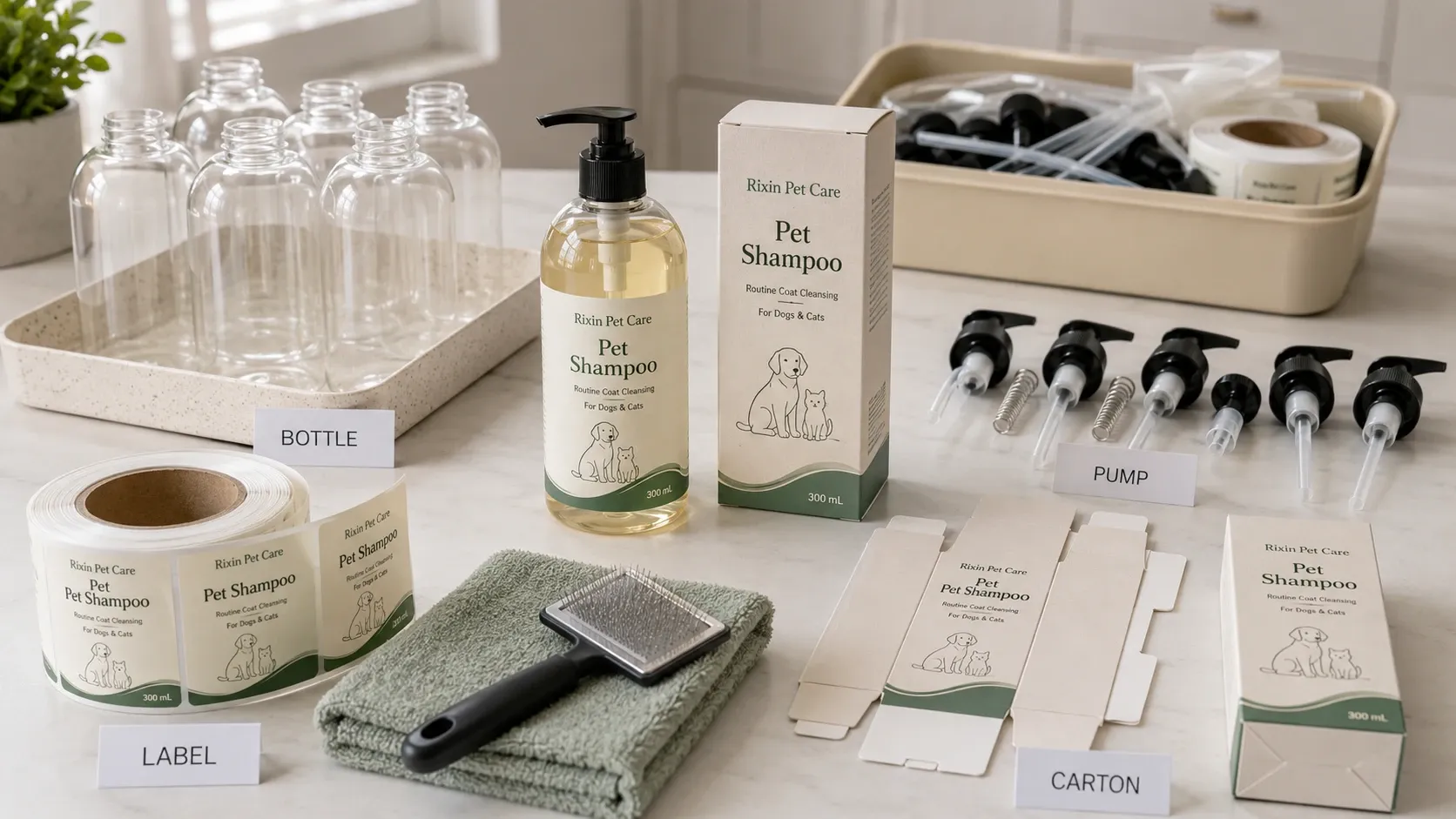
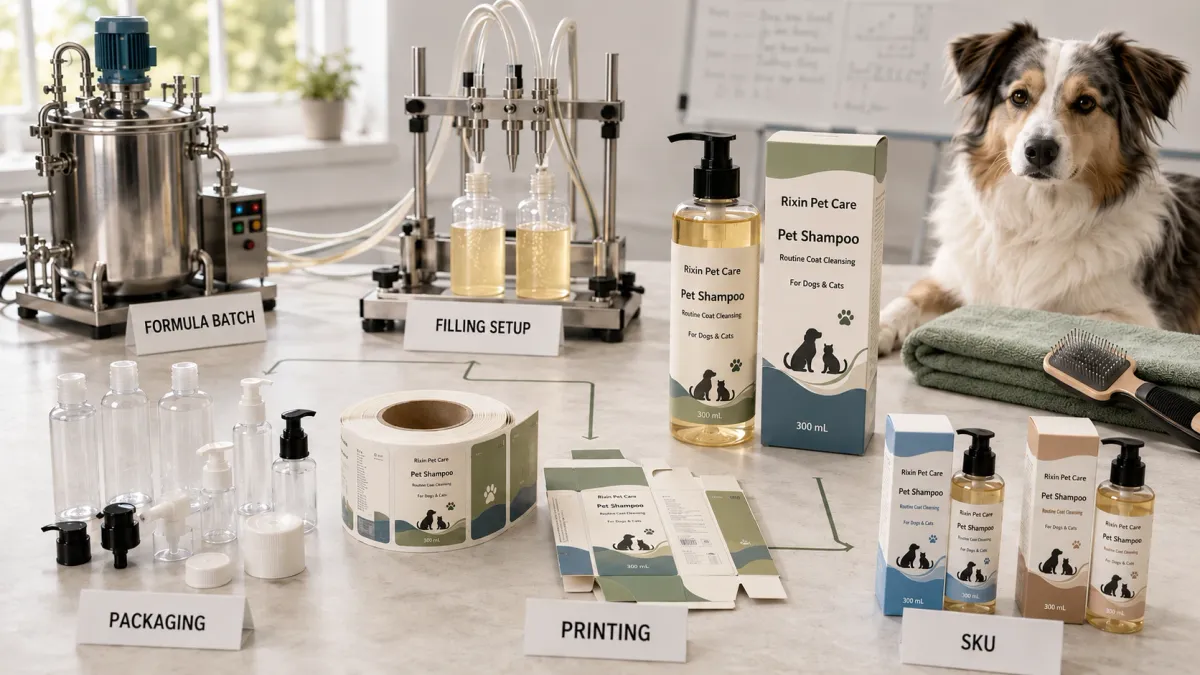
A finished product combines several systems:
- Formula production — the practical bulk batch size.
- Filling and packing — the quantity needed for the selected line setup.
- Primary packaging — bottles, pumps, sprayers, caps, pouches, or lids.
- Printing and decoration — labels, cartons, printed pouches, or direct decoration.
- Variants — formulas, fragrances, sizes, designs, and SKUs.
These minimums may use different units. Formula may be quoted in kilograms, bottles by case or production lot, and labels by roll or piece count. The project must satisfy each relevant minimum or define what happens to unused formula, packaging, and printed materials.
The MOQ stack
| MOQ Layer | What It May Apply To | Buyer Question |
|---|---|---|
| Formula batch | One formula or variation | How much bulk must be made? |
| Filling line | One package format or setup | What is the practical run minimum? |
| Primary packaging | Bottle, closure, sprayer, pouch, lid | Is it stock, special order, or custom? |
| Printed packaging | Label, carton, printed pouch | Is the minimum per artwork? |
| Variant or SKU | Formula, fragrance, size, design | Which change creates another minimum? |
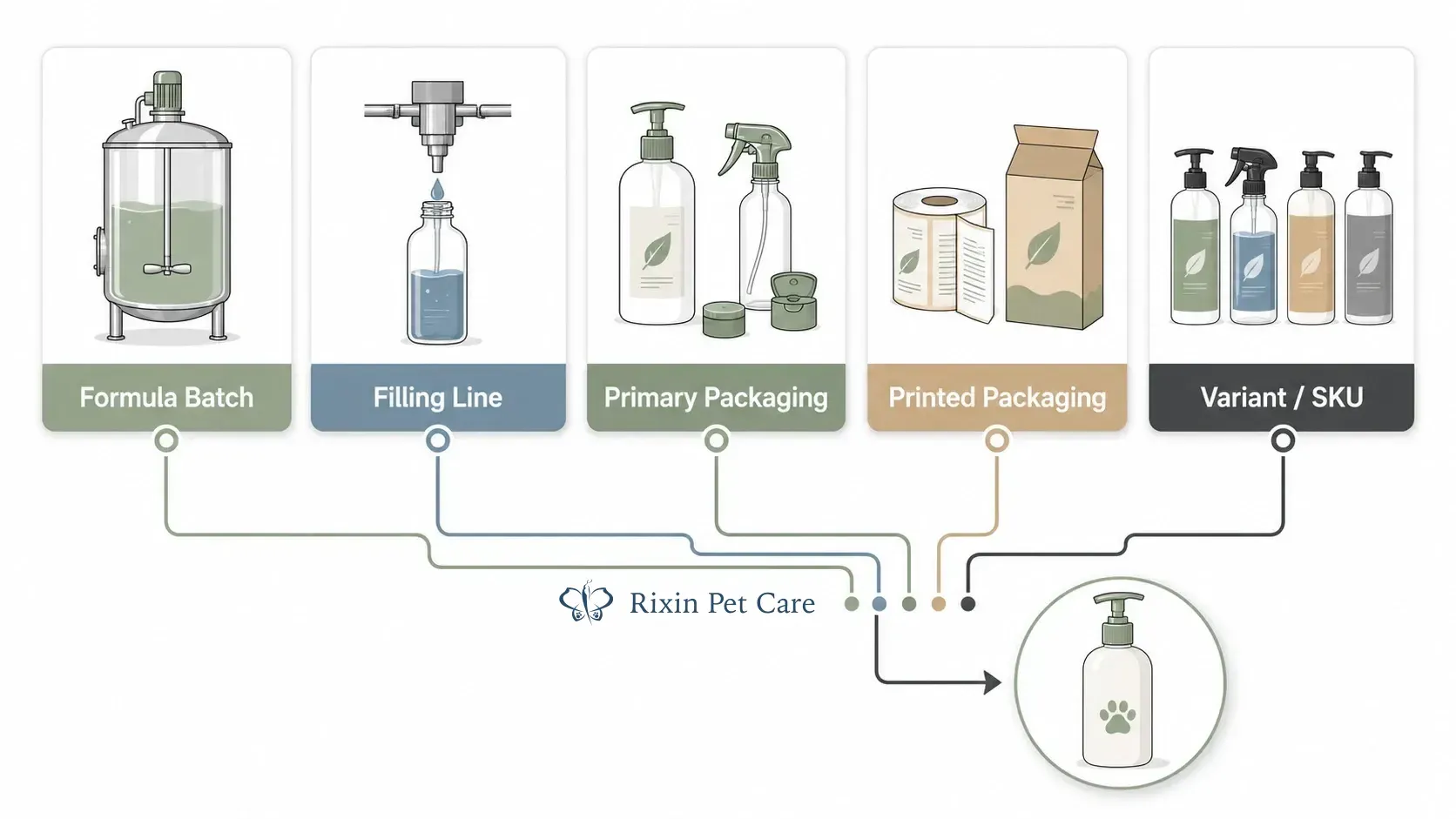
This stack helps buyers identify which decision is setting the commercial minimum.

Formula Batch MOQ
A formula batch MOQ is the minimum practical bulk quantity for one production batch. It may be influenced by mixing equipment, product viscosity, processing steps, raw-material measuring accuracy, cleaning work, and expected transfer or filling loss.
The manufacturer may state this minimum in kilograms or liters rather than finished units. Converting it into retail units depends on fill size, product density where relevant, and an agreed process allowance.
For example, the same bulk quantity produces fewer 500 mL bottles than 250 mL bottles. A formula-batch minimum should therefore not be copied directly into a finished-unit quotation without confirming the selected size.
Ask:
- Is the batch minimum stated by weight, volume, or finished units?
- Does it apply to each formula variation?
- Does changing fragrance create another batch?
- Do changes to color, viscosity, or key materials create a new formula version?
- How is expected production loss handled?
A mature formula direction may have a more established production route. Deeper customization may add material, sampling, or processing variables, but it does not automatically create the same MOQ for every project.
Filling-Line Minimum
The filling operation may have its own practical minimum even when the formula can be produced at a smaller quantity.
A run may require line preparation, machine adjustment, fill checks, coding setup, label or component feeding, in-process checks, and cleaning before the next product. Those steps take time regardless of whether the line fills hundreds or thousands of units.
The filling minimum may also differ by format. A shampoo bottle, fine-mist sprayer, foaming pump, trigger spray, gallon container, or wipes pack may use a different line or setup.
Confirm whether the filling minimum applies per:
- Formula
- Bottle size
- Closure type
- Package format
- Production setup
This becomes important when one bulk batch is divided between several sizes.
Bottle, Pump and Sprayer MOQ
Packaging can create a separate MOQ from formula and filling.
Stock packaging
Stock bottles and closures are existing items available through a manufacturer, supplier, or distributor. They can reduce first-order complexity, although color, shape, material, neck size, and closure choices may be limited.
TricorBraun’s public catalog, for example, distinguishes stock bottles available in case or pallet quantities from broader custom packaging programs. This is a useful illustration of why the packaging route must be named before the MOQ can be understood.
Special-order or custom packaging
A standard item that is not currently stocked may still require a supplier production lot. Custom colors, direct decoration, new molds, uncommon sprayers, or project-specific component combinations can create higher purchasing commitments.
A bottle minimum also does not automatically include the pump, cap, sprayer, overcap, liner, gasket, or dip tube. Request a component-level breakdown.
Confirm:
- Quantity for each component
- Stock, special-order, or custom status
- Color, material, and neck compatibility
- Ownership of unused components
- Storage terms
- Reorder availability
A manufacturer may be able to fill 2,000 units while a packaging supplier requires a larger component purchase. The brand then needs a written plan for the remaining components.

Label, Carton and Printing MOQ
Printed materials may have a minimum per artwork, even when the formula and bottle are shared.
Labels
Label MOQ can depend on material, adhesive, laminate, shape, die, roll direction, print process, and number of designs. Digital printing may support shorter custom runs than some conventional methods. HP notes that digital printing can make short custom label and packaging runs more practical and can support variable information.
However, every converter sets its own order values, material rules, finishing requirements, and minimums. Ask whether several designs can share one run when they use the same size and material.
Cartons and decoration
Printed cartons may have separate minimums for board, printing, cutting, coating, foil, embossing, and artwork. Direct printing, hot stamping, shrink sleeves, and other decoration methods can also create setup requirements even when the bottle itself is standard.
Ask:
- Is the minimum per design or across the order?
- Can several designs share one material and die?
- Is digital printing available for the first run?
- Are plates, dies, screens, or setup fees separate?
- What happens to unused labels or cartons?
Ordering extra printed material may lower print cost but creates write-off risk if the brand later changes artwork, address, barcode, wording, or instructions.
Wipes and Pouch Packaging Minimums
Wipes and pouches usually have a different MOQ structure from bottled liquids.
A grooming wipes project may combine:
- Formula batch
- Wipe substrate
- Sheet size and thickness
- Fold pattern
- Wipe count
- Liquid load
- Pouch film
- Printed rollstock
- Resealable label or lid
- Pouch-forming and sealing setup
Changing from 40 to 80 wipes is not only a label change. It can alter pouch dimensions, film use, pack thickness, case packing, and line setup.
Flexible packaging suppliers also separate standard and custom routes. ePac states that minimums vary by plant and project, and its small-business options distinguish standard pouches from more customized specifications. The practical lesson is that pouch type, dimensions, material, print method, and supplier location can all affect MOQ.
Confirm the minimum for formula, substrate, printed film, closure, wipe count, artwork, and production setup separately. Do not assume a low MOQ pet shampoo route will apply to wipes.
Raw Material and Fragrance Minimums
Common materials may already be part of the manufacturer’s regular inventory. A special raw material, custom fragrance, uncommon color, or buyer-selected supplier may require a separate purchase quantity.
Two products using the same base formula but different fragrances should be planned as separate variants. Fragrance may affect sample approval, appearance, viscosity, product odor over time, packaging interaction, specifications, and label accuracy.
For a buyer-nominated material, confirm:
- Supplier availability and purchase minimum
- Lead time and shelf life
- Supporting information
- Formula compatibility
- Ownership of unused material
Including an ingredient does not automatically support every product statement the brand may want to use. Formula direction and public wording should be reviewed separately.
MOQ per Formula, Scent, Size or SKU
The phrase MOQ per SKU can hide several different minimums.
Consider this hypothetical project:
- 300 mL dog shampoo, fresh scent
- 500 mL dog shampoo, fresh scent
- 300 mL dog shampoo, fragrance-free direction
- 300 mL dog shampoo, fresh scent, distributor artwork
It includes two formula variants, two fill sizes, two artwork versions for one size, and four sellable SKUs.
What “2,000 units” might mean
| MOQ Statement | Possible Meaning |
|---|---|
| Per formula | Each formula version must reach 2,000 finished units |
| Per fragrance | Each scent or fragrance-free version has its own minimum |
| Per size | The 300 mL and 500 mL products each require 2,000 units |
| Per label design | Each market, channel, or brand artwork requires 2,000 units or labels |
| Per SKU | Every unique formula-size-package-artwork combination requires 2,000 units |
| Per run | One production setup must fill at least 2,000 units, with limited splitting |
These numbers are examples, not fixed RixinPetCare terms. Actual minimums should be confirmed for the selected formula, package, artwork, production route, and material availability.
How Customization Affects MOQ
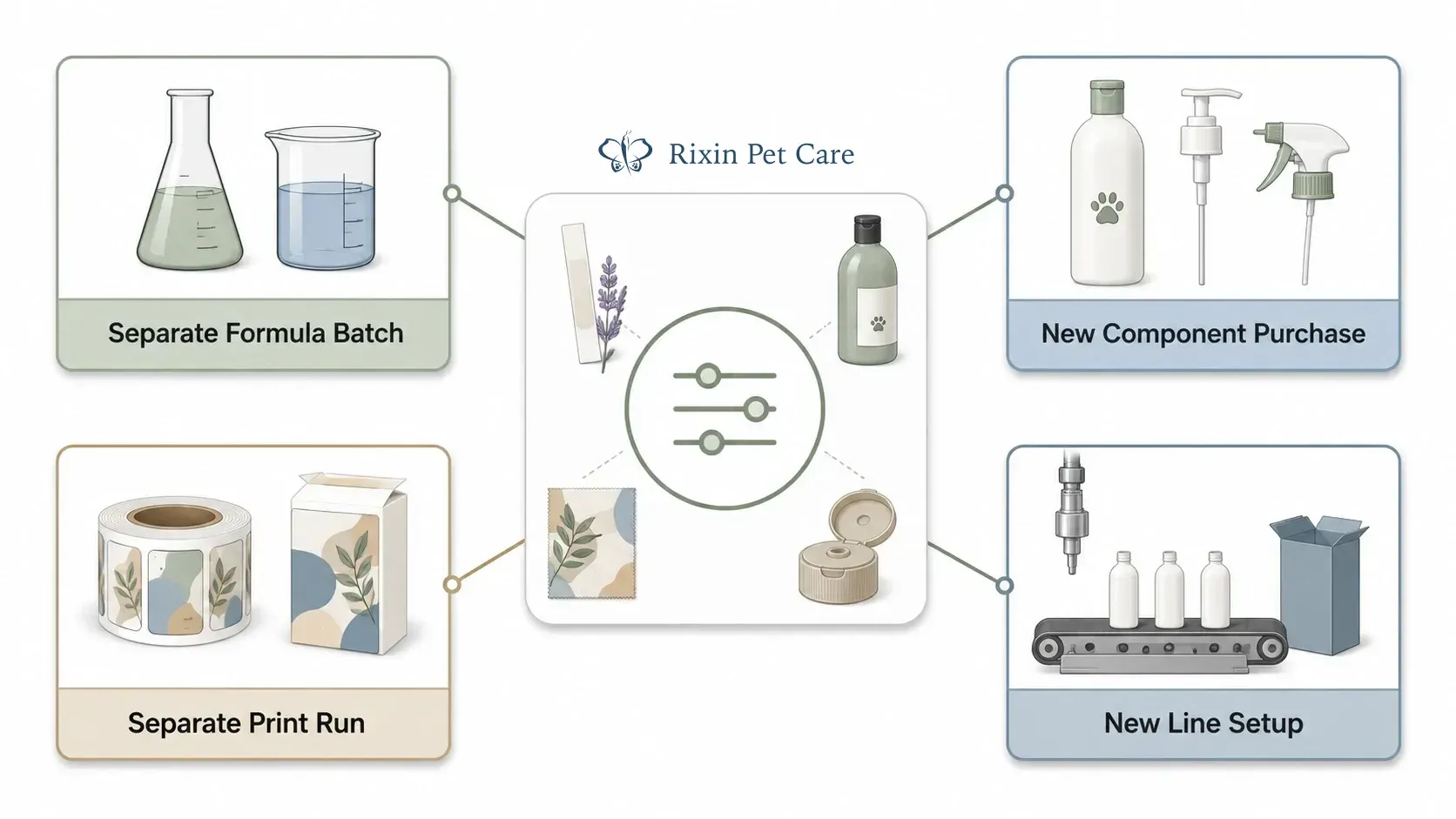
Customization affects MOQ when it changes a formula batch, component purchase, print run, or filling setup.
Mature formula route
A mature formula direction may support a controlled first order when the brand accepts an established structure, common materials, and available packaging.
Selected customization
A fragrance, viscosity, appearance, or packaging adjustment may be practical, but each change should be assessed separately. One change may fit the current process while another introduces a special material or component MOQ.
Deeper OEM development
A deeper OEM route may involve broader formula work, project-specific materials, more samples, and closer formula-package coordination. The MOQ depends on those requirements rather than the “OEM” label alone.
Standard vs custom packaging
Stock bottles, common closures, and pressure-sensitive labels often reduce component complexity. Custom colors, molds, decoration, and pouches may require larger packaging commitments or the purchase of excess components for future orders.
The most useful question is:
Which requested change creates a separate batch, component purchase, print run, or line setup?

Can One Bulk Batch Be Split Across Several Sizes?
Sometimes. One bulk batch may be divided between several fill sizes when the formula and fragrance are identical and the production plan supports the split.
For example, one shampoo batch might be allocated between a retail bottle and a salon size. This can serve two channels without producing two formula batches.
The split does not remove other minimums. Each size may still require a separate bottle, closure, label, filling setup, case pack, and inventory allocation.
Ask:
- What is the smallest practical quantity per size?
- How many line changeovers are required?
- Are both packaging combinations available?
- Does each size have its own print minimum?
- How will actual batch yield be allocated?
A size-only split is generally simpler than changing scent, color, viscosity, or formula code.
Low MOQ Trade-Offs
A smaller order can reduce finished-goods exposure while a brand validates demand. But low MOQ pet grooming products should be compared on complete scope, not unit count alone.
A lower minimum may involve:
- Stock packaging
- Fewer closure or color options
- Labels instead of direct decoration
- A mature formula direction
- Fewer scents or sizes
- Higher unit cost
- Setup fees spread across fewer units
- Separate purchase of excess packaging
- Less flexibility to split the order
One quotation may also exclude cartons, special packaging, selected documents, testing support, storage, or extra sample work that another includes. Compare the same formula, fill size, package, printing, documents, and commercial terms.
Low MOQ should not be achieved by ignoring work needed for the actual formula, package, market, or supply chain.
How to Plan a Realistic First Order
1. Start with an anchor SKU
Choose the product with the clearest role, audience, and channel. For many brands this may be shampoo; for others it may be a waterless spray, paw cleanser, grooming wipes, or salon product.
Review the available decisions on the private label pet shampoo page.
2. Limit early variants
Every additional scent, size, package, and artwork version can create another minimum. One clearly positioned SKU is often easier to fund, explain, and reorder than several lightly differentiated variants.
3. Separate formula and packaging priorities
Ask what must be different in the formula, what can be expressed through label design, which package features are functional, and which decorative upgrades can wait until a reorder.
A mature formula does not require weak branding, and a custom formula does not require a custom bottle mold.
4. Plan the reorder before purchasing
Confirm material lead times, packaging continuity, reorder MOQ, stored components, artwork changes, and production booking. A slightly higher first order using a stable component family may create less long-term risk than a smaller order using hard-to-replace packaging.
5. Estimate quantity by SKU and channel
Include channel allocation, samples, photography units, promotions, replacement allowance, expected sell-through, and reorder lead time. Do not use one combined total for several products without showing the split.
6. Work backward from launch timing
Samples, packaging, artwork, material purchasing, production scheduling, and freight all affect the delivery date. A lower MOQ does not automatically mean a faster project.
Questions to Ask Before Accepting an MOQ
- What exactly does the MOQ apply to?
- Is it per formula, fragrance, size, artwork, SKU, or run?
- What is the formula batch minimum in kilograms or liters?
- How many finished units does that support at the selected size?
- Is there a separate filling-line minimum?
- Are bottles, closures, labels, and cartons quoted separately?
- Are components stock, special order, or custom?
- Is printing minimum per artwork?
- Can one formula batch be split between package sizes?
- What happens to unused packaging or printed materials?
- Who owns stored components, and how long will they be held?
- Are tooling, plates, dies, or setup fees separate?
- Is the reorder MOQ the same as the first-order MOQ?
- How long are the MOQ and pricing valid?
- What quantity split does the manufacturer recommend?
The private label pet grooming process explains how quantity planning connects with the brief, samples, packaging, specification, and production preparation.
MOQ Planning Worksheet
Complete one worksheet for each proposed SKU. Write “open to recommendation” where an answer is not known.
PRIVATE LABEL PET GROOMING MOQ PLANNING WORKSHEET
1. PROJECT
Brand or company:
Target market:
Primary sales channel:
Target launch date:
Main priority: Lower quantity / Lower unit cost / More customization / Faster route / Other
2. SKU
Working product name:
Product type:
Formula route: Mature / Selected customization / Deeper OEM / Open
Fragrance direction:
Fill size:
Package and closure:
Label only or label plus carton:
Artwork versions:
Estimated quantity:
3. FORMULA MOQ
Formula batch minimum:
Unit: kg / L / finished units / other
Minimum applies per formula or fragrance:
Estimated finished units at selected size:
Process allowance:
4. FILLING MOQ
Filling-line minimum:
Applies per size or package format:
Can the batch be split across sizes?
Smallest practical quantity per size:
5. PACKAGING MOQ
Container MOQ:
Closure or sprayer MOQ:
Stock / special order / custom:
Custom color or decoration MOQ:
Excess component quantity:
Ownership and storage plan:
6. PRINT MOQ
Label MOQ per artwork:
Carton MOQ per artwork:
Printed pouch or rollstock MOQ:
Print method:
Setup, plate, die, screen, or tooling fees:
Unused printed material plan:
7. WIPES OR POUCH, IF APPLICABLE
Substrate minimum:
Sheet size and wipe count:
Pouch film minimum:
Lid or resealable-label minimum:
8. FINAL INTERPRETATION
Quoted MOQ:
Applies per: Formula / Fragrance / Size / Artwork / SKU / Run
Binding minimum:
Finished units to order:
Extra components to purchase:
Estimated reorder quantity:
Open questions:Use the worksheet to find the binding minimum. If a custom pump creates excess inventory, compare a stock pump. If three label designs create separate print minimums, consider one launch version. If two sizes require inefficient setups, launch the primary size first.
The goal is not always the lowest number. It is to identify which complexity is worth funding now and which can move to a later order.
Frequently Asked Questions
What is a typical private label pet grooming MOQ?
There is no universal number. It depends on formula batch size, filling setup, packaging, printing, customization, format, and variant count. Ask what the minimum applies to.
Is private label dog shampoo MOQ usually per scent?
It may be. Different fragrances can require separate samples, formula versions, batches, specifications, or production runs. Confirm the minimum for each version.
Does each fill size count as a separate SKU?
Usually, yes. A different size generally requires another bottle, label, fill setup, and case configuration. The bulk formula may sometimes be shared when it is identical.
Can several label designs share one MOQ?
Sometimes. Compatible designs may be grouped when they use the same material, shape, and print process. Other printers apply the minimum to each artwork.
Are bottles and pumps included in the same MOQ?
Not necessarily. Bottles, pumps, sprayers, caps, overcaps, liners, and dip tubes may have separate supply quantities.
Why do wipes have a different MOQ from shampoo?
Wipes combine substrate, liquid, folding, count, pouch film, sealing, closure, and printing. Their production route differs from bottle filling.
Does a custom formula always require a higher MOQ?
No. The result depends on raw materials, processing, packaging, and production route. Ask which specific customization creates the minimum.
Is the lowest MOQ always best for a new brand?
No. A very low quantity may carry higher unit cost, fewer options, excess component purchases, or a narrower quotation scope. The better order is one the brand can finance, sell, reorder, and expand from.
Plan the Quantity by Formula, Scent, Size and SKU
MOQ planning becomes useful when the number is connected to a defined product.
Before requesting a quotation, prepare:
- Estimated quantity per formula
- Estimated quantity per fragrance
- Estimated quantity per fill size
- Number of label and carton designs
- Packaging direction
- Expected SKU count
- Target launch date
- Fixed requirements and flexible preferences
Share your estimated quantity by formula, scent, size, and SKU. This allows the manufacturer to identify the binding minimum, recommend a workable split, and explain where stock or custom routes change the project.
External References
- HP: What Is Digital Printing?
- TricorBraun: Wholesale Bottles, Jars & Bulk Containers
- TricorBraun Flex: Flexible Packaging Products and Customization
- ePac Flexible Packaging: Custom Flexible Packaging FAQ
- U.S. Food and Drug Administration: CPG Sec. 653.100 Animal Grooming Aids
- Federal Trade Commission: Policy Statement Regarding Advertising Substantiation
Ready to Discuss Your Pet Grooming Product Project?
Share your product type, target market, packaging direction, estimated quantity, and any support you need. A rough brief is enough to start a practical next-step discussion.