Private Label Pet Grooming Development Timeline: How Long Does It Take?
Written by: Rixin Pet Care Editorial Team
Reviewed by: Product Development Team for manufacturing context and claim-risk alignment.
This content is provided for product planning, packaging discussion and claim-risk awareness. It is not veterinary advice, treatment guidance or market authorization.
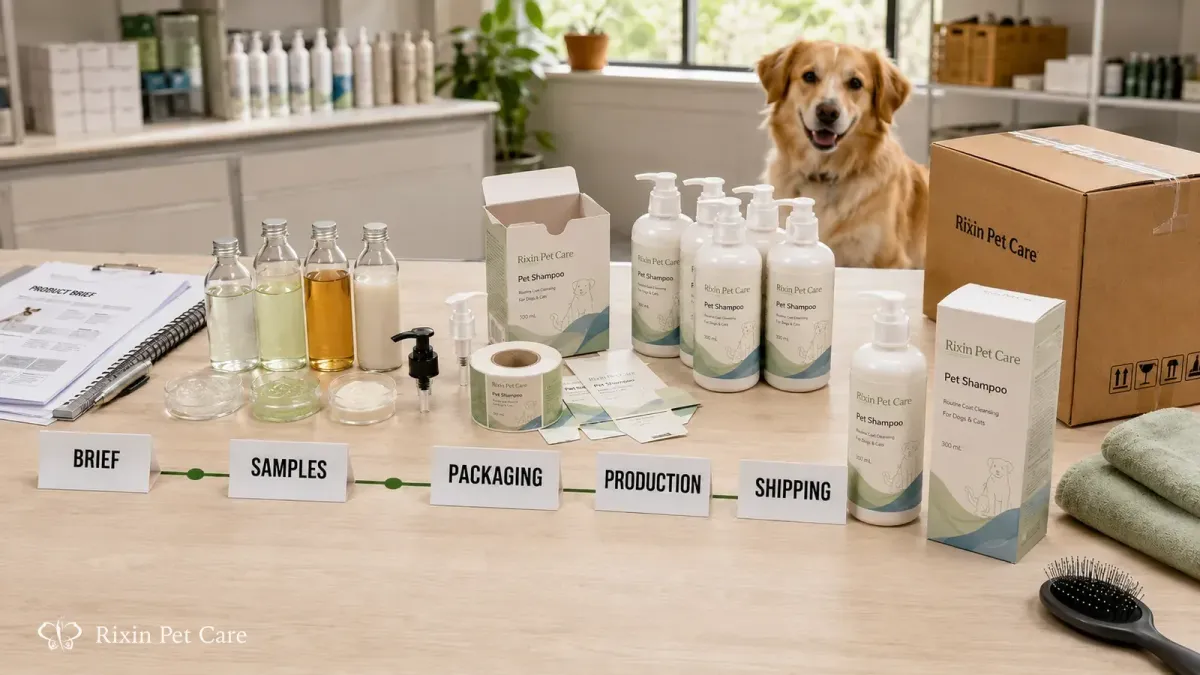
A supplier may quote a production lead time, but that number rarely describes the complete journey from product idea to saleable inventory.
Before production can begin, the brand may need to define the product brief, choose a formula route, review samples, approve a fragrance or sensory direction, select packaging, complete artwork, confirm requested documents, and purchase materials. After production, the project may still need inspection, freight booking, customs clearance, warehouse receiving, photography, listings, or retailer approval.
That is why a useful pet grooming product development timeline should not compress every activity into one number.
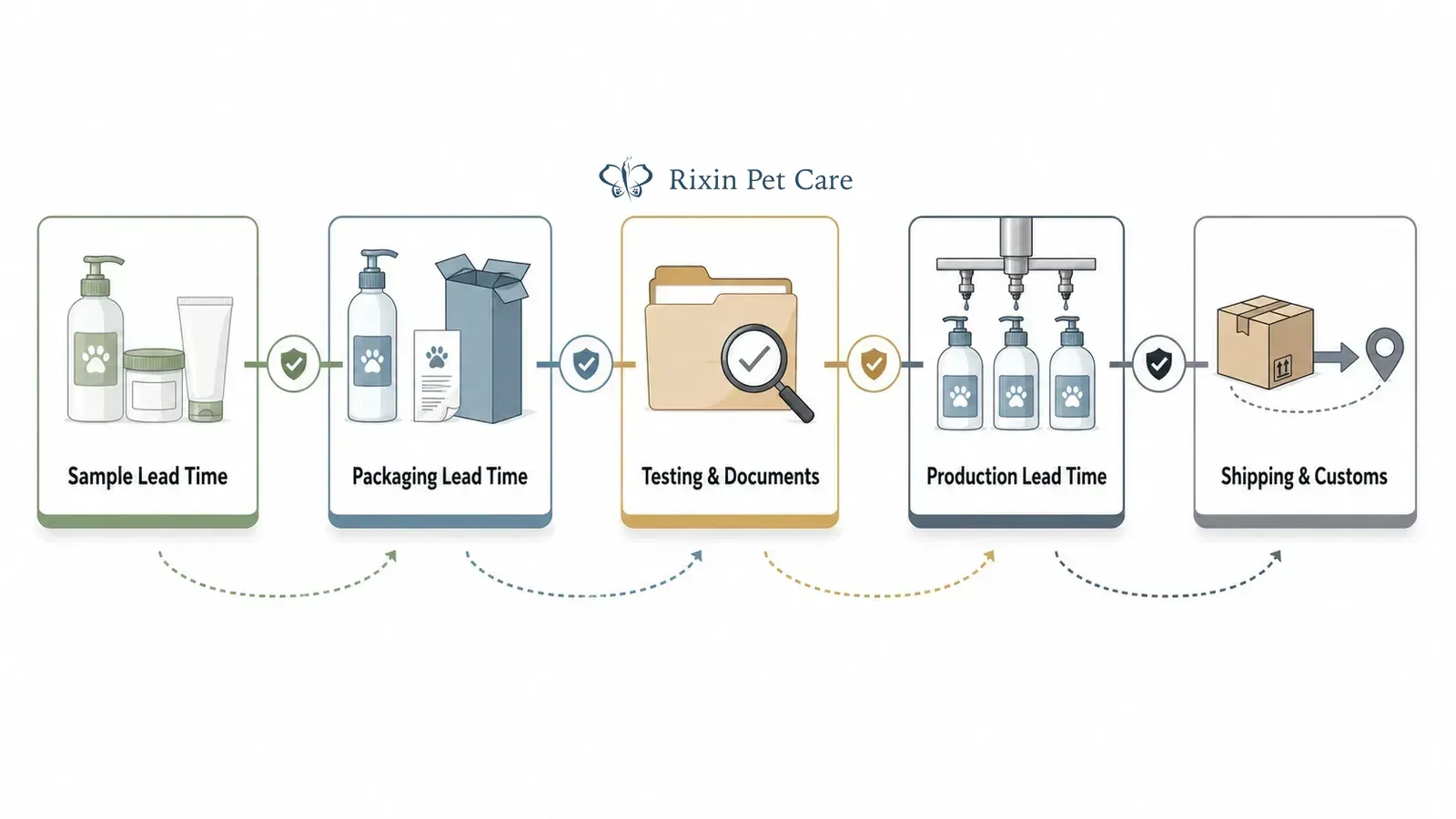
It should separate five different clocks:
Sample Lead Time → Packaging Lead Time → Testing and Document Lead Time → Production Lead Time → Shipping and Customs Time
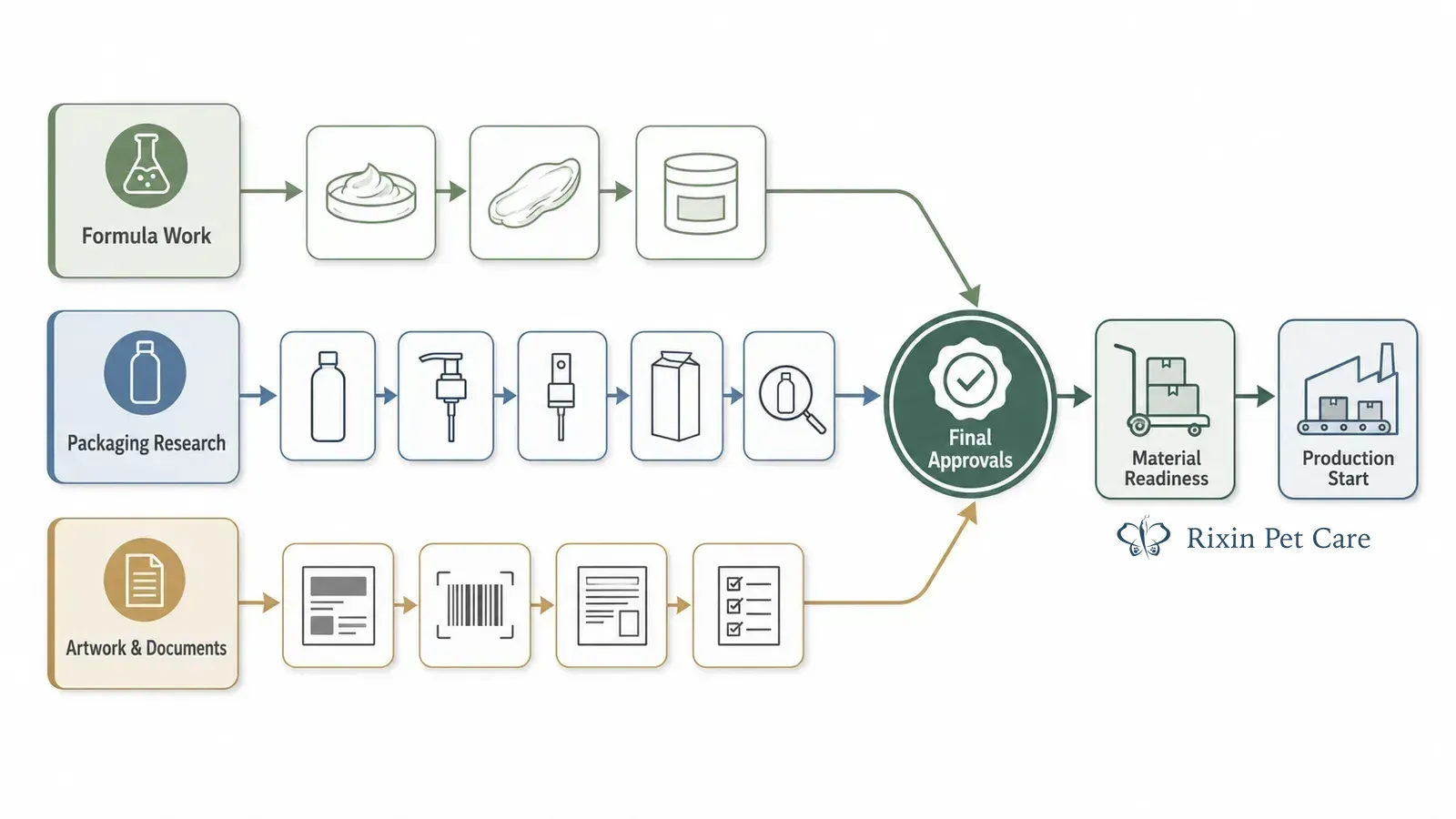
These clocks are connected, but they do not always start together. Some work can happen in parallel. Other work must wait for an earlier decision. The project finishes according to its critical path: the longest chain of dependent activities that must be completed before launch.
For a broader overview of manufacturing routes, MOQ, costs, samples, supplier evaluation, and launch preparation, read the complete guide to private label pet grooming products.
Quick Answer
A private label pet grooming project may take several weeks for a relatively simple mature-formula route or several months when the project involves deeper formula work, multiple sample rounds, custom packaging, additional testing, several markets, or complex shipping.
That is a planning range, not a promise. The actual answer depends on the project scope and the order in which decisions are confirmed.
The most useful timeline questions are:
- Which formula route are we using?
- How many sample and revision rounds may be needed?
- Is the packaging in stock, special order, decorated, or custom-made?
- Which tests, documents, and label reviews are required?
- What must be approved before materials can be purchased?
- When does the manufacturer’s production schedule begin?
- Which shipping route and customs responsibilities apply?
- How much time does the brand need after receiving the goods?
A quoted pet shampoo manufacturing lead time usually refers to the factory’s production stage after the formula, packaging, artwork, quantity, commercial terms, and required materials are confirmed. It should not automatically be used as the complete private label product launch timeline.
Why There Is No Single Universal Lead Time
Two projects described as “private label dog shampoo” can follow very different paths.
Project A may use a mature formula, a stock bottle, an existing pump, one label, one market, and one SKU. Project B may use a benchmark-led formula, a selected fragrance, several viscosity revisions, a custom-colored bottle, a printed carton, three artwork versions, additional testing support, and delivery to a new import market.
The product category is similar. The dependency structure is not.
A realistic schedule is shaped by four groups of work:
| Work Group | Examples | Main Timing Owner |
|---|---|---|
| Manufacturer activities | Formula review, sample preparation, production planning, batching, filling, packing, finished-product checks | Manufacturer |
| Brand decisions | Brief, feedback, formula approval, packaging selection, artwork approval, launch priorities | Brand owner |
| Shared project work | Specification confirmation, wording review, document planning, change control | Brand and manufacturer |
| External activities | Component manufacturing, laboratory work, freight, customs, retailer review | Third parties and responsible parties |
The slowest stage is not always factory production. A project may spend more time waiting for feedback, packaging, artwork, laboratory work, or freight than it spends on the filling line.
Lead time should be attached to a start condition
Instead of accepting “lead time: 30 days” without context, ask:
Thirty days from which confirmed event to which completed event?
A useful stage estimate should identify:
- What must be approved before the clock starts
- What work is included
- Which assumptions the estimate uses
- What can pause or reset the schedule
- What the stage delivers at completion
This makes the estimate easier to manage and easier to update when the project changes.
The Pet Grooming Product Development Process at a Glance
| Stage | Main Decision or Work | Usually Waits For | Can Sometimes Overlap With |
|---|---|---|---|
| 1. Brief and route selection | Define market, format, formula route, package direction, quantity, documents, and target date | Initial commercial direction | Early packaging and document research |
| 2. Formula selection or development | Select a mature formula, adapt a direction, review a benchmark, or develop more deeply | Usable brief | Packaging research |
| 3. Sample preparation | Prepare and dispatch the agreed sample version | Formula direction and sample scope | Initial artwork planning |
| 4. Feedback and revisions | Evaluate, prioritize changes, and approve the next action | Sample receipt and evaluation | Packaging sourcing and document collection |
| 5. Packaging selection | Confirm bottle, closure, sprayer, pump, pouch, wipe pack, label area, and carton | Formula and channel requirements | Formula work, artwork concepting |
| 6. Artwork and label review | Finalize dielines, copy, barcode, language, directions, and print files | Package dimensions and product information | Some document review |
| 7. Testing and documentation | Confirm applicable specifications, records, evaluations, and market-facing information | Formula, package, market, and intended use | Packaging and artwork, depending on scope |
| 8. Material purchasing | Order raw materials, fragrance, bottles, closures, labels, cartons, and other components | Approved specifications and commercial confirmation | Final production scheduling |
| 9. Bulk production and filling | Manufacture, fill, code, assemble, pack, and conduct agreed checks | Approved formula, artwork, materials, order details, and production slot | Freight planning |
| 10. Inspection and shipping | Inspect, prepare export documents, book freight, clear customs, and receive goods | Finished goods and shipment documents | Launch content and warehouse preparation |
The table shows why the schedule cannot be managed as one uninterrupted countdown. Each stage has its own entry gate.
Stage 1: Product Brief and Route Selection
The timeline starts with project definition, not with sample preparation.
A useful brief should state:
- Product type
- Intended grooming routine
- Target pet
- First target market
- Primary sales channel
- Formula starting point
- Sensory and fragrance direction
- Preferred fill size
- Packaging direction
- Estimated quantity by SKU
- Requested documents or reviews
- Target launch date
- Fixed commercial milestones
A vague inquiry such as “I need a premium pet shampoo quickly” does not establish a reliable schedule. The manufacturer still needs to understand what “premium” means, whether a mature formula is acceptable, which package is expected, where the product will be sold, and what the launch date must include.
A clear brief does not need every technical answer. It should divide information into:
- Confirmed requirements
- Preferred directions
- Open questions
That separation allows the project to begin without presenting early ideas as approved specifications.
Use the pet grooming product brief guide and template to prepare the information that affects the first schedule estimate.
Timeline risk at this stage
The main risk is starting development under incomplete assumptions. If the target market, package size, product format, or formula route changes later, several downstream stages may need to restart.
Stage-completion checkpoint
Stage 1 is ready to close when the brand and manufacturer can state:
- The intended cooperation route
- The first product or SKU scope
- The formula starting point
- The initial sample objective
- The packaging direction
- The open document and market questions
- The next approval owner
Stage 2: Formula Selection or Development
The formula route is one of the largest timeline variables.
Mature formula direction
A mature formula route begins with an established product structure or a formula direction the manufacturer already understands. The brand may review it largely as presented or request selected adjustments.
The project may focus on:
- Fragrance
- Appearance
- Viscosity
- Foam level
- Rinse behavior
- Coat after-feel
- Residue preference
- Fill size
- Dispensing format
This route may reduce early development work because fewer technical variables are being changed at the same time.
Selected private label customization
A private label project may start from a mature base but change selected elements. Each requested change should be reviewed for its wider effect.
For example:
- A viscosity change may affect pumping, filling, and dispensing.
- A fragrance change may affect appearance, viscosity, odor during storage, and sample approval.
- A new spray format may require a different viscosity and closure system.
- A different ingredient direction may affect sourcing, processing, information files, or testing plans.
The number of requested changes does not always predict the work accurately. One apparently small change may create several dependencies.
Benchmark-led or deeper custom development
A benchmark-led or deeper OEM route may require more development stages:
- Interpret the benchmark and brief.
- Establish the technical base.
- Confirm the sensory direction.
- Refine fragrance, viscosity, foam, rinse, spray, or after-feel.
- Review the interaction with the selected package.
- Confirm the approved sample or specification.
This route may take longer because the project is discovering and confirming more information.
For a detailed explanation of these routes, review pet grooming formula development support.
Timeline risk at this stage
The main risk is changing the product objective during formula work. A request to “make it more premium” can create repeated rounds because it does not define an observable result.
More useful directions include:
- Reduce fragrance strength
- Increase viscosity slightly
- Produce a lighter foam
- Rinse more quickly
- Reduce the coating feel
- Improve spray distribution
- Create a lower-residue finish
Stage-completion checkpoint
Stage 2 is ready to move forward when the manufacturer can prepare a defined sample version and the brand understands what that sample is intended to confirm.
Stage 3: Sample Preparation
Pet grooming sample lead time is the time required to prepare and dispatch a defined sample. It is not the complete development timeline.
Depending on the project, sample preparation may include:
- Confirming the sample formula or version
- Checking raw material or fragrance availability
- Preparing the laboratory batch
- Conducting internal observations
- Filling the sample container
- Labeling or coding the sample for identification
- Preparing sample notes
- Arranging sample shipment
A sample made from a mature formula route may be easier to prepare than a sample requiring project-specific raw materials, a physical benchmark, multiple fragrances, several viscosities, or a new format.
One sample request may contain several projects
A brand may ask for:
- Three fragrances
- Two viscosities
- Two bottle sizes
- A shampoo and matching spray
- Several benchmark directions
That is not one simple sample. It is a matrix of formula and packaging decisions. Ask the manufacturer to identify which variants are necessary for the next decision and which can wait.
Shipping is part of sample planning
Sample preparation and sample delivery are separate clocks. International courier transit, destination procedures, address errors, payment delays, and local receipt can affect when evaluation begins.
Stage-completion checkpoint
Stage 3 is complete when the brand has received an identifiable sample with enough information to evaluate the intended version.
Stage 4: Sample Feedback and Revisions
Sample evaluation is often the most buyer-dependent stage.
The manufacturer cannot prepare the next useful version until the brand converts its evaluation into clear feedback.
A good feedback record should state:
- What is approved
- What must change
- What should remain unchanged
- Which comments are preferences rather than requirements
- Which decision maker approved the feedback
- Whether another sample is needed
Feedback quality changes the schedule
Comments such as “not good enough,” “make it more natural,” or “make it feel expensive” do not tell the formulator what to preserve or change.
A stronger response might say:
Keep the current appearance and rinse behavior. Reduce the fragrance strength, increase viscosity slightly, and create a lighter after-feel. No change is requested to the package direction.
This narrows the next round and reduces the risk of losing an already approved feature.
Too many decision makers can reset the project
When founders, marketers, groomers, distributors, retailers, and outside consultants review samples separately, the feedback may conflict. The brand should consolidate comments before sending them to the manufacturer.
Approval should identify the approved version
Do not approve “the shampoo” in general. Record the sample code, date, fragrance, color, viscosity direction, and any remaining open point.
A consistent pet grooming sample evaluation should review scent, texture, foam, rinse, residue, spray pattern, packaging performance, and brand fit under consistent conditions.
Timeline risk at this stage
The main risks are delayed feedback, contradictory comments, changing the benchmark, and requesting several changes without identifying priorities.
Stage-completion checkpoint
Stage 4 is complete when the brand approves the sample direction or provides one consolidated revision request with a named decision owner.
Stage 5: Packaging Selection
Packaging should begin early, but final confirmation may depend on the formula.
A packaging route may include:
- Stock bottle and stock closure
- Special-order bottle or closure
- Fine-mist sprayer
- Trigger sprayer
- Lotion pump
- Foaming pump
- Disc-top or flip-top cap
- Wipes pouch and resealable closure
- Refill pouch or salon container
- Pressure-sensitive label
- Direct decoration
- Printed folding carton
- Custom color or custom mold
Packaging lead time is not one category
The packaging schedule may contain several smaller lead times:
- Component research
- Sample component procurement
- Formula-dispensing review
- Supplier availability confirmation
- Color, decoration, or pre-production sample approval
- Bulk component manufacturing
- Printed label or carton production
- Delivery to the filling location
A stock bottle does not always mean immediate availability. A component may exist as a standard design but still need to be produced, transferred, color-matched, or paired with the correct closure.
Formula and packaging must be coordinated
Examples include:
- Product viscosity and pump output
- Low-viscosity liquid and leakage control
- Formula and sprayer pattern
- Foaming formula and foaming pump
- Fragrance system and package interaction
- Wipes liquid and substrate compatibility
- Label material and bottle surface
- Fill volume and container headspace
A mature formula does not mean every package is suitable. A custom formula does not mean packaging research should wait until formula approval.
Timeline risk at this stage
The main risks are choosing a package only by appearance, approving artwork before final dimensions, selecting a special component without confirming the purchase minimum, and changing the closure after compatibility or leakage review.
Stage-completion checkpoint
Stage 5 is ready to close when the package specification, supplier route, fill size, closure, label area, decoration method, and expected component availability are recorded.
Stage 6: Artwork and Label Review
Artwork can begin conceptually before every technical detail is final. Print-ready artwork usually cannot.
Final files may depend on:
- Confirmed bottle, pouch, or carton dimensions
- Dielines and print area
- Product name
- Net contents
- Directions
- Caution wording
- Ingredient presentation
- Responsible-party information
- Barcode
- Batch or date-code area
- Country-of-origin or importer information where applicable
- Market and channel requirements
- Approved public wording
Artwork has three different stages
- Brand design: visual system, hierarchy, colors, typography, and line architecture.
- Technical adaptation: applying the design to the correct dieline, print area, finish, material, and production method.
- Content approval: confirming the product information, directions, wording, barcode, languages, and responsible-party details.
The visual design may progress while formula work continues. Final copy and print approval should wait for the information that supports them.
For U.S. planning, the FDA describes products intended solely to cleanse or beautify animals as animal “grooming aids.” Intended use and public wording still need careful review. See the official FDA Compliance Policy Guide on Animal Grooming Aids.
Timeline risk at this stage
The main risks are approving artwork before the package is fixed, introducing new product wording at final print review, missing a barcode or responsible-party detail, and managing several language or distributor versions without version control.
Stage-completion checkpoint
Stage 6 is complete when the correct print files are approved against the correct package specification and every artwork version has a clear owner.
Stage 7: Testing and Documentation
Testing and documentation do not form one universal package for every pet grooming project.
The required scope depends on the formula, package, intended use, target market, buyer, channel, importer, warehouse, and responsible parties.
Project discussions may include:
- Product specification
- Ingredient information
- Certificate of Analysis for the relevant batch or material where applicable
- Safety Data Sheet where applicable
- Stability support
- Microbial testing support
- Preservative challenge testing support where applicable
- Packaging compatibility review or records
- Batch and production documents
- Label-ready product information
- US GHS or EU CLP review where applicable
- Market-specific wording review
OSHA’s Hazard Communication framework explains the role of hazard classification, labels, and safety data sheets in U.S. workplace communication. The EU CLP framework establishes rules for classifying, labeling, and packaging hazardous chemicals. Exact obligations should be reviewed for the final formula, intended use, target market, and supply chain.
Test planning can start early, but some work needs the final version
The brand can identify requested documents and testing expectations during the brief stage. Some evaluations, reports, or final documents may still depend on:
- The approved formula
- The final fragrance or color
- The final package
- Production-scale material
- A finished batch
- The named market or responsible party
This creates an important distinction:
- Requirement collection can happen early.
- Final execution may need to wait.
Long-duration work must be identified early
Some project-specific evaluations may take longer than sampling, printing, or production. If the brand or channel requires them before launch, they may become the critical path.
Do not ask for “all documents” near the shipping date. Name each requested item, who requested it, what it is intended to support, and when it is needed.
Review the available pet grooming testing and documentation support before finalizing the project schedule.
Timeline risk at this stage
The main risks are late document requests, assuming a document exists for a formula that has changed, confusing a general file with a batch-specific file, and discovering market-facing wording questions after artwork has been printed.
Stage-completion checkpoint
Stage 7 is complete when the required scope, issuer, timing, applicability, and responsible party are documented and all pre-production requirements are satisfied.
Stage 8: Material Purchasing
Production cannot begin only because the sample is approved. The manufacturer also needs the correct materials.
Purchasing may include:
- Formula raw materials
- Project-specific ingredients
- Fragrance
- Color materials where selected
- Bottles or primary containers
- Pumps, sprayers, caps, liners, and seals
- Labels
- Cartons
- Inserts
- Wipes substrate and pouch materials
- Export cartons or special packing materials
Material lead times do not all run together
One project may contain:
- A regularly stocked raw material
- A special-order fragrance
- An available bottle
- A closure that needs a new production lot
- Labels waiting for artwork
- Cartons requiring a separate print approval
The production start date is controlled by the material that arrives last, unless the manufacturer can reorganize the plan without creating additional risk.
Purchase approval is a commercial gate
Material purchasing may wait for:
- Purchase order or contract confirmation
- Payment milestone
- Final quantity by SKU
- Approved artwork
- Approved sample or formula
- Component and print specifications
- Agreement on unused or excess materials
A brand should ask which materials are being purchased specifically for its project and what happens to remaining packaging or raw materials.
Timeline risk at this stage
The main risks are late artwork, changing quantities after materials are ordered, special-order components, excess material decisions, supplier shortages, and assuming all components share the same delivery date.
Stage-completion checkpoint
Stage 8 is complete when the manufacturer confirms that the required materials are available or have an agreed arrival plan linked to the production schedule.
Stage 9: Bulk Production and Filling
This is the stage most people mean when they ask for pet shampoo manufacturing lead time.
Bulk production and filling may include:
- Production scheduling
- Line and material preparation
- Bulk batching
- In-process observations or checks
- Bulk holding or release steps where applicable
- Transfer to the filling line
- Filling
- Closure application
- Labeling or decoration
- Coding
- Carton assembly
- Finished-product packing
- Agreed finished-product inspection or checks
- Batch-document preparation
The production clock needs a defined start gate
A production estimate may begin only after confirmation of:
- Final formula or approved sample direction
- Final packaging specification
- Print-ready artwork
- Purchase quantity by SKU
- Commercial terms and payment milestone
- Required materials
- Requested pre-production documents or approvals
- Available production slot
Ask the manufacturer to state the start gate in writing.
Scale-up needs change control
A laboratory sample and a production batch operate at different scales. The approved sample, specification, processing instructions, fragrance, color, viscosity direction, and packaging should be identified clearly before scale-up.
If the brand changes the formula, fragrance, package, label, quantity, or SKU split after production planning, the schedule may need to be recalculated.
Production completion is not shipment readiness
Finished filling may be followed by:
- Final packing
- Batch or quantity reconciliation
- Agreed inspection
- Document completion
- Palletization or export packing
- Shipment booking
These should be visible in the timeline instead of being hidden inside “production.”
Timeline risk at this stage
The main risks are late material arrival, formula or artwork changes after scheduling, unexpected component issues, unclear acceptance criteria, and assuming the factory can hold the same production slot after a buyer delay.
Stage-completion checkpoint
Stage 9 is complete when the agreed finished goods are packed, the required release or inspection steps are complete, and shipment documents can be prepared.
Stage 10: Inspection and Shipping
Factory completion is not the same as launch readiness.
The post-production schedule may include:
- Buyer or third-party inspection
- Final commercial documents
- Export packing
- Pallet preparation
- Freight quotation confirmation
- Carrier booking
- Pickup or port delivery
- Export procedures
- International transit
- Customs clearance
- Duties, taxes, or destination charges
- Warehouse appointment
- Receiving inspection
- Local delivery
Shipping time depends on the agreed responsibility boundary
Incoterms® rules help define tasks, costs, and risks between seller and buyer in a sale of goods. The named rule and place should be stated clearly because EXW, FCA, FOB, CIF, DAP, and DDP do not describe the same responsibility or delivery point.
A freight estimate should identify:
- Origin and destination
- Transport mode
- Named port, airport, warehouse, or delivery point
- Shipment dimensions and weight
- Incoterms® rule and version
- Importer and customs responsibilities
- Included and excluded charges
- Estimate validity
Customs and destination processes are external to factory production. Brand owners should plan for importer responsibilities, document review, possible examination, warehouse scheduling, and local delivery rather than using the carrier’s transit estimate as a guaranteed receiving date.
Buyer-side launch work may continue after delivery
The finished goods may still need:
- Receiving checks
- Product photography
- Ecommerce listings
- Retailer setup
- Warehouse labeling
- Fulfillment preparation
- Launch content
- Influencer or sample seeding
- Sales-team materials
The target launch date should include this work.
Timeline risk at this stage
The main risks are late freight booking, changing delivery terms, incomplete shipment information, customs questions, seasonal capacity, port disruption, warehouse appointment delays, and failing to reserve time for receiving and launch preparation.
Stage-completion checkpoint
Stage 10 is complete when the goods have reached the planned delivery point and the brand has completed the activities required for commercial launch.
What Can Happen in Parallel?
Parallel planning can shorten the calendar without skipping approvals.
Activities that can often begin early
- Packaging research while formula options are reviewed
- Label architecture while the final copy remains open
- Barcode and responsible-party information collection
- Document requirement collection during the brief stage
- Freight planning before goods are ready
- Warehouse and fulfillment preparation during production
- Photography and listing planning before final delivery
- Retailer or distributor onboarding while packaging is being prepared
Activities that should not be finalized too early
- Final pump or sprayer approval before formula-dispensing review
- Print-ready artwork before package dimensions are confirmed
- Final product wording before intended use and support are reviewed
- Final documents before the formula or batch they describe exists
- Bulk component purchasing before quantity and specification approval
- Production scheduling before critical materials are available
- Launch-date promises based only on a factory production estimate
A parallel-work matrix
| Activity | Can Start Early? | Final Approval Usually Needs |
|---|---|---|
| Packaging research | Yes | Formula, dispensing, quantity, and channel confirmation |
| Artwork concept | Yes | Final dieline and product information |
| Label wording review | Yes | Final intended use, formula direction, and market context |
| Document checklist | Yes | Final applicability and issuer confirmation |
| Freight planning | Yes | Final shipment dimensions, weight, terms, and readiness |
| Photography planning | Yes | Final package appearance and physical goods |
| Production booking | Sometimes | Approved scope, materials, commercial confirmation, and available slot |
The goal is not to start everything immediately. It is to identify which work can advance without creating rework.
Which Stages Are on the Critical Path?
The critical path is the longest sequence of dependent tasks that determines the earliest possible completion date.
For a stock-package mature-formula project, the critical path might be:
Brief → Sample Approval → Artwork Approval → Label Printing → Production → Freight → Receiving
For a custom-package project, it might be:
Package Design → Tooling or Pre-Production Sample → Package Approval → Bulk Components → Filling → Freight
For a project with a long required evaluation, it might be:
Final Formula and Package → Evaluation Completion → Artwork or Market Approval → Production → Delivery
A task outside the critical path may have some scheduling flexibility. A critical-path delay moves the launch date unless another stage can be shortened without creating new risk.
Ask the project team to identify the current critical path after every major change.
What Usually Causes Delays?
Most delays fall into five groups.
1. Incomplete or changing scope
Examples:
- Target market is not selected.
- The product changes from shampoo to shampoo-plus-conditioner.
- The fill size changes after packaging research.
- A one-SKU launch becomes a multi-SKU line.
- A mature formula route becomes a benchmark-led project.
Planning response: Freeze the next decision horizon. Confirm what must be decided now and what can remain open.
2. Slow or conflicting feedback
Examples:
- Samples sit with several reviewers.
- Comments arrive in separate messages.
- One decision maker approves while another restarts the review.
- Feedback does not distinguish required changes from preferences.
Planning response: Name one approval owner and use one consolidated feedback sheet.
3. Late packaging or artwork changes
Examples:
- The bottle changes after the label is designed.
- A new closure is selected after compatibility review.
- The barcode, language, or importer details arrive late.
- A new claim direction is introduced at print approval.
Planning response: Use packaging, artwork, and copy approval checklists with version numbers.
4. Late testing or document requests
Examples:
- A retailer requests a file after production is scheduled.
- A distributor asks for another language or market review after printing.
- The requested document does not match the final formula or batch.
- The brand assumes every file is included in the unit price.
Planning response: Collect requirements from the importer, retailer, distributor, warehouse, marketplace, and internal quality team during the brief stage.
5. Supply-chain and logistics changes
Examples:
- A component is not available in the required quantity.
- A special fragrance needs a new purchase lot.
- Printed materials miss the production slot.
- Freight space or destination handling changes.
- Customs or warehouse receiving takes longer than planned.
Planning response: Confirm material status, shipment assumptions, and schedule buffers at each approval gate.
White Label vs Private Label vs Custom Timeline
Commercial terms are not used identically by every manufacturer. Compare the actual scope rather than relying only on the route name.
| Route | Formula Starting Point | Typical Timeline Advantages | Common Timeline Risks |
|---|---|---|---|
| White label | Existing finished product or ready formula | Fewer formula decisions; may move more quickly into branding and ordering | Stock availability, packaging choices, artwork, documents, and production slots still matter |
| Private label | Mature formula direction with selected changes | Balances speed and differentiation; some work can use established systems | Fragrance, viscosity, packaging, sample rounds, and artwork can add dependencies |
| Custom OEM | Detailed brief, benchmark, buyer specification, or new direction | Greater control over product direction | More formula work, more sample decisions, new materials, compatibility review, and longer approval paths |
White label is not automatically immediate
Even when the core product exists, the brand may still need to confirm:
- Stock or production availability
- Fill size
- Bottle and closure
- Label or carton
- Artwork
- Quantity
- Documents
- Freight
Private label timing depends on the selected changes
A fragrance selection may have a different schedule effect from a new product format. The manufacturer should identify which customization is on the critical path.
Custom development should be planned by milestones
A deeper project should use milestone approvals rather than one distant final deadline:
- Technical base
- Sensory direction
- Package direction
- Final sample
- Documentation and artwork
- Production readiness
The best route is the one that supports the brand’s product goal and commercial plan, not simply the route with the shortest advertised lead time.
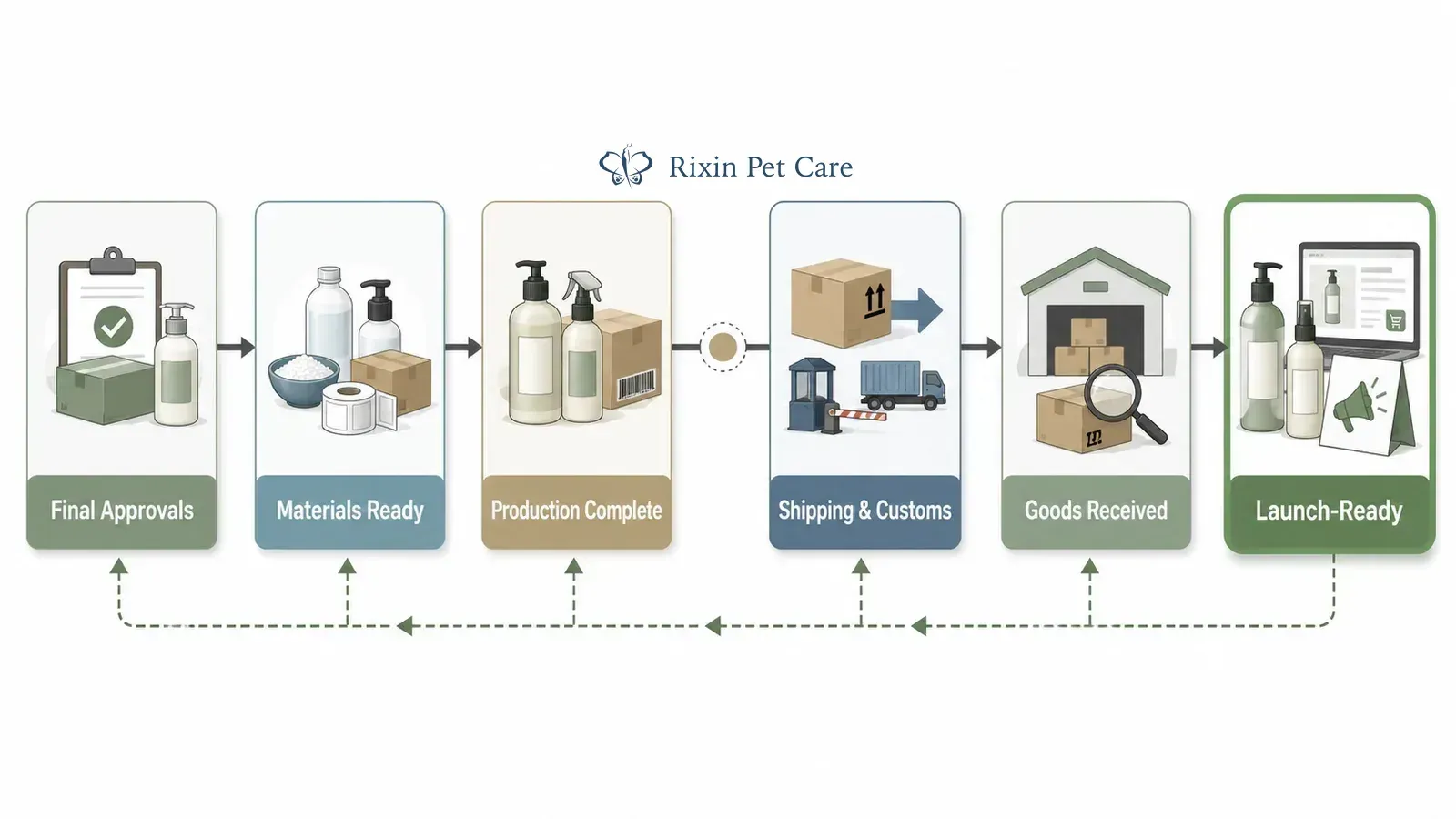
How to Plan Backward from a Launch Date
Start with the date when the product must be commercially ready, then work backward through every required milestone.
Step 1: Define what “launch” means
A launch date might mean:
- Goods leave the factory
- Goods arrive at the destination port
- Goods clear customs
- Goods arrive at the warehouse
- Ecommerce inventory becomes available
- A retailer receives inventory
- A campaign or trade show begins
Use the last milestone that matters to the customer, not the earliest milestone that looks convenient.
Step 2: Add buyer-side readiness
Reserve time for:
- Receiving inspection
- Photography
- Listings
- Retail or distributor setup
- Fulfillment preparation
- Internal sales training
- Launch content
Step 3: Add shipping and customs
Use a route-specific estimate and identify the named delivery point, responsibilities, and buffer.
Step 4: Add production and pre-shipment work
Include production, packing, inspection, document preparation, and freight booking.
Step 5: Add material purchasing
Work backward through the longest raw material, component, label, carton, or pouch lead time.
Step 6: Add final approvals
Include formula, packaging, artwork, quantity, documents, commercial confirmation, and payment milestones.
Step 7: Add sample rounds and buyer review
Do not estimate only sample preparation. Include courier transit, internal evaluation, consolidated feedback, revision work, and approval.
Step 8: Add brief preparation and route selection
Allow time to define the product before asking the manufacturer to commit to downstream dates.
Step 9: Add decision and disruption buffers
A buffer should reflect the project’s uncertainty. A mature formula with stock packaging may need less uncertainty allowance than a multi-SKU custom package project.
Timeline Planning Worksheet
Copy this worksheet into the project brief or shared tracker.
PROJECT
Brand:
Working product name:
Product type:
Target pet:
Target market:
Primary sales channel:
Cooperation route:
Estimated quantity by SKU:
Target commercial launch date:
Definition of launch-ready:

STAGE 1 — BRIEF AND ROUTE
Brief owner:
Brief submitted:
Open commercial questions:
Route confirmed:

STAGE 2 — FORMULA
Formula starting point:
Benchmark or specification received:
Formula direction confirmed:
Open technical questions:

STAGE 3 — SAMPLE PREPARATION
Sample version requested:
Sample scope confirmed:
Estimated sample preparation window:
Sample dispatch date:
Expected receipt date:

STAGE 4 — SAMPLE FEEDBACK
Evaluation owner:
Internal review deadline:
Consolidated feedback date:
Revision required: Yes / No
Approved sample code and date:

STAGE 5 — PACKAGING
Fill size:
Container:
Closure or dispensing system:
Label or decoration method:
Carton or secondary package:
Component supplier route:
Packaging approved:
Expected material readiness:

STAGE 6 — ARTWORK
Dieline received:
Copy owner:
Barcode and responsible-party details received:
Artwork versions:
Technical artwork approved:
Final print approval:

STAGE 7 — TESTING AND DOCUMENTS
Requested item:
Requester and purpose:
Formula-specific or batch-specific:
Issuer:
Required before production, shipping, or launch:
Expected completion:
Open wording questions:

STAGE 8 — MATERIALS
Raw materials ready:
Fragrance ready:
Primary packaging ready:
Labels ready:
Cartons ready:
Other components ready:
Last critical material arrival:

STAGE 9 — PRODUCTION
Production start gate:
Commercial confirmation complete:
Production slot:
Bulk production:
Filling and packing:
Inspection or release step:
Shipment-ready date:

STAGE 10 — SHIPPING AND LAUNCH
Incoterms rule and named place:
Freight mode:
Booking date:
Estimated departure:
Estimated arrival:
Customs and importer owner:
Warehouse appointment:
Expected receiving date:
Photography and listing readiness:
Commercial launch date:

PROJECT CONTROL
Current critical path:
Largest open risk:
Decision owner:
Next required approval:
Schedule last updated:
A Simpler Timeline Tracker
For weekly project reviews, use one line per milestone.
| Milestone | Start Condition | Owner | Target Date | Status | Dependency or Risk |
|---|---|---|---|---|---|
| Brief confirmed | Product, market, route, quantity, and target date defined | Brand + manufacturer | |||
| Sample dispatched | Sample scope and materials confirmed | Manufacturer | |||
| Sample approved | Consolidated evaluation completed | Brand | |||
| Package approved | Formula and dispensing route reviewed | Brand + manufacturer | |||
| Artwork approved | Dieline and product information confirmed | Brand | |||
| Documents ready | Required scope and issuer confirmed | Shared / third party | |||
| Materials ready | Approved components and print files purchased | Manufacturer / suppliers | |||
| Production complete | Formula, package, artwork, quantity, and slot confirmed | Manufacturer | |||
| Shipment departs | Goods, documents, booking, and terms ready | Logistics parties | |||
| Launch-ready | Goods received and buyer-side launch work complete | Brand |
Questions to Ask About Timeline Before Ordering
Ask the manufacturer:
- What does your quoted lead time include and exclude?
- What event starts each stage clock?
- Which decisions must be completed before sampling?
- Which changes normally create another sample round?
- Can packaging research begin while formula work continues?
- Which package components are stocked, special order, decorated, or custom?
- Which material has the longest expected lead time?
- What must be approved before labels and cartons are printed?
- Which tests or documents must be completed before production or shipment?
- When is the production slot confirmed?
- What happens to the schedule if brand feedback is late?
- What happens if the formula, package, artwork, or quantity changes?
- Does “production complete” include packing, inspection, and shipment documents?
- Which party books freight and manages customs under the selected delivery term?
- How should reorder lead time be planned after the first launch?
The private label pet grooming process provides the wider project path from brief and sample review through specification and production preparation.
Frequently Asked Questions
How long does private label pet product development take?
It depends on the route. A relatively simple mature-formula project may take several weeks, while a project involving deeper formula work, multiple sample rounds, special packaging, additional evaluations, several artwork versions, or complex logistics may take several months. Confirm the schedule stage by stage rather than relying on one universal number.
How long does a private label pet shampoo sample take?
Pet grooming sample lead time depends on the formula starting point, requested changes, number of variants, raw material and fragrance availability, internal preparation, and courier delivery. Ask separately for sample preparation time and sample shipping time.
Is production lead time the same as the full launch timeline?
No. Production lead time usually begins after the formula, packaging, artwork, quantity, commercial details, materials, and production slot are confirmed. The complete launch timeline also includes development, approvals, freight, customs, receiving, and buyer-side launch work.
Can formula and packaging work happen at the same time?
Early packaging research can often happen while formula work continues. Final package approval may still depend on viscosity, dispensing, sealing, formula interaction, fill volume, and transport considerations.
What usually causes the longest delay?
The answer varies by project. Common critical-path items include sample feedback, custom or special-order packaging, print approval, project-specific evaluations, material availability, production scheduling, freight, and customs. The longest task may sit outside the factory.
Does white label always launch faster than private label?
White label usually requires fewer formula decisions, but it is not automatically immediate. Stock availability, package selection, artwork, quantity, documents, production scheduling, and delivery still affect the launch date.
How many sample rounds should a brand plan for?
There is no universal number. The result depends on the formula route, clarity of the brief, quality of feedback, benchmark difficulty, and number of variables being changed. Confirm how revisions are handled and what may require another round.
When should artwork begin?
Brand design and label hierarchy can begin early. Final technical artwork should use the approved package dimensions and the confirmed product information. Printing too early can create rework when the package, barcode, wording, or responsible-party details change.
When should testing and document requirements be discussed?
Discuss them during the brief stage. Some final work may need the approved formula, package, production material, or batch, but the requirement itself should not be discovered near shipment.
How should a brand plan a seasonal launch?
Define the actual inventory-ready date, work backward through receiving, customs, freight, production, materials, artwork, packaging, samples, and brief preparation, then add a buffer based on the project’s uncertainty. Avoid building the plan around the factory production estimate alone.
Does the first order usually take longer than a reorder?
A reorder may require fewer development and artwork decisions when the formula, package, files, suppliers, and specifications remain unchanged. Material availability, updated requirements, production scheduling, and discontinued components can still affect the reorder timeline.
Plan the Launch Backward, Not the Factory Date Forward
A workable private label product launch timeline begins with the date the brand needs saleable inventory and works backward through receiving, customs, freight, production, materials, artwork, packaging, samples, and product definition.
Share the target launch date together with the product type, formula route, packaging direction, quantity, target market, requested documents, and fixed milestones. This gives the manufacturer enough context to identify which activities can overlap and which decisions sit on the critical path.
Related Resources
- Private Label Pet Grooming Products: A Complete Guide for Brand Owners
- How to Prepare a Pet Grooming Product Brief for a Manufacturer
- Private Label Pet Grooming MOQ: What Brand Owners Need to Know
- What Affects the Cost of Private Label Pet Grooming Products?
- Private Label Pet Grooming Process
- Pet Grooming Formula Development
- Pet Grooming Testing and Documentation Support
- Private Label Pet Shampoo
External References
- U.S. Food and Drug Administration: CPG Sec. 653.100 Animal Grooming Aids
- Occupational Safety and Health Administration: Hazard Communication
- European Commission: Classification, Labelling and Packaging of Chemicals
- International Organization for Standardization: ISO 22716:2007 — Good Manufacturing Practices
- International Chamber of Commerce: Incoterms® 2020
- U.S. Customs and Border Protection: Basic Importing and Exporting
Ready to Discuss Your Pet Grooming Product Project?
Share your product type, target market, packaging direction, estimated quantity, and any support you need. A rough brief is enough to start a practical next-step discussion.